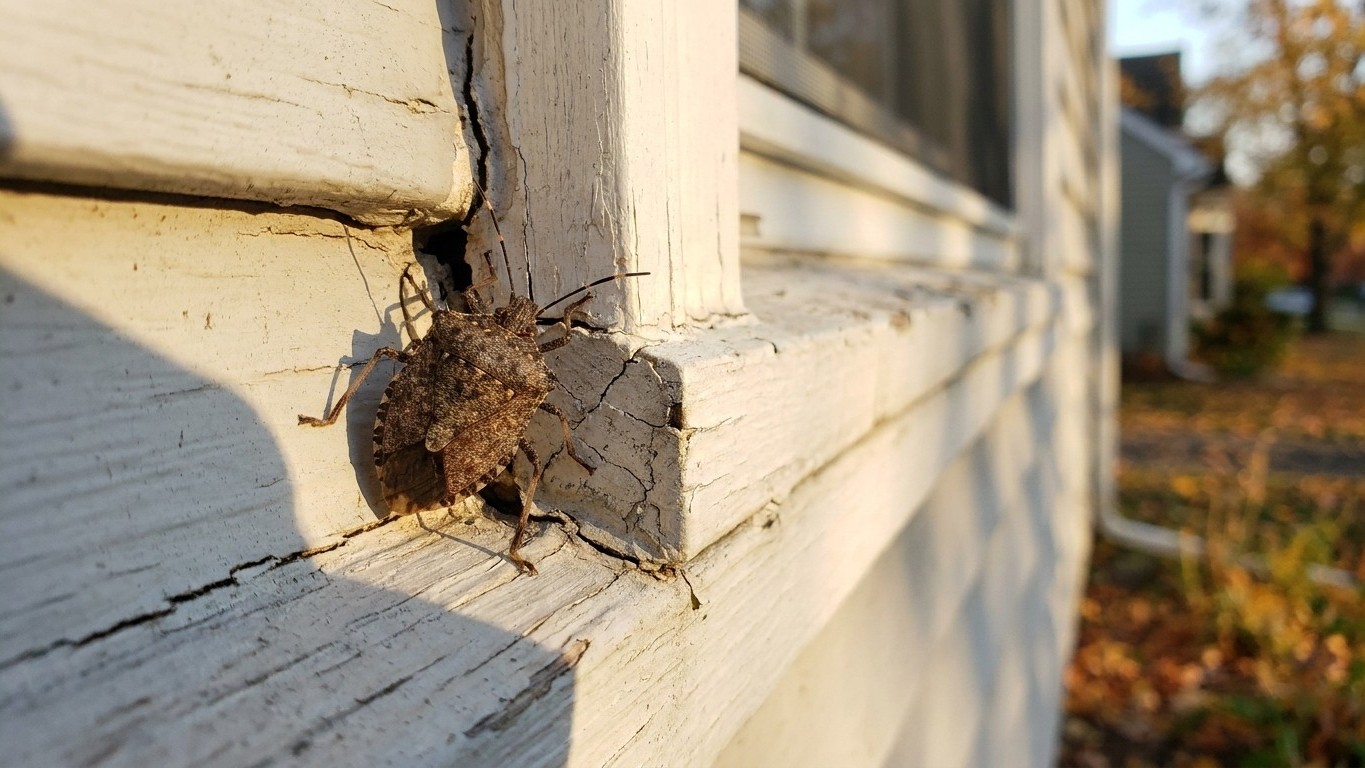

Brown marmorated stink bugs show up in Washington homes mainly in September and October, when falling temperatures send them hunting for a warm place to spend winter. They squeeze through cracks around windows, siding, and attic vents, then reappear indoors on warm days from late February through April. Sealing exterior gaps before that fall migration starts is still the single most effective way to keep them out, since no spray or trap reliably clears an infestation once the bugs are already inside a wall void.
Where and When They Show Up in Washington

The Brown marmorated stink bug (Halyomorpha halys) isn’t native to the Pacific Northwest. It arrived from Asia and was first confirmed in Washington around 2010 in the Vancouver area, along the Columbia River near the Oregon border. From there it spread east into the Yakima Valley, one of the most productive tree fruit regions in the country, and it’s now established in urban and agricultural areas on both sides of the Cascades.
Populations tend to be heaviest in the Portland-Vancouver metro corridor, the Yakima Valley, and parts of the Puget Sound lowlands where older homes with lots of exterior trim give the bugs plenty of entry points. Rural properties near orchards or windbreaks often see bigger swarms simply because the insects are drawn to sun-warmed structures after feeding on nearby trees and crops all summer.
Timing follows a predictable pattern. Adults feed and reproduce through summer, then in early fall they stop feeding and start “aggregating,” gathering in large groups on the sunny south and west sides of buildings before finding a way inside. Once temperatures drop consistently below the 50s, they wedge into attics, wall cavities, and soffits and go dormant. A stretch of unusually warm weather in January or a sunny afternoon in March can trick them into becoming active again, which is why homeowners sometimes find a dozen bugs crawling across a ceiling in the dead of winter.
How to Identify One (and Not Confuse It With a Native Bug)
Brown marmorated stink bugs get their name from the mottled, marble-like brown pattern across their shield-shaped back. Adults run about 5/8 inch long, roughly the size of a fingernail, with a few features that separate them from Washington’s native stink bugs:
- Alternating light and dark bands on the last two antennae segments
- A smooth, rounded shoulder edge instead of the pointed “shoulders” seen on many native species
- Lighter bands visible on the exposed edge of the folded wings
- The unmistakable smell released when one is crushed or handled roughly, often described as bitter and lingering
Native brown stink bugs and the rough stink bug look similar at a glance, but they lack the banded antennae and tend to show up in gardens rather than swarming building exteriors in the fall. Nymphs are trickier to spot, since young stink bugs are smaller, rounder, and sometimes show reddish or black coloring before they molt into the recognizable brown adult form.
Why This Pest Gets Extra Attention in Washington
A stink bug wandering across a windowsill is mostly a nuisance for homeowners. For Washington’s fruit industry, it’s a genuine economic threat. The state grows roughly two-thirds of the nation’s apples along with major pear and cherry crops, and this insect feeds by piercing fruit skin, which leaves dimpled, discolored patches that make apples and pears unsellable at full price even when the damage is only cosmetic. Because of that risk, the Washington State Department of Agriculture and researchers at Washington State University actively track populations using pheromone traps placed in orchards and urban edges, part of a broader regional monitoring effort coordinated through resources like stopbmsb.org, a multi-state research consortium focused on this exact pest.
That agricultural angle also explains why extension offices ask residents to report unusual sightings, particularly in counties where the bug hadn’t previously been confirmed. Early detection in a new area gives growers time to adjust monitoring before a population becomes established near orchard blocks.
What Actually Stops Them
The bugs aren’t dangerous to people or pets, don’t bite, and don’t reproduce indoors or damage wood, wiring, or fabric the way some structural pests do. The real cost is the smell, the sheer number that can accumulate in an attic, and the fact that once a colony finds a good overwintering spot, it tends to return year after year unless the entry points get fixed.
Exclusion Before Fall
Sealing the house before the September migration begins does more than any treatment applied afterward. That means caulking gaps around window and door frames, repairing torn window screens, installing fine mesh over attic and soffit vents, and fixing gaps where siding meets trim or where utility lines pass through exterior walls. Chimney caps and weatherstripping under garage doors matter too, since both are common entry routes homeowners overlook.
Dealing With Bugs Already Inside
For stink bugs that have already gotten past the exterior, a shop vacuum with a disposable bag works better than swatting, since crushing releases that signature odor and can stain fabric or paint. Some people keep a jar of soapy water near windows during peak fall activity and drop bugs directly into it, which kills them without the smell. Store-bought stink bug traps using pheromone or light lures can reduce numbers in a single room but won’t clear an infestation spread through wall voids or an attic.
Insecticide sprays applied to exterior siding in early fall can reduce the number of bugs that make it inside, but residual effectiveness is limited once cooler, wetter weather sets in, which is typical for western Washington by October. Pest control professionals sometimes combine an exterior perimeter treatment with the exclusion work described above, since neither approach alone tends to solve a heavy infestation.
Bugs that die inside wall cavities over winter can attract secondary pests like carpet beetles the following spring, so a heavy die-off behind a wall is worth mentioning to a pest control technician if activity has been going on for more than one season.
What Not to Bother With
Bug zappers and foggers marketed for general household insects have little effect on stink bugs, which tend to stay tucked into voids rather than flying around exposed light sources. Similarly, essential oil sprays sometimes suggested online as a “natural repellent” show inconsistent results in university trials and shouldn’t replace the basic sealing work that actually keeps the population out. The Washington Invasive Species Council, which tracks reports of non-native pests across the state through invasivespecies.wa.gov, notes that physical exclusion and reporting new sightings remain the most reliable tools available to residents, since no single product on the market eliminates an established population.
Homeowners near orchard country sometimes ask whether outdoor pesticide applications on their own property will reduce pressure on nearby farms. In practice, individual residential treatments have little measurable effect on regional populations, since the bugs move freely across property lines and reinvade from surrounding vegetation. Coordinated agricultural monitoring, not scattered backyard spraying, is what keeps the pressure on orchard blocks in check.
One detail that surprises a lot of Washington homeowners: a single stink bug found in January isn’t a sign of a new infestation starting. It’s almost always a straggler from the fall aggregation, waking up briefly because of a warm spell before going back into dormancy once temperatures drop again.
Related guides
- Brown marmorated stink bug in Oregon: When It Shows Up and What Stops It
- Brown marmorated stink bug in Alberta: When It Shows Up and What Stops It
- Brown marmorated stink bug in British Columbia: When It Shows Up and What Stops It
- Onion maggot in Washington
- Brown marmorated stink bug in Montana: When It Shows Up and What Stops It