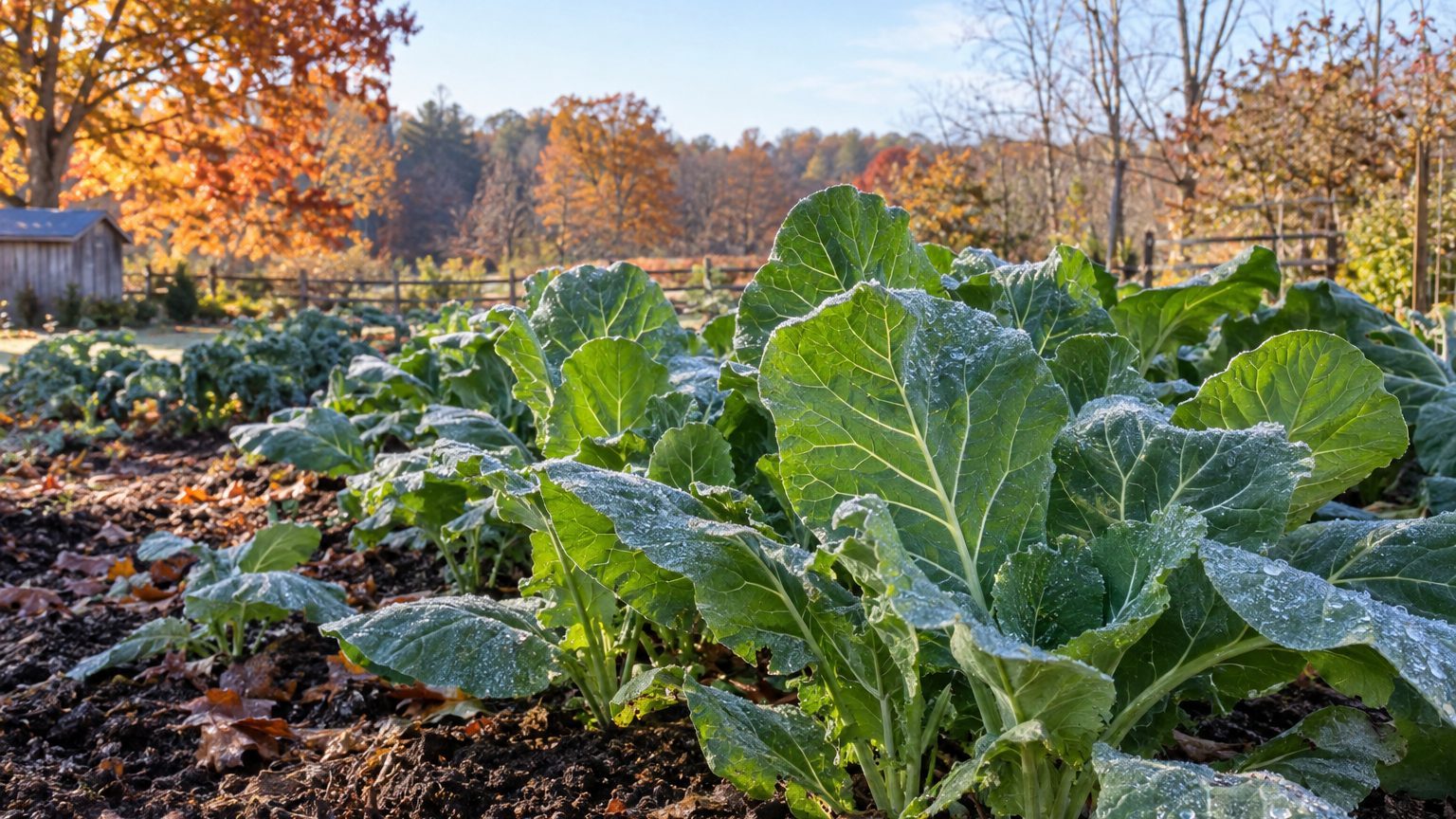

Collards can be sown twice in Virginia: once in early spring around the last freeze, and again in late summer so the crop matures before the first fall freeze. The reference dates below come from the coast, at Virginia Beach. This sowing calendar for collards in Virginia shifts later in spring and earlier in fall as you move toward the mountains.
The short answer for Virginia
The last spring 32°F freeze at the reference station falls between March 20 and April 3, and the first fall freeze between November 10 and November 24. Those numbers come from NOAA’s 1991-2020 Climate Normals for NAS Oceana, in Virginia Beach. They are probabilities of a freeze at 32°F or colder, not calendar promises. The band shows where the odds sit between 30 and 70 percent, so a freeze after April 3 is less likely but still possible. At the edge of the band, the odds are still around three in ten.
Collards are a cool-season green, so they do not need to wait for the safe end of that band. Spring sowing can begin around the window, and the plants shrug off the light frosts that follow. The fall crop works the other way around. Start with November 10, the early end of the first-freeze band, and count backward by the days to maturity printed on your seed packet. That gives the last sowing date for a full-size plant.
The coastal season is long. Pair the shortest gap, April 3 to November 10, and the growing period still runs past seven months. The other figure in the record is a mean daily minimum of 31.6°F for the coldest month at Virginia Beach. That is the average nighttime low in mid-winter, not the record cold, and it sits just under freezing. Mild by Virginia standards, it suits a hardy green that can stand through the winter, though coastal winters still vary from year to year.
This page has frost figures for one place only. It does not have separate dates for the Piedmont, the Shenandoah Valley or the southwest, and it will not borrow a neighboring state’s numbers to fill the gap. If you want the full growing picture beyond sowing dates, start with Growing Collards in Virginia.
What will not work here
Using the coastal dates everywhere is the most common failure. Virginia Beach is the mild end of the state, and the Blue Ridge and southwest Virginia run weeks later in spring and earlier in fall. A gardener in Abingdon or Floyd who sows on March 20 is planting into cold ground. The same gardener counting back from November 10 for a fall crop will be caught by frost before the plants size up. The dates here are a starting point for the coast, not for the mountains.
Treating a frost date as a guarantee also goes wrong. With a 30 to 70 percent band, there is no single day when frost stops. Seedlings set out on April 3 have real odds of meeting one more freeze. Collards forgive a light frost, but a seedling that has just come out of a warm windowsill is tender. Keep a bedsheet or row cover ready for the first two weeks after transplanting.
Late summer is where the fall crop is lost. Sow it too late and the plants are small when the November freezes arrive, which gives you thin leaves and little to harvest. Sow a slow variety too late and the problem grows, because a variety that needs a long stretch to mature has no room to catch up. Days to maturity matter more in a fall sowing than in a spring one. The choice of type is covered in The Best Collards and Greens for Virginia.
Humid summers make close spacing a risk. Coastal Virginia air stays damp through July and August, and crowded collards hold moisture on their leaves, which invites disease and gives cabbage pests cover. Planting at the tighter end of a seed packet’s spacing range is a mistake in a humid season, so give the plants room to dry between rains.
Finally, do not assume winter will end the crop at the coast. With a mean coldest-month minimum of 31.6°F, plants sown on time can stay productive well into the cold season. Pulling them at the first frost throws away the best-tasting leaves of the year. The one date worth writing down for the fall is November 10, the early edge of the first-freeze band, from which you count backward.
What changes across Virginia
Virginia is not one garden. The USDA Plant Hardiness Zone Map (2023 edition, built on 1991-2020 normals) places the state in zones 5a through 8b. That is four numbered zones, and a single hardiness zone is built on one variable only: the average annual extreme minimum temperature. So there is no single answer for the state, and the range means a Tidewater gardener and a high-elevation gardener are working with genuinely different seasons.
The zone number measures how cold the worst nights get, not how long the season lasts. Because the frost dates on this page come from a coastal station, they are the mild-end reference. If you garden in the north of the state or at altitude, shift both ends of the calendar inward. Spring sowing moves later, since the ground stays cold longer. The fall deadline moves earlier, since first freezes arrive sooner. The page does not have specific dates for those areas, so treat any shift as a direction, not a number.
Altitude works within a single county, too. A valley floor and a ridge a few miles away can differ by a zone or more. Cold air pools in low spots on still nights, and frost lingers there while a slope stays clear. That is one reason a neighbor’s tomato-planting date may not fit your yard even in the same town.
To find your own zone, look up your location on the USDA map rather than guessing from a nearby city. Once you have it, compare it with the coastal reference: the lower your zone number, the further you should move the calendar toward later spring sowing and earlier fall sowing. Then look up your zone on the USDA Plant Hardiness Zone Map before you set a sowing date.
Where to check this for your own county
Your state extension service is the best next stop. Virginia’s is run through Virginia Tech, at https://ext.vt.edu/, and it connects to a local office in or near your county. Extension agents work with the same soil and the same weather you do, and they hear about failures the moment they happen.
Two things are worth finding there. The first is a local planting calendar or vegetable guide that gives sowing dates for your part of the state, which will be more precise than the one-station reference on this page. The second is a list of varieties that have been trialled in your county or region. A trial means someone grew several collards side by side in local conditions and recorded which held up, which bolted, and which suffered in humid summers. That is data no general article can replace.
A county recommendation beats a state one, and this page is the state one. It gives you a frame built on frost probabilities at a single coastal station, and it tells you what to adjust. It cannot know your soil or your slope. If the county office gives a different sowing date from the one here, follow the county office.
Local extension offices also often run a Master Gardener help line or plant clinic. Take a description of your site and the seed packet in hand, and ask them to count back from the local first-freeze date with you. It is a short conversation, and it turns a rough calendar into a plan. Start with ext.vt.edu and look for your county office.
Checking this against your own garden
Your own observations outrank every date on this page. A frost band is an average across many years and one station, and your yard is one small piece of ground with its own habits. Three things are worth watching, and none needs equipment.
- Soil warmth by feel. Push your hand into the bed in the morning. If it is still cold and clings in wet clumps, wait. Soil that crumbles and feels only cool tells you the bed has warmed and dried faster than your neighbors’ beds, which points to a sheltered, sunny spot.
- Where frost lingers. After a cold night, note which parts of the yard are still white at breakfast. Those low spots are your late-frost pockets and need later sowing. The ground that clears first is your early bed.
- The first true leaves. A seedling shows its first pair of seed leaves, then the true leaves that look like a collard. Slow, pale or leggy growth there tells you the spot lacks light or warmth, and sturdy true leaves say the seedlings are ready to harden off and go out.
Keep notes for a season. Write down the date of the last frost you see on your own lawn, along with when you sowed and how the plants did. After two or three years, those notes will tell you more than any state average, because the frost band on this page is where the odds start, and your yard decides the rest.
Common questions
Can I sow collards in Virginia in winter?
At the coast, where the mean minimum of the coldest month is 31.6°F, plants already established can stand through winter. Fresh sowings in the coldest months are a different matter, since seedlings need warmth to germinate and grow. Inland and at altitude, winter is harder, so check local guidance.
When should I sow collards for a fall harvest?
Work backward from the first-freeze band, which is November 10 to November 24 at the coastal reference station. Read the days to maturity on the seed packet and subtract them from November 10. Mountain gardeners should count from an earlier date.
Do the frost dates on this page apply to my county?
Only if you live near Virginia Beach. The dates come from one coastal station, and the Blue Ridge and southwest Virginia run weeks later in spring and earlier in fall. Check your county extension office for your own dates.
What does the 30-70% band actually mean?
It is the range of dates where the chance of a 32°F freeze falls between 30 and 70 percent, taken from 1991-2020 normals. It describes probability, so a freeze after the later date remains possible in some years.