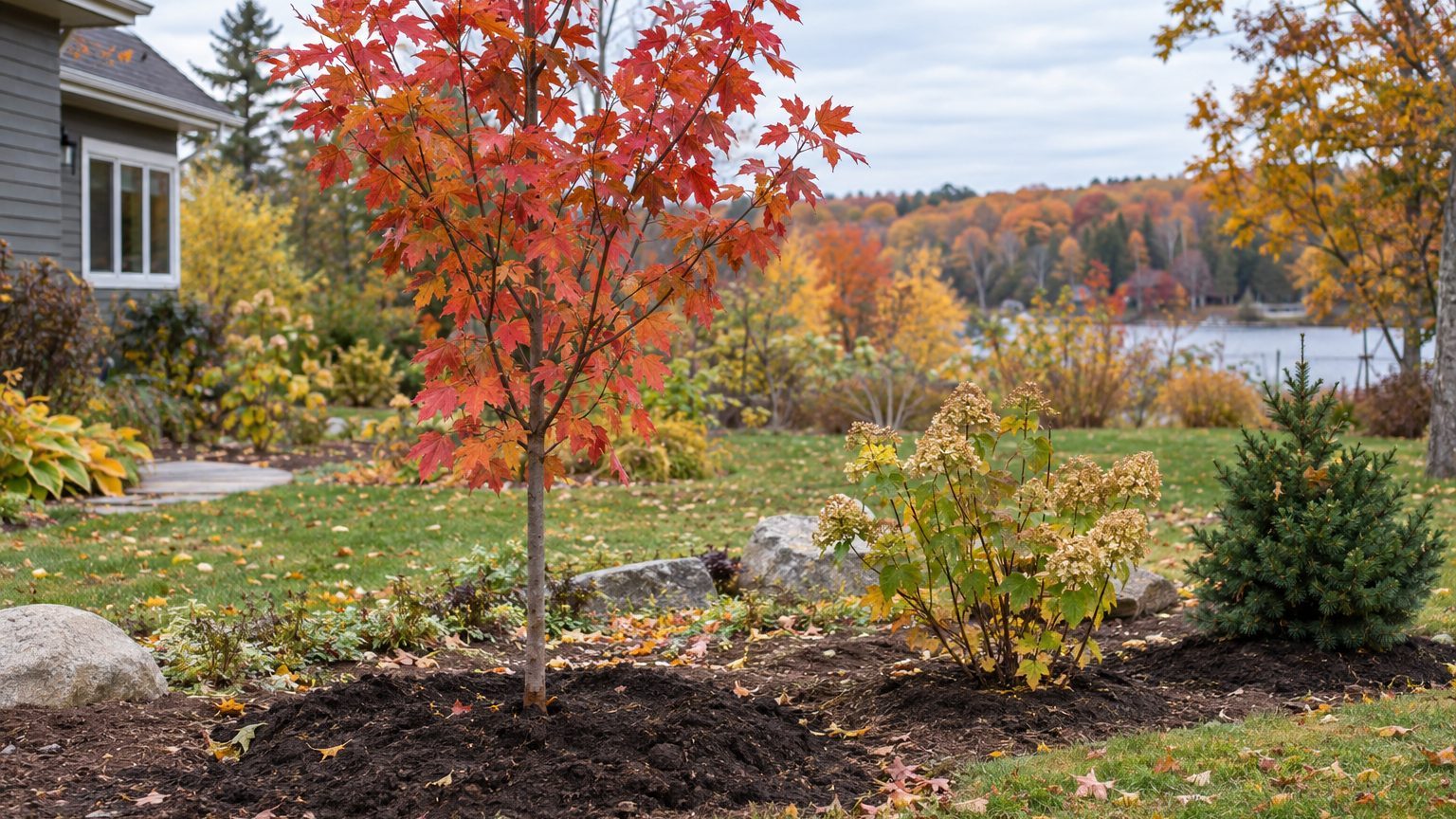

Near Vancouver, you can plant trees and shrubs deep into fall and through much of winter, because the ground there does not freeze the way it does inland. Elsewhere in British Columbia, the conservative target is six weeks before the first fall frost. Counted from Vancouver’s average first frost of November 10, that lands around September 29. Colder districts should count back from an earlier frost and finish earlier. The true limit, frozen ground, arrives later than the frost.
The deadline in British Columbia
Roots do not follow the calendar the way leaves do. They keep growing as long as the soil is workable and above freezing, which is often weeks after the air has turned cold enough to shut down everything above ground. That gap is what fall planting rests on. Cornell Cooperative Extension in Orleans County states the rule this way: “Fall is an excellent time for transplanting, provided you get them to their new home at least 6 weeks before the ground freezes, allowing them time to establish roots before winter dormancy.” (Cornell Cooperative Extension, Orleans County)
Working backward from the first frost
Almost nobody knows the date their soil will freeze, and weather agencies rarely publish it. The first fall frost is easier to find, and it comes earlier than the ground freeze, so counting six weeks back from it builds in a cushion. Environment and Climate Change Canada’s 1981-2010 normals for the Vancouver International Airport station put the average first fall frost on November 10. Six weeks before that is September 29. Think of it as the conservative target, the date that keeps you safe, not the point where planting stops working.
Two cautions come with that November 10. It is a mean, not a guarantee: in one year out of two the first frost falls later than that, and in the other half it arrives earlier. So treat it as the midpoint of a window. It also comes from a single coastal station, and a province is not one climate. Northern and upland districts run weeks behind Vancouver, which means their first frost comes earlier and their planting deadline moves earlier with it. Local frost ranges are laid out in First and Last Frost Dates in British Columbia. One more wrinkle: Canadian normals cover 1981-2010, while the US figures elsewhere on this site cover 1991-2020, so the two sets are not measured over the same years.
Where the ground stays open
Here is where the coast changes the answer. At the Vancouver station, the mean daily minimum of the coldest month is 0.8 °C, according to the same Environment and Climate Change Canada normals. Even the coldest month’s average night stays above freezing. The soil there does not lock up for the winter, so a six-weeks-before-freeze deadline does not apply in that part of the province. The city sits in Canadian hardiness zone 9a, per Natural Resources Canada’s plant hardiness site, a rating from the Canadian system, which is built differently from the USDA’s.
In that mild climate, fall and even winter are the best time to plant, not a risky extension of the season. Cool soil, steady rain and dormant tops let roots settle in with little stress, and the plant meets its first dry summer with a head start. Keep planting through fall and winter whenever the soil is workable near Vancouver, and finish by late September in colder districts. Gardeners on the Prairies face a much tighter clock, spelled out in How Late Can You Plant Trees and Shrubs in Fall in Manitoba?
What to plant late, and what to wait on
Timing is only half the decision. What you plant matters just as much, and the mild coast forgives more than the interior does. The general pattern holds everywhere in the province: plants that are fully hardy for your zone and arrive with their roots intact do well when planted late, while plants living at the edge of their range, and evergreens that keep losing water all winter, are the ones that fail.
The safe bets
Container-grown trees and shrubs are the easiest late planting. Their root systems are whole and their soil comes with them, so the move is barely a shock. Balled-and-burlapped trees have lost some roots in the digging, but they still establish well when fully hardy for the site. Deciduous trees and shrubs help their own case by dropping their leaves. With no foliage to feed, they ask very little of new roots, and that is why late fall works so well for maples, serviceberries and similar woody plants. Bare-root stock belongs here too, but only while it is dormant, after leaf drop and before buds swell.
The risky ones
Borderline plants are the ones rated at or near the limit for your area. Their first winter is when they are least prepared, with young roots and no track record on your site. Hold them until spring, when they get a full season to toughen up. Check the tag carefully, too. Natural Resources Canada states plainly that there are no simple conversions between the Canadian and USDA zone systems, and that Canadian zone 4a overlaps nine different USDA zones, from 3a to 7a. A tag printed with a USDA number is not a reading of Canadian zone 9a. Match plants to the Canadian zone for your town, and when a tag is vague, ask the nursery.
Evergreens, both conifers and broadleaf types, keep transpiring through the winter. Where soil freezes, roots cannot replace that water, and foliage browns. So in colder districts, plant evergreens earlier than everything else or wait for spring. Near the coast the risk is lower because the soil stays open, though a newly planted evergreen still needs water during dry stretches.
| Plant type | Late fall verdict | Reason |
|---|---|---|
| Hardy container-grown deciduous trees and shrubs | Good choice | Intact roots, no leaves to feed |
| Hardy balled-and-burlapped trees | Good choice | Some root loss, but strong establishment |
| Bare-root stock | Only while dormant | Needs to be leafless and unbudded |
| Borderline-hardy plants | Wait for spring | Least tolerant of a first winter |
| Evergreens in colder districts | Plant early or wait | Foliage loses water all winter |
The practical rule: hold anything borderline until spring, and let the fully hardy plants carry the fall season. More on choosing and setting plants is in Planting and Caring for Trees, Shrubs and Perennials.
Watering and mulch until the ground freezes
A tree planted in fall spends its first winter doing one job, and it is not growing. Top growth shuts down with the cold, but roots keep pushing outward in soil that is still workable and above freezing. Those roots are the investment. They decide whether the spring flush of leaves is strong or thin, and whether the plant survives its first summer without constant help. Feeding and heavy pruning at planting time push tender top growth in the wrong season, so leave both for spring.
Water deeply, then keep watching
Deep, slow watering beats frequent sprinkles. A soak that reaches below the root ball draws roots downward, while a light spray wets the top and evaporates. Give new plantings a thorough soaking at planting, then keep going until the ground freezes in colder districts. Near the coast, where the ground stays open, the endpoint is different: keep watching through any dry spell, because early fall can run dry even when the rainy season is only weeks away. Push a trowel into the soil beside the root ball and feel it. If it is dry there, water, whatever the calendar says. Because the rule counts back from frozen ground, colder districts should also finish their last deep soak while the soil can still drink it.
Mulch in a ring, not a volcano
Mulch does two jobs for a new planting: it holds moisture and it evens out soil temperature. NC State Extension gives the depth in its Extension Gardener Handbook (chapter 11, Woody Ornamentals). On weeds, it says: “A 2-inch to 3-inch layer of mulch suppresses most annual weed seeds and makes it easy to hand-pull any that do germinate.” On trees, it says: “Provide a 3-inch layer of mulch to reduce water loss and maintain uniform soil moisture and temperature around roots.” The two sentences serve different purposes and land on the same depth.
More is not better. Mulch piled against the trunk stays wet, softens bark and invites rot and rodents. Spread it in a wide flat ring, thin or bare right at the trunk so the root flare stays visible, and let the ring reach past the planting hole. Aim for a mulch ring 2 to 3 inches deep with a gap around the trunk. The full method, including what to do with an old volcano, is in Mulching Without Killing the Plant.
What goes wrong
Most fall planting failures trace back to timing, dryness or the wrong plant, and the mix depends on where in the province you garden.
Planting too late for a colder district
Six weeks before freeze-up gives roots time to anchor. A tree set into cold, nearly frozen soil has no time to do that, and the interior and upland districts, which run earlier than the coast, hit that limit sooner than any Vancouver-based date suggests. If you miss the window there, stage the plant: keep it in its container in a sheltered spot and plant in spring, rather than gambling on soil that is about to lock up.
Winter burn and heaving, in colder districts only
Winter burn is what happens when evergreen foliage loses water that frozen soil will not replace. It shows up as brown, scorched needles in late winter, and it belongs to districts where the ground actually freezes. Heaving is the freeze-thaw cycle pushing shallow root balls up out of the soil. Neither is a worry where the ground stays open, as at the Vancouver station. Where they do apply, a proper mulch ring helps by keeping soil temperature more even, and firm planting at the right depth helps too.
Drying out in a dry fall
This is the most common failure in mild districts, and the easiest to prevent. A newly planted tree has a small root ball in a big planting hole, and a dry stretch in September or October can leave it parched while the gardener assumes rain is coming. Heavy soil brings the opposite problem, since a planting hole can hold water in the wet months, so plant at the right height and do not sink the root flare. Water new plantings through any dry spell, even in November. Region-specific timing for other jobs is collected in the British Columbia guides.
Common questions
Can I plant a tree in Vancouver in December?
Generally yes, if the soil is workable, meaning it is not waterlogged or hard with frost. At the Vancouver station the mean daily minimum of the coldest month is 0.8 °C, so the ground does not freeze the way the six-weeks rule assumes. Cool, damp weather suits dormant, fully hardy trees. Skip the day when the ground is sodden, since working wet soil compacts it.
Is September 29 the last day to plant?
No. September 29 is the conservative date, six weeks before the average first fall frost of November 10, as recorded at the Vancouver International Airport station. Frost is an air temperature, and the ground freezes later, so the true limit falls after that date. In colder or higher districts, where frost arrives earlier, the safe date moves earlier as well.
Does Canadian hardiness zone 9a match a USDA zone?
Not by any simple conversion. Natural Resources Canada builds its zones from seven climate variables, while the USDA uses one, and the agency says plainly that there are no simple conversions between the two. Vancouver is in Canadian zone 9a for the 1991-2020 normals, but that rating should be compared against Canadian zone information on plant tags, not against a USDA number.
How deep should mulch be around a new tree?
NC State Extension recommends “A 2-inch to 3-inch layer of mulch” for weed suppression, and “a 3-inch layer of mulch” around trees to reduce water loss and even out soil moisture and temperature. Keep it in a ring with a gap at the trunk. Piling it deeper does not add protection, and a mulch volcano can rot the bark it touches.