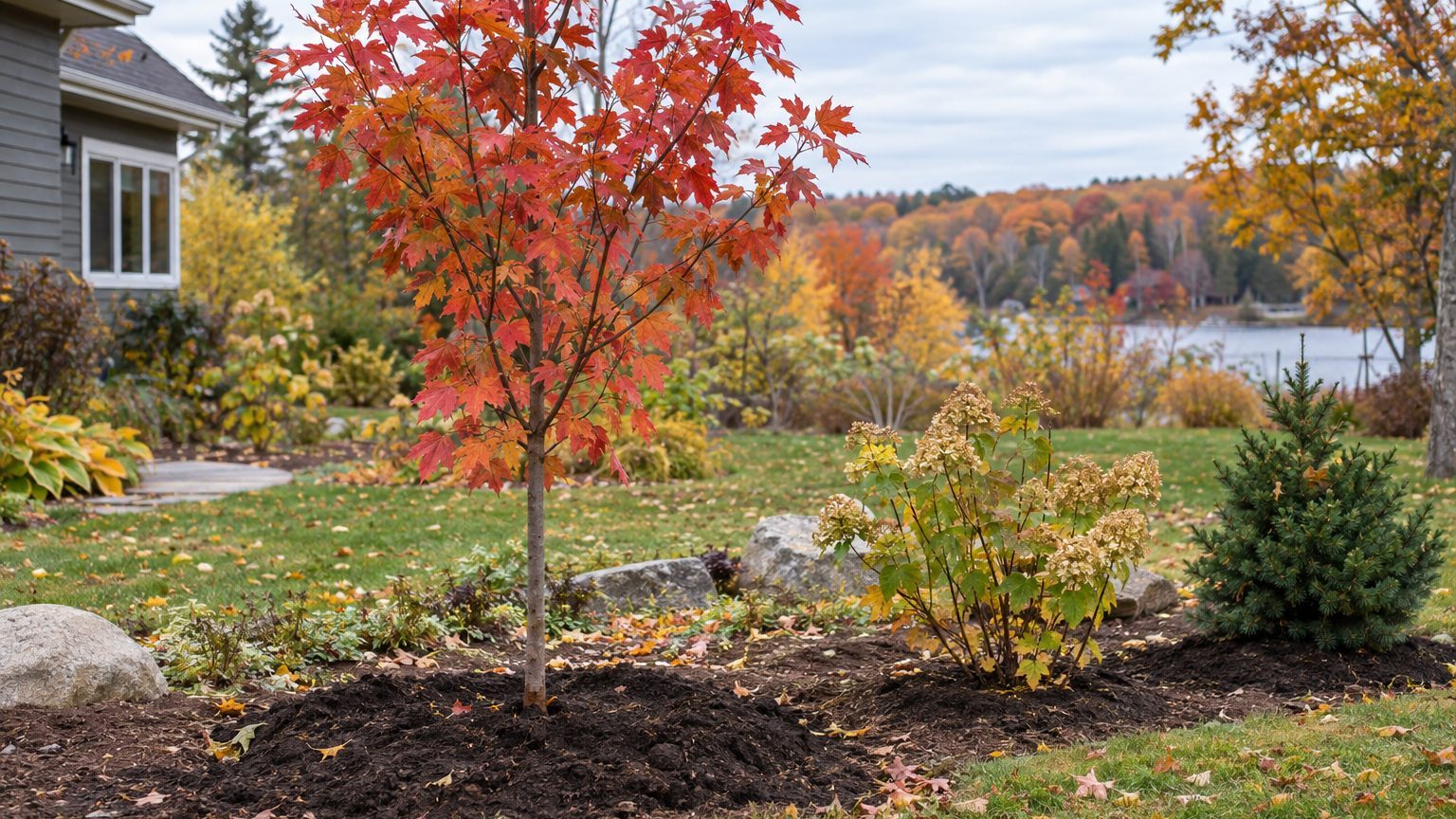

Along the Los Angeles coast, trees and shrubs can go in the ground through fall and well into winter, because the ground never freezes there. NOAA’s 1991-2020 Climate Normals show no freeze in an average year at the Los Angeles reference station, so frost sets no deadline. In places that do freeze, the rule is to plant at least six weeks before the ground locks up. California contains both situations, and yours decides everything that follows.
The deadline in California
Roots keep growing while the soil is workable and above freezing, long after the air turns cold. A maple can be bare of leaves and still pushing new roots outward in November. That is why the planting deadline is counted back from the day the ground freezes, not from a calendar page and not from the first frost on your car windshield. Air temperature drops first. The soil, holding the summer’s heat, follows weeks later.
Where the ground never freezes
Los Angeles makes the case plainly. The NOAA NCEI 1991-2020 Climate Normals could not even compute a freeze normal for the reference station (the data carry the code -666), because freezes do not happen in an average year. NOAA’s Regional Climate Centers daily records, drawn from the ACIS database, show zero days at or below 32°F across 30 years, and the frost-free season is listed as 365 days. The mean daily minimum of the coldest month is 49.1°F. That is the number that decides winter hardiness, and it sits far above anything that would stop a root.
In Los Angeles and the frost-free coastal and southern parts of California, there is no fall planting deadline from frost, and fall into winter is the best planting season. Cooler soil and milder days let roots settle in before the first hot summer, which is the real test of any new tree in that region. The constraints there are heat, drought and water restrictions, so the useful question is whether you can keep a new root ball moist until winter rain does the work for you.
Where the ground does freeze
Northern California, the Central Valley and the Sierra do freeze, and none of them should borrow Los Angeles’s calendar. Here the rule from Cornell Cooperative Extension (Orleans County) applies: “Fall is an excellent time for transplanting, provided you get them to their new home at least 6 weeks before the ground freezes, allowing them time to establish roots before winter dormancy.” The source is at cce.cornell.edu, and it counts from the ground, which freezes later than the air does. Your first fall frost is a warning light, not the finish line.
Direction matters. The colder the spot, meaning farther north or higher in elevation, the earlier the first fall frost and the earlier the planting window closes. A Sierra yard runs out of time well before a Central Valley one. To anchor your own count, look up your first fall frost range in First and Last Frost Dates in California, then place your planting several weeks ahead of the date the soil actually stiffens. This is also why one number for the whole state would be wrong. The USDA Plant Hardiness Zone Map 2023 lists California from 5a to 11a, and Los Angeles is just one point on that spread. Other parts of the state differ, sometimes dramatically, so read your own conditions rather than the average.
What to plant late, and what to wait on
Container-grown and balled plants that are fully hardy for your location establish well in fall. Their roots are intact or mostly intact, and they arrive carrying a soil package that cushions the transition. In Los Angeles, with a coldest-month mean minimum of 49.1°F, nearly everything sold locally as hardy qualifies on cold alone. The sorting there happens on heat and water: choose plants suited to dry summers, and fall planting gives them the longest runway.
The risky candidates are different depending on where you garden. In the colder parts of the state, borderline plants, the ones rated near your winter minimum, have not had time to toughen up if they go in late. Evergreens add a second problem. Their needles or leaves keep losing water through winter, and if the soil is frozen, new roots cannot replace it. A deciduous tree drops its leaves and coasts. A broadleaf or conifer evergreen keeps spending.
| Plant type | Frost-free Los Angeles | Where the ground freezes |
|---|---|---|
| Fully hardy container shrubs | Plant through fall and winter | Plant if at least 6 weeks remain before the ground freezes |
| Fully hardy balled trees | Plant through fall and winter | Same window, counted from ground freeze |
| Deciduous trees and shrubs | Good fall candidates | Good fall candidates inside the window |
| Evergreens | Fine; keep roots moist | Plant early in the window or wait for spring |
| Borderline-hardy plants | Cold is rarely the limit; heat and water are | Wait for spring |
The table is a sorting tool, not a promise. A hardy plant set into frozen soil in January will struggle no matter how tough its label says it is. In the colder parts of California, put in only fully hardy container and balled plants late in fall, and hold borderline plants and evergreens for spring.
Planting depth, hole shape and root-ball handling follow the same rules in any season, and Planting and Caring for Trees, Shrubs and Perennials covers them. One more point for the frost-free regions: a late-fall planting does not need the same urgency as a northern one, so use the extra time. Pick the plant that suits your yard’s sun and soil, not the one that happens to be on the sale bench.
Watering and mulch until the ground freezes
A tree planted in fall spends its first winter building roots. Leaves, new shoots and flowers can wait. The plant’s job from planting day to spring is to push roots into the surrounding soil so that it can pull water when the weather turns hot or dry. That is why water matters more than fertilizer in the first months, and why heavy pruning or feeding that coaxes soft new top growth is a poor trade.
Where the ground freezes, water deeply until freeze-up. Soak slowly enough that moisture reaches below the root ball, then let the surface dry a little before the next soak. A shallow sprinkle every day teaches roots to stay near the top, which is exactly where they are hurt first by cold and drought. In the Sierra and other cold areas, keep watering while the soil is still workable and stop only when it actually freezes.
Where the ground never freezes, there is no freeze-up to count toward, so rainfall and your own check of the soil decide. Poke a finger or a trowel into the root zone. If it is dry a few inches down, water, and follow any local water restrictions, which in California can shape how and when you irrigate. A drip line or soaker run slowly is a good fit for a new tree because it puts the water where roots are.
Mulch helps in both situations by slowing evaporation and evening out soil moisture and temperature. NC State Extension’s Gardener Handbook (chapter 11, Woody Ornamentals, at content.ces.ncsu.edu) gives two figures for two jobs. On weeds: “A 2-inch to 3-inch layer of mulch suppresses most annual weed seeds and makes it easy to hand-pull any that do germinate.” On trees: “Provide a 3-inch layer of mulch to reduce water loss and maintain uniform soil moisture and temperature around roots.” The two statements land in the same range, and more is not better.
Spread mulch as a ring, in a 2-inch to 3-inch layer, and keep it clear of the trunk. A ring looks like a doughnut with the trunk in the hole. A volcano piles mulch against the bark, holds moisture against it and invites rot. If you see a mound, pull it back. The full approach, including materials, is in Mulching Without Killing the Plant.
What goes wrong
The most common failure is simply planting too late for the climate you actually have. In a cold part of the state, a shrub set in after the ground has begun to stiffen has had no time to anchor. Its roots sit in a root ball that is colder than the surrounding soil, and the plant goes into winter unprepared. If you miss the six-week window before ground freeze, wait for spring rather than gambling on a late planting.
Winter burn is the next problem, and it belongs only to places where the ground freezes. Evergreens keep losing water through their foliage on sunny, windy winter days. If the soil is frozen, roots cannot make up the loss, and the needles or leaf edges turn brown by late winter. A well-watered plant going into freeze-up with an established root system is far less likely to suffer. Frost-free Los Angeles does not face this, since its soil never locks up.
Heaving is the third. Where soil freezes and thaws repeatedly, the cycle can push a shallow, newly planted root ball upward, leaving roots exposed to air. Mulch in a ring, at the depths above, moderates the swings, and checking the plant after thaws lets you press it back into place gently. None of this applies where winter lows stay above 32°F.
Drying out is the one problem every region shares, and in a dry fall it is the likeliest culprit. A new tree has few roots outside its original root ball, so the soil around it can look moist while the ball itself is parched. In Los Angeles, where nothing freezes, a dry root ball is the failure to watch for, not frost. Check the ball, not just the surface. More region-specific advice sits in the other California guides.
Common questions
Is it too late to plant a tree in Los Angeles in December?
No. NOAA’s data show no freeze in an average year at the Los Angeles reference station, and the coldest-month mean minimum is 49.1°F, so the ground is not frozen and no frost deadline applies. Watering and local restrictions are what limit you.
How do I know when my ground freezes?
Use your first fall frost range as a signal that the clock is running, then expect the ground to freeze later. Cornell Cooperative Extension counts the six weeks back from ground freeze, not from the first frost. Your county extension office can tell you how soon after the first frost the soil in your area usually stiffens.
Does the six-week rule apply in the Central Valley or the Sierra?
Yes, where the ground freezes. Count back six weeks from ground freeze, which comes earlier in the Sierra than in the Valley. If you want to compare how another state works through the same question, How Late Can You Plant Trees and Shrubs in Fall in Georgia? walks through it.
How deep should mulch be around a new tree?
NC State Extension says “A 2-inch to 3-inch layer of mulch suppresses most annual weed seeds” and recommends “a 3-inch layer of mulch to reduce water loss and maintain uniform soil moisture and temperature around roots.” Stay in that range, keep it in a ring, and leave the trunk bare.