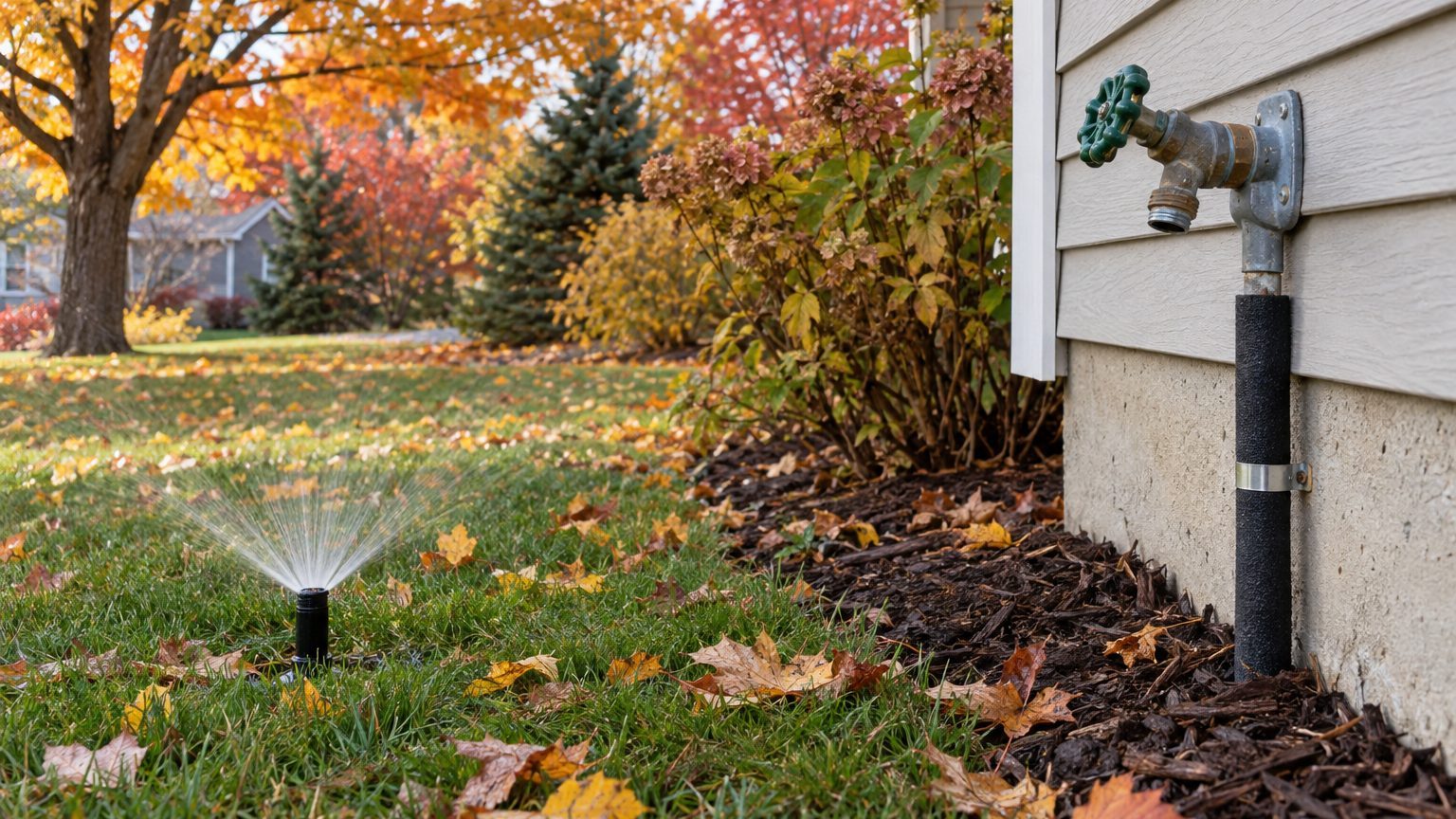

Finish before the first hard freeze. In the Boise valley, NOAA’s 1991-2020 Climate Normals put the first 32°F freeze between October 7 and October 21, and most of Idaho sits higher and colder, so the work moves earlier the farther you get from the valley floor. Sprinkler lines, the backflow assembly and every outdoor spigot all need attention. Below: how the timing works, which method suits Idaho winters, and where things tend to go wrong.
When to do it in Idaho
Winterize sprinklers and outdoor faucets in the Boise valley before the October 7 to October 21 window, the range NOAA’s 1991-2020 Climate Normals give for the first 32°F freeze at the Boise station (USW00024131, 30 to 70 percent probability band). The rule is before the first hard freeze, not after the first light one. A light frost tells you the season has turned, and the hard freeze that follows it is what splits pipe.
What that range actually means
NOAA’s figure is not a date on which frost arrives. It marks the stretch where the odds of a 32°F night climb from 30 percent to 70 percent. Early in the range, most years still pass without a freeze. By the end of it, a freeze is more likely than not. Some falls bring cold before the range even begins, which is why the smart move is to be done as the window opens, not halfway through it.
Idaho’s winters leave no room to skip the job. Boise’s coldest month averages an overnight low of 25.4°F, according to the NOAA NCEI Climate Normals for 1991-2020. That is a mean, so plenty of nights run colder. A climate like that is nothing like a place where winter lows hover above freezing and a full blowout can be skipped. Buried pipe gets some protection from the soil, but the shallow and exposed parts of any system (the backflow assembly, above-ground risers, spigots, valve boxes) do not.
Colder parts of Idaho
Boise is a low valley. Most of the state is higher, with far shorter growing seasons, and the USDA Plant Hardiness Zone Map (2023) runs from 3b to 7b across Idaho. One date for the whole state would be wrong. In mountain valleys, on the high plateau and in the northern reaches, the first fall frost comes earlier than Boise’s range, so draining and blowouts move earlier too. If you live above the valley floor, treat the Boise window as the latest possible date, not your target, and work back from your own local first frost. Other regional differences are covered in the Idaho guides.
The last irrigation cycle of the year belongs in this same stretch. Give the lawn a final deep soak while the lines are still live, then shut the system down. The Winterizing a Lawn guide covers what the grass needs before the ground locks up.
Sprinkler lines: drain or blow out
Why trapped water breaks things
Water expands as it turns to ice, and pipe walls, fittings and valve bodies have nowhere to give. Whatever water sits in a line when the temperature drops below freezing pushes outward until the weakest point splits. That weak point is often a fitting, a valve diaphragm, a pop-up head body or the brass and plastic of the backflow preventer. The damage stays hidden all winter. You find it in spring, when the system pressurizes and a geyser appears or a zone refuses to hold pressure.
Buried mainline is the sturdy part. The parts that fail first are the ones close to the surface or above it: risers, heads, the valve manifold and anything sitting in the open air near the house.
Three ways to empty a system
A manual drain uses valves at the low points of the system. You shut off the supply, open each drain valve, and gravity does the rest. It works only if the system was installed with sloped lines and drain valves in the right spots, and it leaves water behind in any dip or flat run.
An automatic drain valve opens by itself when line pressure falls, letting water out at the low point. It is convenient, but it shares the weakness of the manual approach: water trapped in flat stretches and around heads stays put. Grit can also keep a valve from seating or opening properly, so you cannot count on it working every year.
A compressed-air blowout pushes air through each zone and forces water out of every head. It is the only method that clears heads, risers and flat runs along with the low points. Compressed-air blowout, zone by zone, is the method this climate calls for, with drain valves as a helper, not a substitute. Given Boise’s coldest-month lows and the even colder conditions elsewhere in the state, relying on gravity alone is a gamble.
The sequence, in general terms: shut off the water supply to the irrigation system, connect the air source at the blowout port, and work zone by zone. Open one zone at a time and run air until the heads are spitting only mist. Keep the airflow modest and stay within the pressure rating of your pipe and heads, because too much air can crack fittings or damage a head that runs dry too long. Never run air into a zone with no open head, and wear eye protection, since a head can launch debris. Then open the drain valves, drain the backflow assembly following the maker’s instructions, leave its handles halfway between open and closed, and set the controller to its off or rain mode so the schedule is preserved for spring.
When a professional is the sensible choice
Hire someone if you don’t own an air compressor of the right size, if the system has no blowout port, or if you aren’t sure what your pipe is rated for. The same goes for large properties with many zones, where a mistake with pressure does real damage. Book the visit ahead of the frost window, not during it, and ask whether the price covers draining the backflow assembly too. A professional blowout costs far less than replacing a manifold and a few cracked heads in April.
Outdoor faucets and hoses
This job takes a few minutes and requires nothing beyond turning valves and unscrewing hoses. Hoses come off and the interior shutoff valve closes before the first hard freeze, which in Boise means by the time the October 7 to October 21 window opens and earlier in colder parts of Idaho. For a fuller walkthrough, see Winterizing Outdoor Faucets Before the First Freeze.
The order matters:
- Disconnect every hose, splitter, timer and spray attachment, then drain the hoses and coil them indoors or in a shed.
- Find the interior shutoff valve for each outdoor spigot, usually in a basement, crawlspace or utility room, and close it.
- Open the outside spigot fully and leave it open so the water between the shutoff and the tap can drain.
- If the interior valve has a small bleeder cap, open it briefly to let the last water out, then close it.
An insulated spigot cover is a cheap backup for cold nights, but it does not replace draining. A cover slows heat loss and cannot stop water that is already trapped from freezing during a long cold spell.
Why a frost-free faucet still fails
A frost-free spigot has a long stem, so the valve seat sits deep inside the heated wall while only the spout is outside. When you turn it off, water in the barrel is supposed to run out through the spout. Leave a hose attached, though, and the water has nowhere to go. The barrel stays full inside the wall, and when it freezes, the pipe splits where you can’t see it. Even a hose with the nozzle open holds enough back to cause trouble, and a hose left on all winter can ruin a frost-free faucet. Details on how these fixtures work are in Frost-Free Outdoor Taps.
These faucets also depend on slope. The barrel has to tilt slightly downward so water can run out, and one that was installed level or pitched upward will hold water no matter what you do. If the spigot drips after you shut it off, or you suspect it isn’t draining, that is a plumber’s job. Anything past turning valves and removing hoses, including replacing a spigot, correcting its pitch or repairing a leak inside a wall, should go to a licensed plumber.
What goes wrong here
The early cold snap
Fall in Idaho can swing from warm afternoons to a hard freeze in a matter of days, and the 30 percent odds at the start of the Boise window mean some years the cold arrives before anyone has touched the system. The spring evidence is a cracked head or riser, a valve that leaks or stays stuck open, or a wet patch in the lawn where a buried fitting split. Prevention is timing: schedule the work for the last warm weekend before the window opens, not the first one after a forecast scare. If a freeze is forecast before you finish, shut off the irrigation supply and open the low-point drains that same day, then complete the blowout when the weather allows.
The forgotten hose
Every year, a hose stays screwed onto a back-yard spigot, and a frost-free faucet with a hose attached is a broken faucet waiting for spring. You may see nothing until you turn the water on in April, when a spray, a steady drip or a damp spot on the wall or ceiling inside gives it away. Walk the whole perimeter of the house the day you winterize, including the side yard and any spigot near a garage or shed. If you ever find water where it shouldn’t be after a cold spell, Frozen Pipes explains what to do next.
The valve box that floods
Irrigation valves sit in buried boxes, and those boxes collect runoff, dirt and sometimes standing water. Freezing water around valves that were never fully cleared can crack a valve body or wreck a solenoid, and the sign in spring is a zone that won’t shut off or won’t turn on. Blowing out the lines removes the water inside the valves, and a quick look at the boxes shows whether they are filling with water or silt. Keep the lids on and seated so snow, meltwater and animals stay out, and have anything that keeps flooding checked by an irrigation professional.
Common questions
Can I wait until after the first frost to winterize my sprinklers?
A light frost is the warning to act, not a signal you have time left. The rule is to finish before the first hard freeze, and in Boise NOAA puts the first 32°F freeze between October 7 and October 21. In colder parts of Idaho it comes sooner. If you wait for a frost to prompt you, you risk a hard freeze on the very next night, before you have emptied the lines.
Do automatic drain valves mean I can skip the blowout?
In Idaho, it’s safer not to. Automatic drains open at low points, but they can leave water in flat runs, around heads and inside valves. Debris can also keep a drain valve from working. With an overnight low in the coldest month averaging 25.4°F in Boise, according to NOAA’s 1991-2020 normals, the safest routine pairs drain valves with a compressed-air blowout.
Is a frost-free faucet safe to leave alone all winter?
Only if nothing is attached. Remove every hose, splitter and timer, close the interior shutoff and leave the outside spout open so the barrel can drain. A frost-free faucet with a hose left on can hold water inside the wall, freeze and split. If it keeps dripping after you shut it off, call a plumber, because it may not be draining properly.
Does the Boise date apply everywhere in Idaho?
No. Boise is a low valley, and most of the state is higher and colder, with an earlier first fall frost. The October 7 to October 21 range comes from the Boise station and works as the latest date for valley locations. If you live in the mountains, on the high plateau or in the northern part of the state, plan to winterize earlier and watch your own local forecast for the first hard freeze.