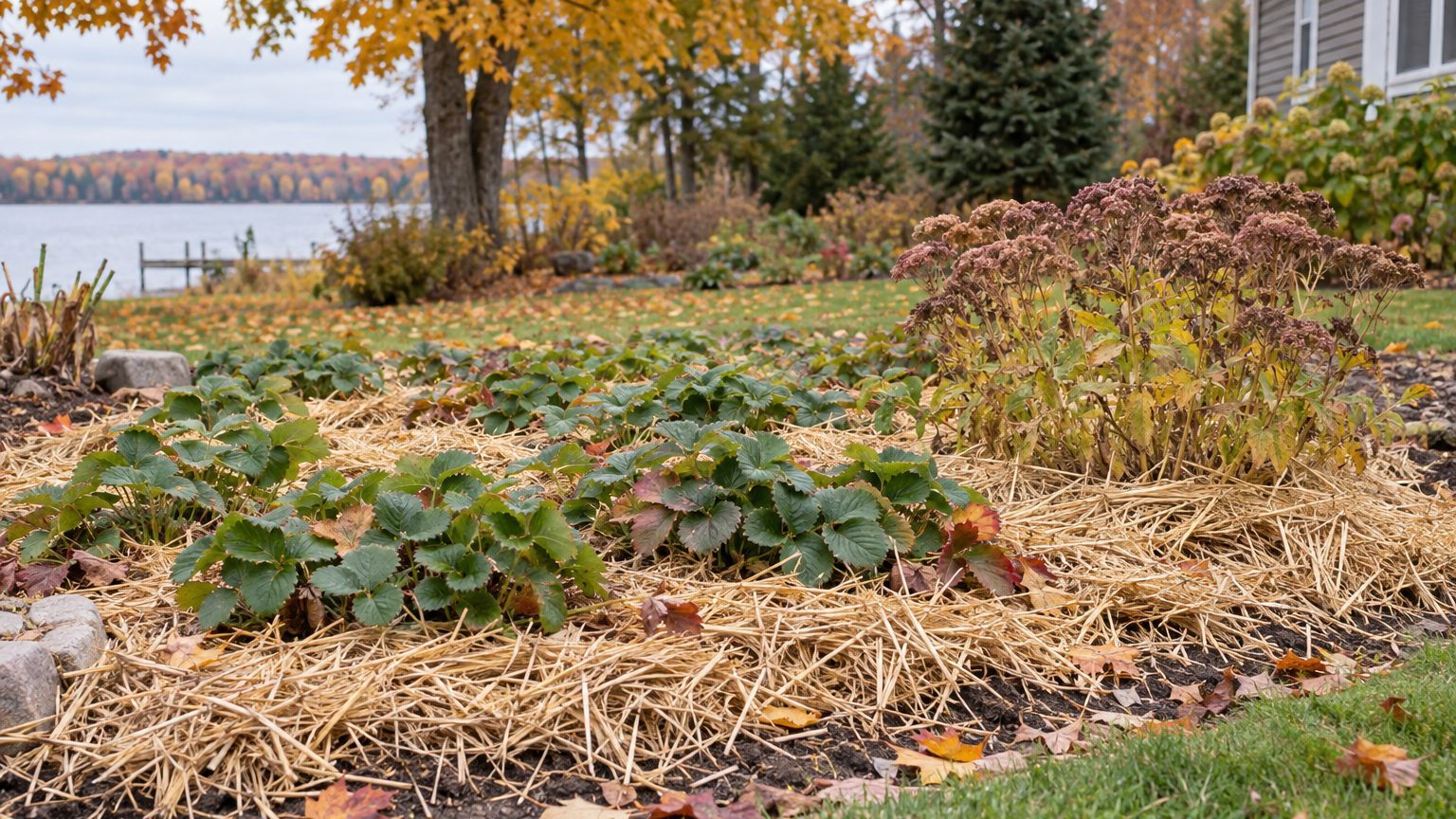

At Billings, strawberries and borderline perennials get their winter mulch after the ground starts to freeze. That is well after the first fall frost, which NOAA’s 1991-2020 Climate Normals place between October 1 and October 14 (the dates where the odds of a 32°F freeze run in the 30-70% band). A frost tells plants to go dormant. Frozen soil tells you it’s time to cover them. Mulch spread too soon does more harm than bare ground.
When to put winter mulch down in Montana
Gardeners tend to think of winter mulch as a blanket, something that keeps roots warm. It works closer to the opposite. Its job is to hold the soil frozen once it has frozen, so it doesn’t melt on a sunny afternoon and refreeze that night. Every one of those cycles can push shallow crowns upward. A layer laid over warm September soil does the reverse of what you want: it holds heat, keeps plants half-active, and gives rot and rodents a cozy place to settle.
Billings is the anchor for the numbers here. NOAA’s Climate Normals for 1991-2020 put the mean daily minimum of the coldest month at 17.9°F. That is an average night, not a record low, and it sits well under freezing. So the ground does freeze in a normal Montana winter. The trouble comes from the interruptions. Chinook winds, which can bring a spring-like afternoon in the middle of January, are exactly the kind of thaw that mulch is meant to buffer against. Snow cover helps too, but snow is unreliable, and a dry, windy winter can leave crowns exposed.
The first fall frost at Billings lands between October 1 and October 14, according to the same NOAA normals. That is the start of the clock, not the moment to act. Wait until the October 1 to October 14 first-frost window has passed and the soil surface stays frozen through the day, then mulch. In a typical year that means the mulching window opens later in the fall, after several hard freezes rather than the first light one. Strawberry leaves that have been nipped by frost but remain green are still storing energy, and covering them early smothers that process.
Other parts of Montana run on a different schedule. The USDA Plant Hardiness Zone Map (2023 edition, built on 1991-2020 data) spans zones 3a to 6a across the state, and it measures only the average annual extreme minimum temperature. Billings is one of the milder valleys. Higher elevations and areas farther north see the first frost earlier and the ground freeze earlier, so fall tasks like mulching move earlier there, while uncovering in spring moves later. Mountain valleys can frost in any month, so a calendar date is a poor guide in those places. Watch the soil: if a garden fork meets a stiff crust in the morning, you’re in the window. The First and Last Frost Dates in Montana page helps you place your own town relative to Billings, and the other Montana guides cover regional differences.
Strawberries
Strawberry crowns sit right at the soil surface, which makes them more exposed than almost anything else in a home garden. The buds that will become next June’s berries are already formed by late fall. Bare cold can kill them, and so can heaving, when repeated freezing and thawing lifts the whole plant out of the ground and snaps the fine roots underneath. A plant that looks fine in April but produces nothing usually had its crown damaged in a January thaw. For more on the crop itself, see Growing Strawberries.
Clean straw is the standard covering, and for good reason. It’s light and airy, it sheds water rather than soaking it up, and it doesn’t compress into a sodden layer the way wet leaves do. Choose straw, not hay. Hay carries seed heads that will sprout into weeds in your berry bed. Pine needles are an option for those who have them, though they are less common on Montana properties than in other states. Avoid whole leaves, grass clippings and anything that will pack down.
The depth question deserves care. The only figure in the sources for this article is from NC State Extension, and it isn’t written for strawberries specifically: “A 2-inch to 3-inch layer of mulch suppresses most annual weed seeds and makes it easy to hand-pull any that do germinate.” That is a general mulch depth, and it is a useful ceiling for most beds. For strawberries, the goal is to cover the leaves loosely enough that air still moves through the straw. Fluff it, don’t press it down. More is not better. A thick, packed mound holds moisture against the crowns and invites the exact rot you were trying to avoid.
Timing follows the soil, not the calendar. Cover the bed after the ground has started to freeze, which at Billings means after the October 1 to October 14 first-frost window and usually after several hard nights. Gardeners in colder, higher parts of Montana should expect to do it earlier, because their freeze arrives earlier.
Spring is the other half of the job. Pull the straw back once new growth starts to show and hard freezes have loosened their grip, and leave it lying between the rows. Look under the straw. Pale yellow new leaves mean the plants are waking up and starving for light. Uncover gradually rather than all at once, and keep the straw close by. If a frost night is forecast after you’ve pulled it back, drape it loosely over the plants again, especially once blossoms open. Spring frost timing varies by town, so check the local last-frost range in the frost dates guide before you commit.
Perennials and borderline plants
Most established perennials that are truly hardy for your zone don’t need much help. Peonies, daylilies and most native prairie plants have been getting through Montana winters for a long time. The plants that benefit from a mulch layer are the borderline ones: species rated near the cold limit of your area, anything planted this fall or last, and shallow-rooted plants whose crowns sit near the surface. The zone number matters here, but only as a starting point. The USDA system is based on the average annual extreme minimum, and the state spans 3a to 6a. A plant rated for zone 4 may sail through winter in a protected Billings yard and struggle in a windy, exposed 3a valley.
Plants that commonly earn a layer of winter mulch include:
- Newly planted perennials in their first winter, whose roots haven’t spread deeply yet
- Garden chrysanthemums, which are often sold as perennials but are frequently borderline
- Coral bells and other shallow-rooted, evergreen-crowned plants
- Roses that aren’t fully cold-hardy, especially around the graft or the base of the canes
- Perennial herbs at the edge of their range, covered in Getting Perennial Herbs Through the Winter
How you apply it matters more than what you use. Shredded leaves, straw or chopped bark all work as long as they don’t mat. Pile it in a ring around the crown rather than on top of it. Think doughnut, not volcano. Mulch touching stems and crowns holds moisture against the bark, softens the tissue and gives voles a hidden path to the plant. Leave a small gap of bare soil right at the base.
For depth, stay within the NC State Extension range quoted above, “A 2-inch to 3-inch layer of mulch.” Their advice for woody plants is similar: “Provide a 3-inch layer of mulch to reduce water loss and maintain uniform soil moisture and temperature around roots.” That guidance is written about trees, but it is a fair benchmark for shrubs and roses as well. Piling it higher doesn’t add protection. Apply a ring of mulch in the 2-inch to 3-inch range, kept off the crowns, after the ground has started to freeze. The Mulching Without Killing the Plant page goes deeper on ring shape and materials.
What goes wrong
The most common mistake is mulching too early. It looks responsible: the first frost hits, the garden gets tidied, the straw goes on. But if that happens during the October 1 to October 14 first-frost window at Billings, the soil is still warm and the plants aren’t fully dormant. The result shows up in spring as soft, brown crowns and blackened leaf bases. The fix is simple. Wait for the soil to freeze, and let it freeze hard before covering.
Matting is the next problem. Wet fall leaves, especially whole maple or cottonwood leaves, pack into a slimy sheet that shuts out air. Under it, crowns rot. You can spot it in spring by the smell and the gray, slick layer that peels away in one piece. Use straw, or shred leaves first with a mower so they stay loose.
Voles are a quieter risk. A thick layer of mulch tucked against stems gives them shelter and a protected runway, and they’ll chew bark and crowns all winter without you seeing anything. Damage appears when you uncover: girdled stems, tunnels in the straw. Keeping mulch in a ring off the crowns, and applying it late rather than early, removes most of the appeal. Voles settle in when the weather still lets them build nests, before the ground locks up.
Forgetting to uncover is the fourth. Straw left on strawberries into warm spring weather blanches the new leaves, delays growth and holds cold, wet soil around the crowns. Start pulling mulch back as soon as new growth appears, well before the last spring frost range has ended, and keep the straw handy to re-cover on a frost night. A little planning turns the same straw into a frost cover.
Common questions
Is it too late to mulch if snow has already fallen?
Not at all. If the ground is frozen and there’s snow on top, you can still spread straw or shredded leaves over the snow-free areas, or brush snow aside and add mulch. What matters is that the soil is already cold. Snow is itself a good insulator, so mulch matters most in the stretches where snow melts off or blows away.
Should I mulch every year, or only some winters?
Strawberries benefit every winter because their crowns are exposed. For perennials, focus on newly planted and borderline plants. Well-established, hardy species in a sheltered spot may not need anything beyond the snow.
Can I use grass clippings or whole leaves?
They tend to mat, hold water and rot, which makes them a poor choice near crowns. Clean straw and shredded leaves stay looser. If you use leaves, chop them first and keep them within the 2-inch to 3-inch range.
What about herbs like thyme or sage?
They follow the same logic, but many herbs also demand sharp drainage, so wet mulch can do more harm than good. Cover lightly, once the soil has frozen, and keep it off the stems. Details for individual herbs are in Getting Perennial Herbs Through the Winter.
The figures in this article come from NOAA NCEI 1991-2020 Climate Normals for Billings, the USDA Plant Hardiness Zone Map (2023), and the NC State Extension Gardener Handbook. Billings is milder than many Montana valleys, so treat its dates as a reference point and let your own soil make the final call.