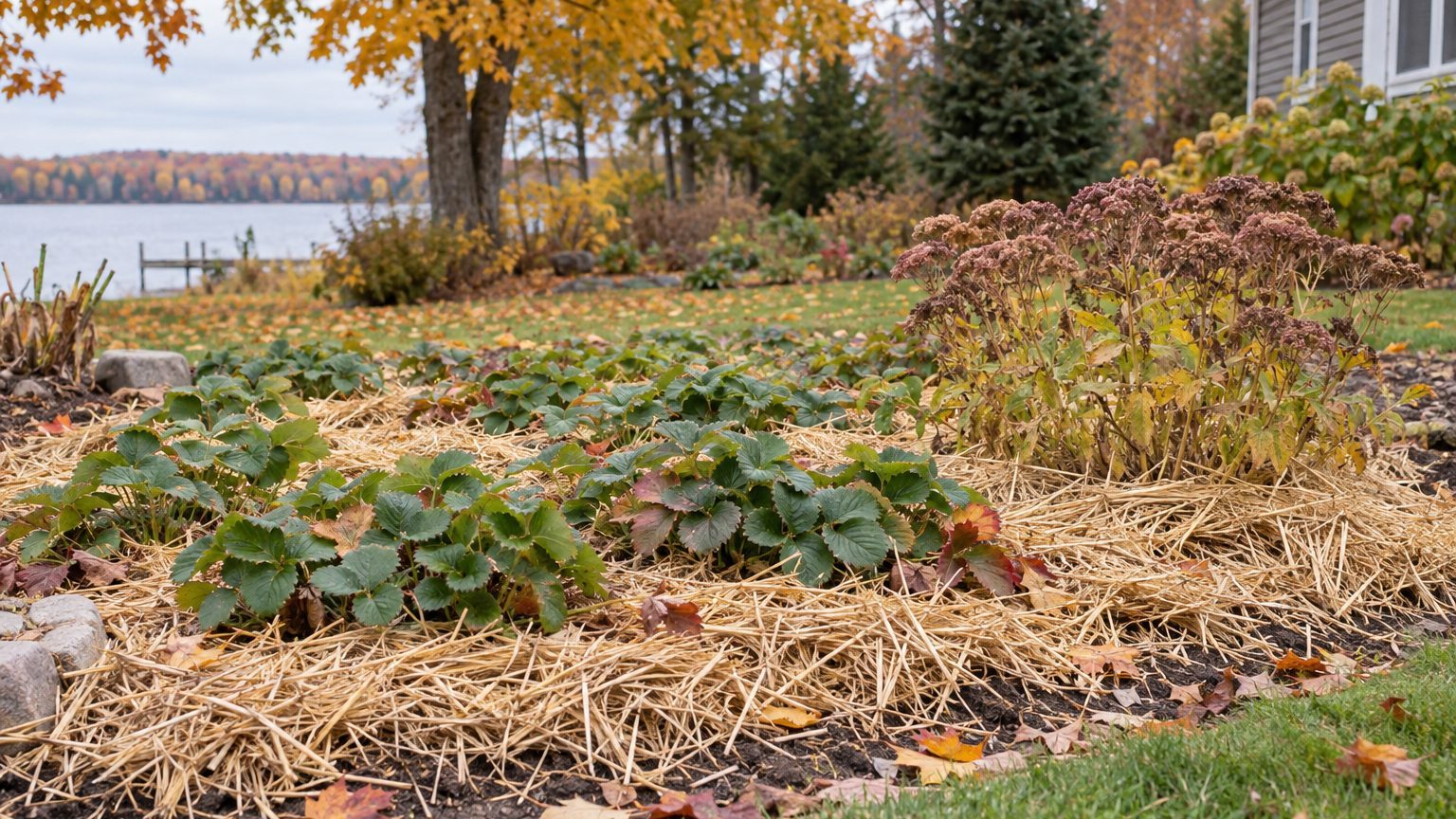

Wait for the ground, not the calendar. NOAA’s 1991-2020 normals for the Fargo airport station put the first fall freeze between September 25 and October 5, but that is your cue to start watching the soil, not to start spreading mulch. Straw for strawberries and a loose layer for borderline perennials go down once the soil surface has begun to freeze, which comes well after that first frost. The details below cover the timing, the depth, and the mistakes that cost North Dakota gardeners plants.
When to put winter mulch down in North Dakota
Most people assume winter mulch is a blanket, something that keeps plants warm. In North Dakota it works the opposite way. NOAA’s 1991-2020 Climate Normals for Fargo show a mean daily minimum of 0.2°F in the coldest month (an average of the nightly lows, not the record low), so the ground freezes and stays frozen for months. Mulch is there to keep it that way. Think of a foam cooler: it doesn’t make the ice colder, it stops the ice from melting. The real threat to a plant isn’t a hard January night. It’s the sunny afternoon in February or March when the top layer thaws, the night refreezes it, and each cycle pushes shallow crowns a little further out of the ground.
Reading the window
Fargo’s first fall freeze falls between September 25 and October 5, in the 30 to 70 percent probability band for 32°F, according to NOAA NCEI. That is the reference-city figure from an airport station. Suburban and rural gardens usually freeze one to two weeks earlier, and gardens farther north tend to freeze earlier still. Check your own county’s dates in First and Last Frost Dates in North Dakota before you anchor anything to Fargo’s numbers. Whatever your date turns out to be, the rule is the same: wait until the soil surface has started to freeze, well after the first-freeze window of September 25 to October 5, and only then put the mulch on.
Why not sooner? In early fall, the soil still holds summer heat. Mulch laid over warm, damp ground keeps the heat in, slows the plant’s slide into dormancy, and creates a cozy, sheltered space for mice and voles that are looking for winter quarters. Crowns sitting under a wet, warm blanket can also start to rot before real cold arrives.
A practical test beats a date. Push a trowel into the bed on a cold afternoon. If the top inch or so is stiff and crusty, and it stayed that way through the day, the ground has started to freeze. A few nights of hard freeze in a row usually get you there. A single frosty morning doesn’t.
Have the mulch ready early
Fall in this part of the country can turn fast. A mild October can flip into a hard freeze in a matter of days, and the bales you meant to pick up are suddenly sold out or buried under snow. Buy the straw while the beds are still bare of frost, stack it somewhere dry near the garden, and spread it when the ground tells you to. The waiting is the only hard part.
Strawberries
A strawberry plant keeps its growing point in the crown, right at the soil surface, with nothing above ground to protect it once the leaves die back. That position is the problem. Repeated freezing and thawing heaves shallow crowns upward and tears fine roots, and bare cold with no snow cover, especially with dry wind, can injure the crown directly. Snow is nature’s mulch, but in North Dakota it arrives unevenly and wind scours open ground, so a bed that looks protected in December can be bare by February.
What to use and how deep
Clean straw is the standard choice. It’s light, it holds air, it sheds water instead of soaking it up, and it doesn’t pack down. “Clean” matters: straw from wheat, oats, or similar crops that was cut and baled without a lot of weed seed. Hay is the one to avoid, because it’s full of seed and you’ll be pulling grass out of your berries all summer. Whole oak or maple leaves tend to mat into a wet, airtight sheet, so if you use leaves, shred them first.
For depth, the only figure I can give you comes from NC State Extension, and it was written for weed control and moisture, not for North Dakota winters: “A 2-inch to 3-inch layer of mulch suppresses most annual weed seeds and makes it easy to hand-pull any that do germinate.” Fluffy straw settles and thins as it gets wet and snowed on. For a strawberry-specific depth in cold-winter conditions, NDSU Extension is the better source. Whatever depth you choose, cover the crowns evenly and don’t leave bare patches that wind can pry open. Anchor the edges if your beds are exposed. The Growing Strawberries page covers what happens in the rest of the season.
Taking it off in spring
Mulch left on too long smothers the plants, and this is the step people forget. In spring, check under the straw regularly once the snow is gone. As soon as new leaves start to show, pale yellow under the straw, pull the mulch off the crowns and rake it into the aisles. Pale leaves are a sign the plant is reaching for light and shouldn’t stay under cover. Leave the straw between the rows, where it helps with weeds and keeps berries off the soil later. Keep some within reach in case a frost is forecast once flowers have opened, because open blossoms are the most vulnerable part of the plant. A light cover thrown over the bed that evening and removed the next morning can save the crop.
Perennials and borderline plants
The USDA Plant Hardiness Zone Map (2023 edition, based on 1991-2020 normals) places North Dakota in zones 3a to 4b. That’s a territory-wide range, built on one variable: the average annual extreme minimum temperature. Fargo sits at one point in it, and other parts of the state are colder or milder. This matters because the plants that need winter mulch are the ones whose hardiness rating sits at or just past the edge of where you garden. A perennial rated well below your zone shrugs off winter without help. A plant rated for a warmer zone, or one that has barely rooted, needs the steady, frozen soil that mulch provides.
In practice, that means a handful of categories. Perennials planted this season haven’t built deep roots yet and are the most likely to heave, so they deserve mulch even if the tag says they’re hardy. Garden mums are often sold as perennials but rooted shallowly. Hybrid or grafted roses, where the cultivar is grafted onto a different rootstock, are vulnerable at the graft union. Shallow-rooted evergreen-leaved plants and Mediterranean-type herbs also struggle. For the herb side of this, see Getting Perennial Herbs Through the Winter.
| Plant type | Why mulch helps | How to apply |
|---|---|---|
| Newly planted perennials | Shallow roots, prone to heaving | Loose ring after the ground starts to freeze |
| Garden mums | Shallow roots, borderline hardiness | Loose ring; leave stems standing through winter |
| Grafted roses | Protects the graft union | Ring or mound around the base, after the freeze |
| Rated for a warmer zone than yours | Steadies soil temperature | Ring around the crown, never a pile on top |
On depth, stay with what the sources say. NC State Extension, in its Extension Gardener Handbook chapter on woody ornamentals, says: “Provide a 3-inch layer of mulch to reduce water loss and maintain uniform soil moisture and temperature around roots.” Combined with the 2-inch to 3-inch weed-control range quoted earlier, that gives you the order of magnitude. More is not better. A thick layer holds water against stems and crowns, and a pile heaped against a plant turns into a mulch volcano that invites rot and rodents.
The shape matters as much as the depth. Lay a loose ring around the crown, not a pile on top of it, and keep the mulch just back from the stems themselves. That leaves the crown breathing and gives mice less cover. The mechanics of ring mulching are in Mulching Without Killing the Plant.
What goes wrong
Too early, too thick, too wet
Mulching too early is the most common mistake and the quietest. The first sign is often nothing, until spring, when crowns come up soft, brown, or hollow. Warm soil under a heavy blanket stays damp and keeps plants half active when they should be going dormant. The fix is patience: wait for the ground to freeze, as described above, rather than reacting to the first frost.
Matting is the second problem. Wet whole leaves and grass clippings collapse into a dense, slimy layer that doesn’t breathe. Under it, crowns rot, especially during the thaw and refreeze cycles of late winter. Stick to airy materials like straw or shredded leaves, and stay within the 2-inch to 3-inch range from NC State Extension rather than piling on extra “just in case.”
Voles, and the spring you forgot
Voles love mulch. A thick layer next to a stem, especially with snow on top, is a protected tunnel where they can chew bark, roots, and crowns all winter without being seen. Prevention starts with timing, since waiting until the ground has frozen means the animals have already settled elsewhere. Keep mulch pulled back from trunks and stems, and put hardware cloth around young trees and shrubs.
The last mistake is forgetting spring. Strawberries left under straw come up pale and weak, and perennials with a pile still on their crowns stay cold and wet while the rest of the garden wakes up. Set a reminder for the first week the snow is gone, and check under the mulch rather than waiting for the weather to feel warm.
Common questions
Can I mulch strawberries right after the first frost?
Not yet. The first frost, which NOAA places between September 25 and October 5 for Fargo, only signals that growth is slowing. Soil is still warm at that point. Wait until the surface has started to freeze, so you aren’t trapping heat and giving rodents a place to nest.
Is snow cover enough on its own?
Snow is excellent insulation when it falls early and stays put. The trouble is that North Dakota snow can arrive late, blow away, or melt in a thaw and leave beds exposed. Mulch is insurance for the years snow doesn’t cooperate.
Do hardy perennials need winter mulch?
Established plants rated comfortably for your zone usually don’t, and a layer of mulch won’t hurt if you keep it to the 2-inch to 3-inch range and off the crown. First-year plantings, shallow-rooted plants, and anything rated for a warmer zone are the ones that benefit most.
How do I find the right timing for my county?
Start with the frost-date table in First and Last Frost Dates in North Dakota, then watch your own soil. More seasonal advice is gathered in the North Dakota guides. Keep in mind that the Fargo numbers come from an airport station, and a rural garden a few miles out often freezes a week or two sooner, which moves your mulch date earlier too.