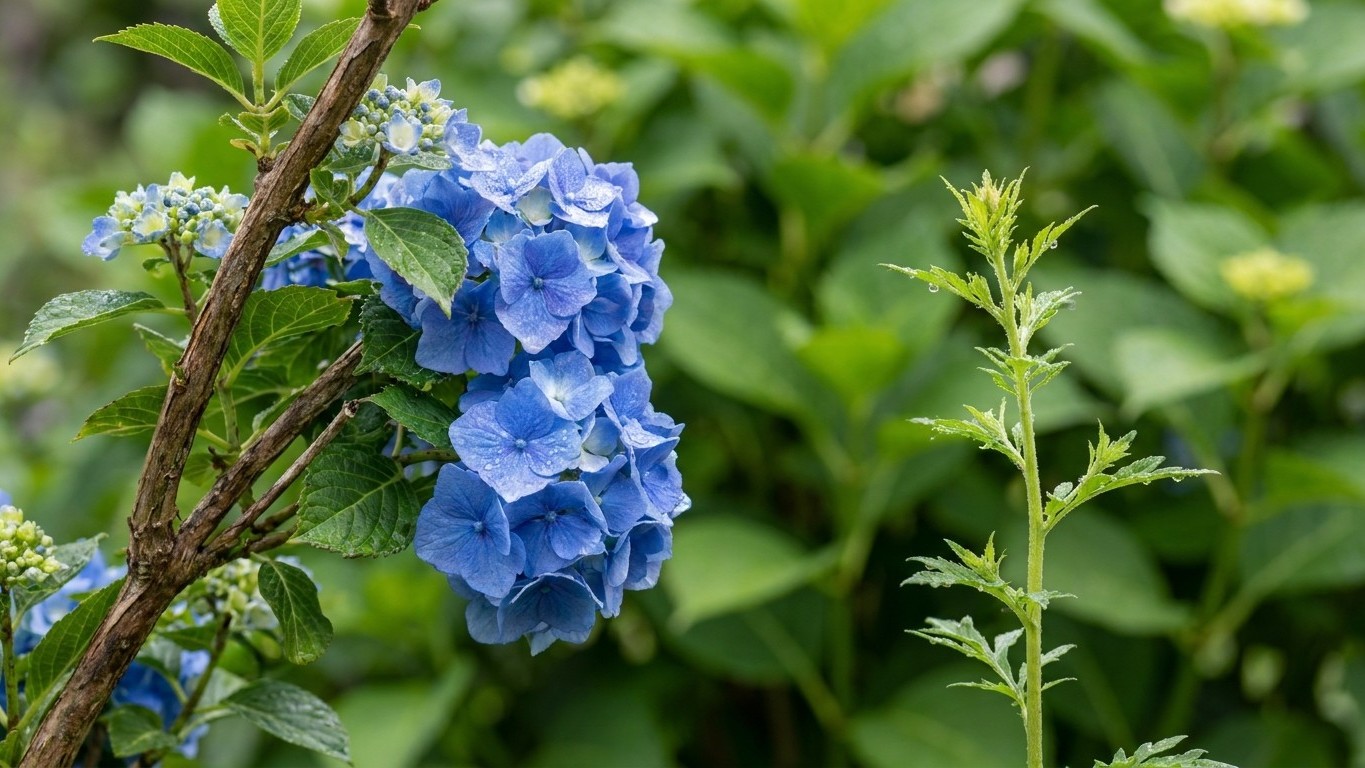

Growing hydrangeas in Kansas works best with panicle and smooth types, planted in spring after the last frost (or in early fall), in morning sun and soil that holds moisture without staying soggy. Bigleaf hydrangeas can bloom here, but they ask for more babying. A late freeze kills their flower buds, and alkaline soil mutes the blue. For fuller background on the species, start with the How to Grow Hydrangeas: The Complete Guide, then come back for the Kansas specifics.
When to Plant Hydrangeas in Kansas
The frost window
The reference point here is the airport weather station in Wichita. Using NOAA NCEI 1991-2020 Climate Normals (the 30-70% probability band for a 32F freeze), the last spring frost falls between April 4 and April 18, and the first fall frost between October 23 and November 2. Those are Wichita airport numbers, not a statewide promise. Suburban and rural gardens usually see the last spring frost one to two weeks later and the first fall frost one to two weeks earlier, and the gap widens at elevation. Northern Kansas and the higher ground in the west run later in spring than Wichita. Check your own county before you commit to a date.
Translate that into a working window. If your garden sits a week or two behind the airport, your safe spring planting dates run from roughly April 11 to May 2. Panicle and smooth hydrangeas tolerate a cool snap once they are in the ground. Bigleaf types, which carry tender buds and new growth early, are better off planted toward the later end of that range.
Seed, cuttings or nursery plants
Hydrangeas are not a seed-to-bloom crop the way annual flowers are. Seed from named cultivars does not come true, and seedlings take years to reach flowering size. Most gardeners buy a container-grown shrub or root a cutting. If you want to try seed anyway, sow it indoors about ten weeks before your target planting date. For a May 1 plant-out, that means starting around February 20.
Cuttings are the better do-it-yourself route. Softwood cuttings taken from a healthy shrub in late May or June typically root in a matter of weeks. Pot them up, give them a protected spot over winter, and plant them out the following spring.
Count-back arithmetic for hardening off
A nursery plant raised in a greenhouse, or a rooted cutting grown indoors, needs about 7 to 10 days of gradual outdoor exposure before it goes in the ground. Start with a couple of hours of shade, add a little sun each day, and leave it out overnight only once nights stay above freezing. Work backward from the planting date. Aiming for April 25 means starting hardening off around April 15. Aiming for May 2 means starting around April 22. If a hard freeze shows up in the forecast during hardening, bring the pots back inside.
Fall is the other window, and it is open as you read this. A container hydrangea planted in early October still has the weeks before the Wichita-reference freeze (October 23 to November 2) to settle in, and the soil usually stays workable beyond that. Mulch it, water it through dry spells, and expect modest top growth until spring. Gardeners who would rather skip the risk can wait until April.
Soil and site preparation
Light matters first. Smooth and bigleaf hydrangeas do best with morning sun and shade from the hot afternoon, which in a Kansas summer can mean the difference between a plant that looks fine and one that looks scorched by July. Panicle hydrangeas tolerate more sun, six hours or so, and bloom better for it, though afternoon relief helps them in the southern part of the state too. Wind is the other site factor. Open prairie exposure shreds big leaves and dries the plant out, so a spot on the east side of a house or fence pays off.
Soil texture varies widely across Kansas, and I will not pretend to quote a soil survey. Plenty of gardens are heavy clay, which holds water well but drains slowly. Hydrangeas want soil that stays evenly moist yet drains within a few hours after a soaking rain. To test, dig a hole about a foot deep, fill it with water, and see whether it empties by the next day. If water is still standing, plant on a gentle mound or raise the bed rather than digging a deeper hole that turns into a bathtub.
Amendment timing is where most people lose weeks. Start four to eight weeks before planting, or the previous fall. Work two to three inches of compost into a wide area, not just the planting hole, since hydrangea roots spread outward. Take a soil test through your county extension office at the same time, because pH decides both your color options and whether leaves turn yellow with green veins (a sign the plant cannot take up iron). Sulfur lowers pH slowly, over months, so it belongs in the early prep, not on planting day.
On the day itself, dig the hole two to three times as wide as the root ball and exactly as deep. Set the crown level with the surrounding soil, backfill with the native soil you loosened, water slowly, and mulch two to three inches deep, keeping it off the stems. Spacing depends on the cultivar. Compact panicle and smooth types can sit three to four feet apart, while full-size panicles often need five to eight feet. The plant tag gives the mature width, and I would trust it over optimism.
Varieties that suit Kansas
Winter cold and spring freezes drive the choice. Hydrangeas differ in whether they bloom on old wood (last year’s stems) or new wood (this year’s growth). Old-wood bloomers lose their flowers if the buds freeze. New-wood bloomers just regrow and flower. In a state where a warm March can be followed by a hard freeze in April, new-wood types are the dependable ones. Heat and drought tolerance, stem strength, and how long the flowers hold their color round out the list.
| Type | Widely sold examples | Blooms on | Kansas fit |
|---|---|---|---|
| Panicle (Hydrangea paniculata) | Limelight, Little Lime, Bobo, Quick Fire | New wood | Most reliable; tolerates sun and cold; blooms white and often ages to pink |
| Smooth (Hydrangea arborescens) | Annabelle, Incrediball | New wood | Dependable bloom; likes afternoon shade; Incrediball has sturdier stems than Annabelle |
| Oakleaf (Hydrangea quercifolia) | Snow Queen | Old wood | Tough once established; handles heat; buds can be lost to a late freeze |
| Bigleaf (Hydrangea macrophylla) | Endless Summer | Old and new wood (reblooming types) | Needs shelter and acidic soil for blue; reblooming types are the safer bigleaf bet |
Color deserves its own note. Only bigleaf hydrangeas swing between pink and blue with soil chemistry, and blue needs acidic soil with available aluminum. In alkaline soil, which is common across much of Kansas, the same plant tends toward pink or purple. Chasing blue in the ground is a long project. A bigleaf in a large container filled with acidic potting mix is far easier. Panicle and smooth types stay white or green, with panicles fading to pink or burgundy in cool fall weather, regardless of pH.
What to plant alongside
Good neighbors for a hydrangea share its taste for moisture and partial shade without crowding its roots. Hostas, ferns, astilbe, and heuchera all fill the ground beneath and shade the soil, which cuts evaporation. Spring bulbs such as daffodils and tulips bloom and fade before the hydrangea leafs out fully, and their foliage hides in the shrub’s shadow. A low ground cover like creeping sedum or barrenwort does the same job near the edge of the bed, as long as it is kept a hand’s width from the stems.
Competitors are the plants that drink the same water. Shallow-rooted trees such as maples drain the soil under them, and a hydrangea planted in the dripline will wilt every afternoon in July. Turfgrass pressed right up to the trunk steals water and nitrogen, so cut a mulched ring at least two to three feet wide. Other big shrubs with greedy, fibrous roots also compete if planted too tightly. Give each plant its own space.
Watering, feeding and support
Hydrangea means “water vessel,” and the plants live up to it. New plantings need a deep soaking about twice a week during their first summer when rain is absent, enough to wet the soil to a depth of 6 to 8 inches. Established shrubs do better with a long weekly soak than daily sprinklings. Water at the base in the morning so leaves dry quickly. A soaker hose or drip line is the easiest way to keep foliage dry and roots wet. Afternoon wilting in July heat is normal, but if leaves stay limp in the cool of the evening, the roots are dry or drowning, so check the soil with your finger.
Mulch does the quiet work. Two to three inches of shredded bark or leaf mold holds moisture, moderates soil temperature, and suppresses weeds. Refresh it each spring and pull it back a few inches from the stems, because mulch piled against bark invites rot.
Feeding is simpler than the product aisle suggests. One application of a balanced, slow-release fertilizer in early spring, as growth starts, is enough for most established shrubs. Heavy nitrogen produces lush leaves and flopped stems with fewer blooms. A second light feeding in early summer suits bigleaf reblooming types. Stop fertilizing by midsummer so new growth can harden before winter. Compost spread under the mulch does gentle work too, and a soil test tells you whether phosphorus or potassium is actually short.
Support matters mainly for big-headed varieties on thin stems, such as Annabelle, which collapses under rain-soaked blooms. A ring of stakes or a peony cage set early in spring lets the stems grow up through it and hide it. Sturdier cultivars like Incrediball need less help.
Pruning follows the bloom wood. Panicle and smooth types flower on new growth and can be cut back in late winter or early spring, before buds swell. Bigleaf and oakleaf types set buds the previous summer, so prune right after flowering and only to remove dead wood in spring. Wait until new leaves appear before judging which stems died over winter, since a stem that looks dead in March may leaf out in May. Hydrangeas do not sucker aggressively, though smooth types spread by underground shoots and can be divided in early spring.
Common problems

Afternoon wilting is the one most people mistake for disease. Big leaves lose water faster than roots can supply it on hot, windy days. If the plant perks up by evening, nothing is wrong beyond a need for deeper watering, more mulch, or afternoon shade. If it stays limp after a good soak, look for root problems: waterlogged clay, a girdling root, or a planting hole dug too deep.
No blooms is the second complaint. On bigleaf and oakleaf types, the usual cause is flower buds killed by a winter or spring freeze, or pruning at the wrong time. Dead-looking tips and stems that leaf out only near the base tell the story. On panicle and smooth types, too much shade or too much nitrogen is the likely cause. Move toward more light, hold back on fertilizer, and be patient with a plant that went in this year, because it may spend the first season growing roots.
Yellow leaves with dark green veins point to iron chlorosis, common where soil pH runs high. The iron is in the soil but locked up. Lowering pH slowly with sulfur and adding organic matter helps, and chelated iron gives a temporary fix. Plain uniform yellowing across old leaves more often means overwatering or poor drainage.
Brown, crispy leaf edges mean scorch from wind, heat, or dry soil. The fix is the one you already know: mulch, a deeper soak, and a more sheltered spot next year. Dark, angular or round spots on leaves are usually fungal leaf spot. They look ugly but rarely kill the plant. Rake and discard fallen leaves, water at the base, and thin crowded stems. A white dusting on leaves is powdery mildew, which tends to appear in humid weather with poor airflow and responds to better spacing and, if severe, a labeled fungicide.
Pests that actually show up in Kansas
The K-State Research and Extension pest list for home gardens (S158 and MF3480) is written mostly for vegetable plots, so many of its entries, such as squash bug, squash vine borer, harlequin bug, and Colorado potato beetle, are crop pests that only visit a hydrangea in passing. The list is not exhaustive and pressure varies across the state. These four from it do real damage to hydrangeas. K-State puts overall pest activity from spring through late summer.
Bagworm
You see small spindle-shaped bags of silk and plant debris hanging from branches, then ragged, chewed foliage. Egg hatch runs late April to early May, and larvae feed through the summer. The control that works is hand-picking the bags before hatch and dropping them in soapy water. Once larvae have emerged, a Bt (Bacillus thuringiensis) spray works best while they are still small.
Grasshopper
The first sign is leaves chewed from the edges, often overnight, on plants near weedy ground or dry pasture. Grasshoppers overwinter as eggs and hatch into spring, with feeding continuing through summer. Lightweight row cover or fine netting over young shrubs is the one measure I would lean on, along with keeping tall weeds trimmed around the bed.
Blister beetle
Look for slender, elongated beetles in groups, feeding on foliage and flowers in summer, and leaving leaves skeletonized. Do not crush them bare-handed, since they release a compound that can blister skin. Knock them into a bucket of soapy water while wearing gloves.
Spotted cucumber beetle
Yellow-green beetles with black spots show up on open blooms and nibble petals and leaves. They are active in the warm months. Handpicking or a shake into soapy water, done in the morning when they are sluggish, is the practical control. Stubborn infestations can be sent to your county office for identification.
Harvest and end of season
Cut flowers for the vase in the cool of the morning, taking long stems and plunging them into water right away. Smooth hydrangea blooms are best when fully open. Panicle blooms last longest when cut once the florets are firm. For hot-water treatment, dip the cut end in boiling water for a few seconds, then into cool water, which helps bigleaf blooms stay upright.
For drying, the easy way is to let blooms age on the shrub until the petals feel papery, usually late summer into fall, then cut and hang them upside down in a dry, dim place. Some gardeners stand stems in a few inches of water and let them dry slowly, which keeps color better. Stored in a dry spot away from sunlight, dried flowers last for months.
As the first fall frost nears, which in Wichita’s reference figures lands between October 23 and November 2 (and often sooner in suburban or rural gardens), stop fertilizing and keep watering if fall is dry. Leave panicle and smooth stems standing until late winter, since the old growth gives some protection and the plants flower on new wood anyway. Bigleaf types gain from a cage of chicken wire filled with shredded leaves around the base after a few hard frosts, plus a fresh layer of mulch over the roots. Potted hydrangeas can move into an unheated garage once nights drop well below freezing, with an occasional light watering through winter.
Local help
County-level frost dates, soil tests, and pest identification are all available through K-State Research and Extension, whose county offices will tell you how your garden differs from the Wichita reference figures. For more regional guides, browse the Kansas guides. If you garden across the region, compare with Growing Hydrangeas in Kentucky: Types, Colour and Winter and Growing Hydrangeas in Quebec: Types, Colour and Winter.
Common questions
Can hydrangeas really grow in Kansas?
Yes. Panicle and smooth types are the most reliable, since they bloom on new wood and handle cold winters. Bigleaf and oakleaf types can work with shelter, mulch, and some luck with late freezes. Give all of them afternoon relief and consistent water.
Why won’t my hydrangea bloom?
On bigleaf and oakleaf types, the cause is usually buds killed by a freeze or removed by pruning at the wrong time. On panicle and smooth types, look at light, nitrogen, and plant age. A newly planted shrub may take a season to settle before flowering well.
Can I make pink hydrangeas blue in Kansas?
Only bigleaf hydrangeas change color with soil chemistry, and blue needs acidic soil with available aluminum. Kansas soil often leans alkaline, so a container with acidic mix is the easier route. Get a soil test first so you know your starting pH.
Should I cut hydrangeas back in the fall?
Leave them standing. Panicle and smooth types can be pruned in late winter or early spring, and bigleaf and oakleaf types should only be pruned right after they bloom or to remove dead wood in spring. Fall cutting removes protection and, on old-wood bloomers, next year’s flowers.
How much sun do hydrangeas need in Kansas?
Morning sun with afternoon shade suits smooth and bigleaf types. Panicles can take about six hours of sun, but even they appreciate afternoon relief in hot, windy parts of the state. Watch for scorched edges as a sign the spot is too exposed.