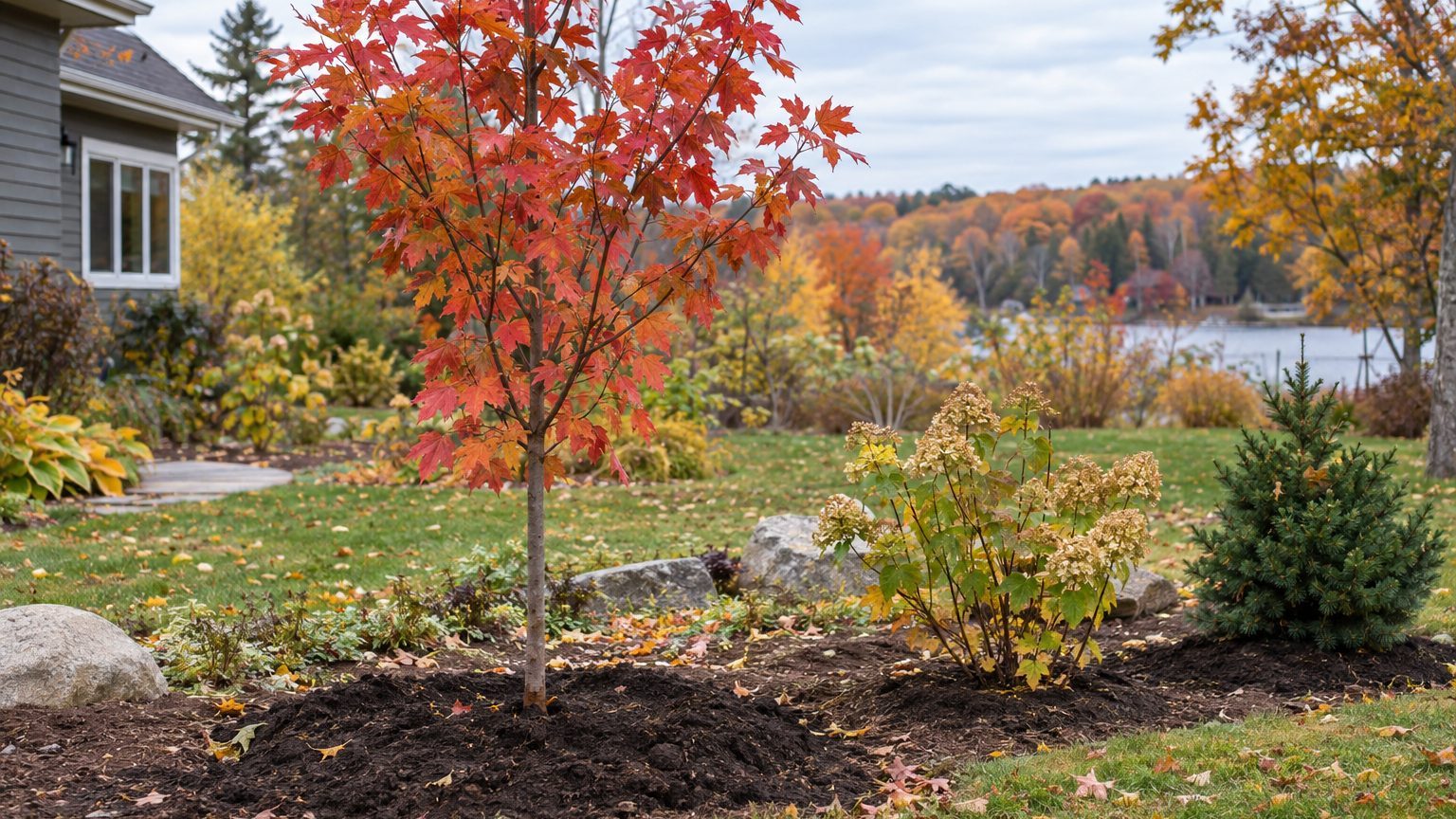

In Newfoundland and Labrador, the safe target for planting trees and shrubs is about September 5, six weeks before the first fall frost, which averages October 17 at the St. John’s A weather station. That is the conservative date, not the last one. Roots keep working after it, and the true limit is the day the ground freezes, which comes later. Northern and upland districts run earlier. Past the target you are gambling, and some plants win that bet far more often than others.
The deadline in Newfoundland and Labrador
Why roots outlast the air
Roots follow the soil, not the forecast. Soil holds summer’s heat long after the air turns raw, so a tree can be shedding leaves overhead while its roots keep pushing outward. That growth stops only when the soil gets cold enough to shut it down, and the real finish line is frozen ground. Cornell Cooperative Extension puts the working rule this way: “Fall is an excellent time for transplanting, provided you get them to their new home at least 6 weeks before the ground freezes, allowing them time to establish roots before winter dormancy.”
Notice what the rule counts back from. Not the first frost, which is a statement about air temperature, but the freezing of the ground itself. Here the ground does freeze. At St. John’s, the mean daily minimum of the coldest month is -8.7 °C (16.4 °F), according to Environment and Climate Change Canada’s 1981-2010 normals. A warm region might shrug off a planting deadline altogether. This one can’t.
Working the date from the first frost
Nobody can print the date the ground will freeze in advance, so the practical move is to count back from something we do have. Environment and Climate Change Canada puts the average first fall frost at the St. John’s A station on October 17. That is a mean, and a mean cuts both ways: in one year out of two the first frost lands later, and in the other half it lands earlier. Treat October 17 as the midpoint of a window, never as a safe date.
Count six weeks back from it and you reach September 5. Cornell’s rule applied to this frost date gives a conservative deadline, and it is conservative on purpose. The ground freezes after the first frost, so the real limit sits later than September 5. But the margin is there for the years the cold comes early, and for the plants that need more time than the textbook allows.
Aim to have trees and shrubs in the ground by early September, with September 5 as the conservative target, and earlier in colder northern or upland districts.
That last clause matters. The St. John’s A figures describe one station on the Avalon Peninsula, and a province is not one climate. Farther north and higher up, the first fall frost arrives weeks ahead of the St. John’s date, and the ground follows it down. Fall tasks always move earlier as you head toward the cold. Anyone planting outside the St. John’s area should check the local dates in First and Last Frost Dates in Newfoundland and Labrador before settling on a planting week.
One more caution on the numbers. Canadian normals cover 1981-2010, while the US figures elsewhere cover 1991-2020, so the two sets don’t line up year for year. Natural Resources Canada rates St. John’s at zone 6a in the Canadian plant hardiness system (1991-2020 normals). That is not a USDA zone, and no simple conversion exists between the two.
What to plant late, and what to wait on
The stock you buy decides how forgiving the calendar is. Container-grown and balled-and-burlapped plants arrive with most of their roots intact, so a fully hardy one can settle in even when you are behind the September 5 target. The word “hardy” carries weight here, because it has to be hardy for your spot, not just for the nursery’s description. A plant that is comfortable in the Canadian zone 6a of the St. John’s reference city, with room to spare, is a safe bet for a late fall planting. A plant that is merely tolerant of that zone is a spring job.
Evergreens are the exception inside the “hardy” group. Needles and broad evergreen leaves lose water all winter long, through wind and sun, while roots sitting in cold or frozen soil can’t pull much up to replace it. A spruce or rhododendron planted late has fewer working roots to cover that loss. If an evergreen is going in, it belongs early in the window, not at the tail end of it.
| Type of plant | Late fall outlook | Reason |
|---|---|---|
| Hardy deciduous shrubs in containers | Good, even a bit behind schedule | No leaves to feed, roots intact, soil still workable |
| Hardy deciduous trees, container or balled | Good if planted while the soil is workable | Roots keep growing until the ground cools toward freezing |
| Evergreens, needled or broadleaf | Risky after the early-September target | They keep losing water all winter with roots that can’t keep up |
| Borderline-hardy plants | Wait for spring | A full growing season of roots before their first winter |
Borderline plants deserve their own paragraph, because they cause the most heartbreak. These are the ones you are hoping will make it, such as a species rated one notch warmer than your area or a cultivar with a shaky reputation. Fall planting gives them a few weeks of root growth and then hands them the full force of a winter that bottoms out around -8.7 °C on an average coldest-month night. That average hides colder spells. Hold these plants for spring, and give them the whole warm season to build a root system before they face their first winter.
Plant hardy deciduous container and balled stock as late as the soil stays workable, but hold evergreens and borderline plants for early September or spring.
For the mechanics of the planting itself (hole width, root flare, backfill), Planting and Caring for Trees, Shrubs and Perennials covers the steps that apply in any season.
Watering and mulch until the ground freezes
A tree planted in fall has one job before winter: grow roots. It is not trying to grow taller or fuller. Whatever energy it has goes into pushing roots into the surrounding soil, and next spring’s top growth depends on how well that went. This is why the first winter is about roots, not growth. A newly planted tree with a modest crown and a well-anchored root system will beat a leafy one whose roots never got past the original ball.
Water is what lets that happen. Soil often looks damp on top while the root ball underneath is dry, because the ball is a dense lump of soil that sheds water like a sponge sheds oil when it dries out. Soak the planting area slowly and deeply, so the water reaches the root ball and the soil just beyond it, rather than sprinkling the surface. Then check again after a week without rain. A dry fall is hard on new roots, and the ground is not going to freeze for you until it is ready.
Keep watering deeply until the ground freezes, since freeze-up is the signal that roots have gone dormant and the job is done for the year.
Mulch in a ring, not a volcano
Mulch earns its place by slowing water loss and evening out soil temperature. NC State Extension’s handbook gives two figures for two purposes. On weeds: “A 2-inch to 3-inch layer of mulch suppresses most annual weed seeds and makes it easy to hand-pull any that do germinate.” On trees: “Provide a 3-inch layer of mulch to reduce water loss and maintain uniform soil moisture and temperature around roots.” The two statements land at the same depth, so there is no reason to go beyond it. More is not better.
The shape matters as much as the depth. Spread the mulch in a wide, flat ring around the planting area, and pull it back from the trunk so bark stays exposed to air. A mound piled against the trunk, the so-called volcano, holds moisture against the bark and invites rot and gnawing animals, and it can bury the root flare that should stay visible. The ring should look like a doughnut with a hole in the middle. Mulching Without Killing the Plant walks through the common mistakes in more detail.
What goes wrong
The most common failure is simply planting too late for the climate. With a first fall frost averaging October 17 at St. John’s, and arriving earlier in colder districts, a tree that goes into the ground well past early September has little time before roots slow. The plant may look fine through winter and then fail to leaf out. That is a slow, expensive way to learn the calendar. If you miss the September 5 target, plant only fully hardy container or balled deciduous stock while the soil is still workable, or hold everything until spring.
Winter burn comes next on the list. Evergreens lose moisture through their foliage on sunny, windy days while the soil is too cold to supply more, and the leaves or needles turn brown at the tips or all over. A late-planted evergreen with a small root system is the most exposed. Water well before freeze-up, keep the mulch ring in place, and choose a spot sheltered from the worst wind.
Heaving is the one that surprises people. Alternating freeze and thaw pushes shallow or loosely set root balls up out of the soil, leaving roots exposed to air and drying winds. Mulch moderates the swings, which is part of what the NC State handbook means by “uniform soil moisture and temperature.” Firm planting and a steady mulch ring are the best protection. If a root ball does rise in spring, press it back and water it in.
Last, there is the quiet failure of a dry fall. If rain is scarce through October and November, new plants can go into winter thirsty with no one noticing. Gardeners in the Pacific Northwest face a similar calendar problem with a different climate, as laid out in How Late Can You Plant Trees and Shrubs in Fall in Washington?, but the fix is the same: check the soil, not the sky.
Common questions
Can I still plant in November?
Only if the soil is workable and not frozen, and only with fully hardy deciduous container or balled stock. Planting that late falls well beyond the conservative September 5 target, so the roots get little time to grow before the ground freezes. In colder northern and upland districts, the soil may already be closed to you. When in doubt, wait for spring.
Is October 17 the date to plant by?
No. October 17 is the average first fall frost at the St. John’s A station, from Environment and Climate Change Canada’s 1981-2010 normals. It is a midpoint: in one year out of two the frost comes later, and in the other half it comes earlier. The planting target comes from counting six weeks back from it, which gives September 5.
Does the September 5 target hold in Labrador or at higher elevations?
Not as written. The figures come from one station, and colder districts reach their first frost and frozen ground earlier. Their planting deadline moves earlier too, so count back from the local first frost rather than the St. John’s one.
Does zone 6a mean I can use USDA zone 6a plants?
No. Zone 6a is the Canadian hardiness zone for St. John’s, built from seven climate variables, while the USDA system relies on one. Natural Resources Canada notes there are no simple conversions between the two, and that Canadian zone 4a overlaps nine USDA zones, from 3a to 7a. Choose plants by checking their hardiness against your own conditions, and see the Newfoundland and Labrador guides for more local planning.