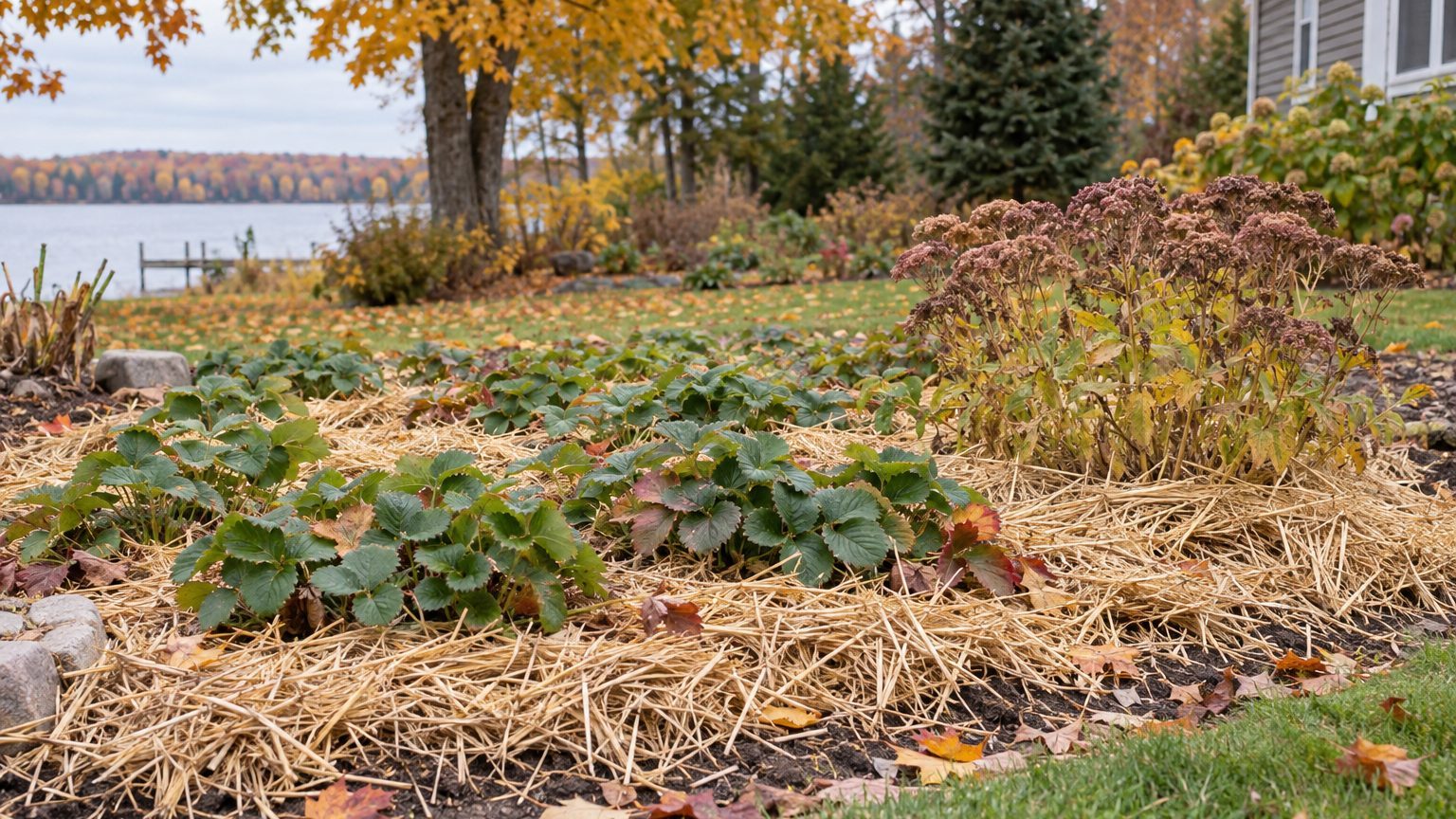

Mulch strawberries and perennials in Nunavut after the soil surface starts to freeze, not when the first frost arrives. At Rankin Inlet, Environment and Climate Change Canada’s 1981-2010 normals put the average first fall frost on September 13. The job belongs in the stretch after that date, once nights stay hard and the ground crust no longer thaws by afternoon. Mulch put down sooner works against the plants. Farther north, where fall frost comes earlier, the whole schedule slides earlier with it.
When to put winter mulch down in Nunavut
Winter mulch does the opposite of what the name suggests. It is not a blanket for keeping plants warm. It is a lid for keeping frozen soil frozen. A crown that freezes in autumn and stays locked until the spring thaw is in good shape. One that freezes, thaws during a mild spell, and freezes again gets pushed up a little with each cycle until its roots hang in open air. That cycle is called heaving, and a layer of mulch applied at the right moment is the cheapest way to stop it.
Cold alone is not the problem at Rankin Inlet. Environment and Climate Change Canada’s 1981-2010 normals give the coldest month a mean daily minimum of -34.3 °C (-29.8 °F, for readers comparing against US gardens). That is the average overnight low, not the record low. It tells you the ground freezes hard every winter, so the northern logic applies in full. Natural Resources Canada places Rankin Inlet in Canadian hardiness zone 0a, a rating built from seven climate variables that does not convert to a USDA zone. Plants rated for that kind of cold handle it. The ones that die are usually caught by swings and exposure.
Why laying it early backfires
Mulch spread over warm autumn soil slows the very freeze you are waiting for. The ground stays damp and mild under the cover, crowns sit wet in conditions that favor rot, and voles hunting for winter shelter find a ready-made, insulated nest while the soil is still easy to dig. Wait, and the same material does its real job, which is smoothing out temperature swings once the ground has set.
Finding the window
The one date in the record is the average first fall frost at the Rankin Inlet A station (climate ID 2303401): September 13. It is a midpoint. In one year out of two the first frost falls later, so treat it as the center of a window, never as a safe date. Frost also kills leaves long before it locks up soil, which lags well behind the air. The mulching window opens after that frost and the first run of hard nights, and it closes when snow settles over the beds for the season. Mulch after the soil surface starts to freeze, in the stretch that follows the September 13 average first frost.
A field test beats the calendar. Push a hand trowel into the bed in the afternoon. If the surface is a stiff crust that has not softened since morning, go ahead. Rankin Inlet is a single station, and northern districts run weeks behind its spring and ahead of it in fall, so gardeners there should mulch earlier than the Rankin Inlet pattern suggests. For a closer read on your own area, see First and Last Frost Dates in Nunavut.
Strawberries
A strawberry plant keeps its growing point, the crown, right at the soil line, with nothing above it but a few leaves. Two things damage it over winter. Heaving lifts the crown and snaps or exposes the roots. Bare cold does a quieter kind of harm: dry winter air pulls moisture from an uncovered crown while the roots sit in frozen soil and cannot resupply it. With a coldest-month mean daily minimum of -34.3 °C at Rankin Inlet (Environment and Climate Change Canada, 1981-2010), the ground freezes every year, so both threats are real.
Strawberries in pots face a harsher version. Soil in a container freezes from every side and can thaw and refreeze more often than ground soil, and mulch on top does nothing for the walls. Sinking the pot into a bed so soil surrounds it, then mulching as you would the bed, gives far better odds. Snow works the same way where it drifts reliably, but wind-scoured spots lose it, and you cannot count on it.
What to use and how deep
Clean straw is the standard choice. Its hollow stems trap air, it sheds water instead of holding it, and it stays fluffier than leaves or wet grass clippings, which mat down into a cold, soggy sheet. Look for straw rather than hay: hay carries weed seed, and straw with grain heads left in can sprout in spring. In a territory with few trees, leaf and bark supplies are thin, so line up your straw before the season turns.
On depth, the reference is NC State Extension, whose Gardener Handbook says: “A 2-inch to 3-inch layer of mulch suppresses most annual weed seeds and makes it easy to hand-pull any that do germinate.” That sentence is about weeds, not winter, but it is the range the sourced material gives, and straw settles as it gets wet and snowed on. Measure after it settles and stay inside that range. Piling it higher adds rot risk, not warmth. Spread clean straw over the crowns only after the soil surface has frozen, and keep it within 2 to 3 inches once settled. The rest of the season, from planting to picking, is covered in Growing Strawberries.
Pulling it back in spring
Uncover once the snow is off the bed and the soil has thawed, and do it before new leaves turn pale yellow under the straw. In the colder north the last spring frost comes later, so uncovering happens later too. Do not haul the straw away. Rake it into the aisles, where it keeps weeds down and fruit clean, and keep it within reach so you can flip it back over the crowns on a frosty night.
Perennials and borderline plants
Start with the label. Natural Resources Canada rates Rankin Inlet in Canadian zone 0a, using 1991-2020 normals, and its own comparison states there are no simple conversions between the Canadian and USDA systems. A tag that says “zone 4” tells you little unless you know which system it uses. So “borderline” in Nunavut means any plant whose rating is for a milder climate than the one you actually have. Mulch narrows that gap a bit. It does not close it, and a plant rated for much milder winters is a gamble with or without a cover.
Several kinds of plants gain the most. Perennials in their first winter have shallow, unestablished roots that heaving can wreck. Plants with crowns at or near the surface behave like strawberries. Woody perennial herbs sit near the edge of their tolerance almost everywhere, and the same goes for anything you have not seen survive a winter in your own bed. Fully established, truly hardy perennials often need little beyond snow. Getting Perennial Herbs Through the Winter goes deeper on the herb side.
A ring, not a pile
Shape matters as much as timing. Mulch heaped against a crown or stem holds moisture at the one spot that should stay dry, and it invites rot and rodents right where the plant is most vulnerable. Lay the mulch as a ring around the crown, thickest toward the outside, with a small clear patch of soil at the center. For depth, NC State Extension’s handbook, in its chapter on woody ornamentals, advises: “Provide a 3-inch layer of mulch to reduce water loss and maintain uniform soil moisture and temperature around roots.” That sentence is about trees, and it sits at the top of the same order of depth as the weed-control figure of 2 to 3 inches. Ring each crown with a 2-inch to 3-inch layer, after the soil surface has started to freeze, never over the crown itself.
Use light, dry, loose material. Wet or heavy stuff compresses and chills the root zone instead of buffering it.
What goes wrong
Most winter mulch failures trace back to four mistakes, and each one leaves a recognizable mark by spring. Before looking at them, a reminder of why the ground matters: at Rankin Inlet the soil freezes every winter, so the goal is always to protect frozen ground from thawing, never to warm it.
| Mistake | What it looks like | What prevents it |
|---|---|---|
| Mulching too early | Soggy crowns, soft brown tissue at the base, soil that stays unfrozen under the cover | Wait until the surface crust stays stiff through the afternoon |
| Mulch that mats and rots | A slimy, gray sheet with a sour smell and flattened plants beneath it | Use clean, dry straw or other loose material, not wet clippings or whole leaves |
| Voles nesting in it | Runways, shredded stems, chewed crowns when the cover comes off | Keep mulch off stems, keep it thin and loose, and skip the early start |
| Forgetting to uncover | Pale, spindly growth, a damp smell, crowns that stay soft | Pull it back from the crowns once snow is off the bed and growth appears |
The spring side of the problem
Gardeners tend to remember the fall chore and forget the spring one. Mulch left on crowns after the thaw holds cold and moisture against them just as growth begins, and the plant pays for it. Pull the mulch back from crowns once the snow has left the bed and new growth shows. Colder districts thaw later, so their date falls later too.
Mulch that is too deep fails in a different way: it turns into a volcano against stems and traps water. Mulching Without Killing the Plant shows what a correct ring looks like and why it works.
Common questions
Should I mulch right after the first frost?
No. A frost blackens leaves, but the soil is still unfrozen and still holding autumn warmth. At Rankin Inlet the average first fall frost is September 13 (Environment and Climate Change Canada, 1981-2010 normals), and in half of years it comes later. Wait until the surface crust stays stiff through the day. Gardeners in colder, more northern districts will see that point arrive earlier.
Is snow cover enough on its own?
Where snow settles early and stays deep, it does the same job as mulch. The risk is the gap before the snow arrives and the places where wind strips it away. A modest layer of mulch covers both, and it matters most for strawberries and borderline plants. Hardy, established perennials in a snowy spot may need nothing.
How deep should winter mulch be?
Stay with NC State Extension’s figures: a 2-inch to 3-inch layer, and the handbook’s advice to provide a 3-inch layer around roots for moisture and temperature stability. Do not go beyond that range. More depth packs down wet and leaves the plant worse off. Straw settles, so judge the depth after it has.
Does a USDA zone on a plant tag apply here?
Not directly. Natural Resources Canada rates Rankin Inlet in Canadian zone 0a, and notes there are no simple conversions between the two systems. For instance, its comparison shows Canadian zone 4a overlapping nine USDA zones, from 3a to 7a. One more wrinkle: the frost date and temperature figures here come from 1981-2010 normals, while the zone is based on 1991-2020 normals, so even the Canadian numbers describe different thirty-year periods. For further local detail, the Nunavut guides are the place to look.