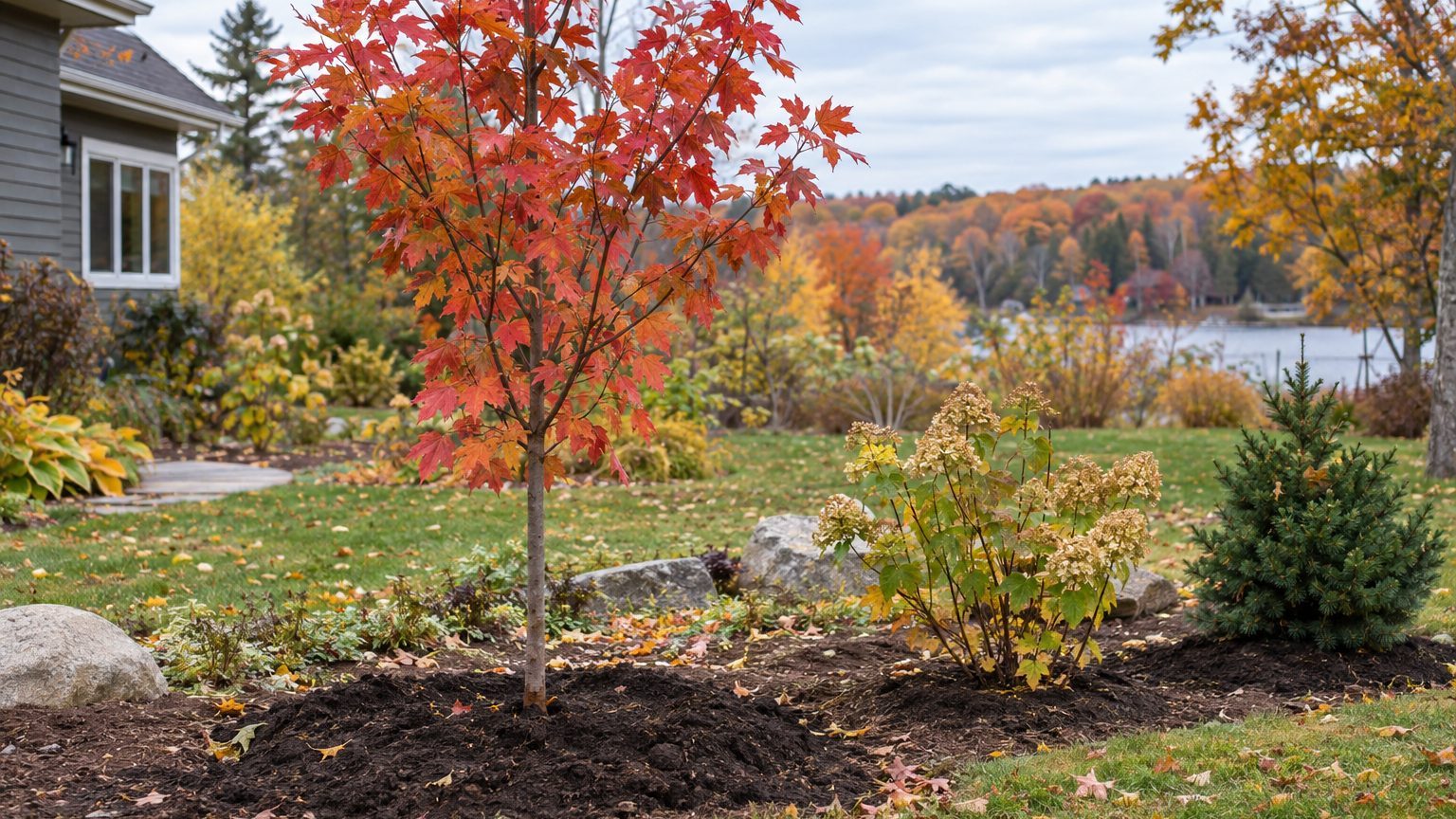

Aim to have trees and shrubs in the ground between September 6 and September 17, six weeks before the first fall frost in Salt Lake City, which NOAA’s 1991-2020 normals place between October 18 and October 29. That is the safe target, not a hard stop. Roots keep growing in workable soil well past the first frost, so a plant set in a little later can still make it. Each extra week costs some of its margin, and higher, colder ground runs out of time sooner.
The deadline in Utah
A tree’s roots and its branches run on different thermostats. Buds and leaves shut down when nights cool, but roots keep pushing into soil as long as it stays workable and above freezing. That gap is the whole reason fall planting works. The plant spends its energy underground while the top has nothing to feed.
Where the dates come from
Cornell Cooperative Extension states the rule this way: “Fall is an excellent time for transplanting, provided you get them to their new home at least 6 weeks before the ground freezes, allowing them time to establish roots before winter dormancy.”
The catch is that almost nobody tracks the date their own ground freezes. Air frost is the nearest public number, and the ground freezes later than the air does. NOAA’s NCEI 1991-2020 Climate Normals for the Salt Lake City station (USW00024127) put the first fall 32°F freeze in the 30 to 70 percent probability band between October 18 and October 29. Count back six weeks and you get a conservative deadline of September 6 to September 17. Write that range on the calendar. The true limit, frozen ground, usually arrives after the first frost, so a shrub planted a bit past the range has not missed the boat. It has simply used up its cushion.
Does the rule apply here? Yes, fully. The mean daily minimum of Salt Lake City’s coldest month is 24.2°F, according to the same NOAA normals. That is well below 32°F, so the ground does freeze. This is not a place where winter planting is the easy default.
Adjusting for elevation and region
Salt Lake sits in a mild valley. Most of Utah is higher and colder, and the direction of the adjustment is simple: colder ground gets its first frost earlier, so the planting deadline moves earlier too. A foothill bench or a mountain town should aim ahead of September 6, not behind it. Southern Utah is warmer, so frost comes later and the window stretches later, though there is no verified range to give you for it here. The USDA Plant Hardiness Zone Map (2023) runs from 4a to 9a across the state, which is one more sign that a single statewide date would be wrong for somebody.
To pin the timing to your own town, start with First and Last Frost Dates in Utah and count back from your local first-frost range. Other seasonal timing around the state lives in the Utah guides.
What to plant late, and what to wait on
Not every plant gets the same grace period. A tree that is fully hardy for your zone, and that arrives with its roots intact in a container or a burlapped ball, has the best odds of settling in. Its only job is to grow roots before the ground locks up, and cold soil does not stop that.
The good candidates
Hardy deciduous trees and shrubs are the safest fall bets. They drop their leaves, lose almost no water through the winter, and put their energy into roots right away. Container-grown plants carry an undisturbed root system, so they take the move well. Balled-and-burlapped trees have lost part of their roots in digging, so they lean harder on those fall weeks and on steady watering. Salt Lake City’s coldest-month minimum of 24.2°F is the benchmark for judging hardiness: if a plant is rated for colder than that in your zone, the winter itself is not the threat. Plants that can handle only a mild winter are the exception, and they belong in the next group.
The risky ones
Borderline plants, meaning those that are only marginally hardy where you live, need a full growing season to toughen up before they face a Utah winter. Evergreens carry a different problem. Their needles and leaves keep losing moisture on dry, sunny, windy winter days while cold soil cannot send water back up. An evergreen planted too late has too few roots to keep pace. Wait until spring on borderline-hardy plants and on evergreens that miss the September 6 to September 17 target.
| Plant type | Fall planting outlook | What to do |
|---|---|---|
| Hardy deciduous tree, container-grown | Good, even a little past the target | Plant, water deeply, mulch |
| Hardy deciduous tree, balled and burlapped | Good if planted inside the range | Aim for September 6 to September 17 |
| Hardy deciduous shrub | Good | Plant, then keep the root zone moist |
| Evergreen tree or shrub | Risky if late (winter water loss) | Plant inside the range or wait for spring |
| Borderline-hardy plant | Poor | Wait until spring |
The broader mechanics of getting a plant into the ground, from hole width to root flare, are covered in Planting and Caring for Trees, Shrubs and Perennials.
Watering and mulch until the ground freezes
The first winter is about roots, not growth. A newly planted tree may show nothing above ground for months, and that is the right outcome. Everything it has is going into a root system wide enough to feed it next summer. Pushing top growth with extra fertilizer or heavy pruning in fall works against that.
Water deeply, then keep going
Water slowly enough that it soaks down instead of running off, and do it again whenever the soil around the root ball has dried out. A nursery root ball is a small block of soil sitting in a larger hole, and it can dry out while the surrounding ground still feels damp. Utah falls can run dry, and dry soil freezes harder and pulls moisture out of roots. Keep watering until the ground actually freezes, not until the leaves drop. Dormant roots still drink.
Mulch in a ring, not a volcano
Mulch evens out soil temperature and slows evaporation, both of which matter more in a first winter than in any later one. NC State Extension’s Gardener Handbook gives two figures for depth. On weeds: “A 2-inch to 3-inch layer of mulch suppresses most annual weed seeds and makes it easy to hand-pull any that do germinate.” On trees: “Provide a 3-inch layer of mulch to reduce water loss and maintain uniform soil moisture and temperature around roots.” Both point to the same order of depth, and a 2-inch to 3-inch layer, spread in a ring, is the number to keep in mind.
More is not better. Mulch piled against the trunk in a cone, the so-called volcano, holds moisture against the bark, invites rot and hides the root flare. Spread it wide, let it thin out toward the trunk, and keep it clear of the bark itself. A fuller walk-through is in Mulching Without Killing the Plant.
What goes wrong
Planting too late for the climate
The most common mistake is also the simplest one. Trees go in after the six-week window and the ground freezes before roots have gained any hold. The plant is not dead on arrival, but it enters winter with a root system barely larger than the one it came with. Colder spots feel this first, since their deadline falls earlier than the Salt Lake City range. Gardeners comparing climates can set this against How Late Can You Plant Trees and Shrubs in Fall in New York?, where the same six-week logic meets a different frost calendar.
Winter burn and heaving
Evergreens that go in late often turn brown and bronze by late winter. This is winter burn: sun and wind pull water from needles faster than frozen soil can resupply it. A planting inside the target range, steady watering and a mulch ring reduce the odds, but only a root system can really fix it.
Heaving is the other late-season trap. Salt Lake City’s coldest-month minimum of 24.2°F means freezing nights, and where nights freeze and days thaw, soil expands and contracts. A shallow, loosely planted root ball can be pushed upward a little at a time until roots are exposed. Plant at the right depth, firm the soil and keep mulch in place.
Then there is the dry fall, which catches people because the weather feels easy. Cool days and no rain look like perfect planting weather, and the soil quietly dries out. Water through a dry fall until the ground freezes, even when the plant looks fine.
Common questions
Can I still plant trees in Utah in October or November?
Sometimes. The safe target is September 6 to September 17, but the real limit is when the ground freezes, which comes later than the first fall frost (October 18 to October 29 in Salt Lake City). A hardy, container-grown deciduous tree planted past the target can still root in, provided the soil is workable. Water it, mulch it, and accept a higher risk than an earlier planting carries. Evergreens and borderline plants are better held until spring.
Does the six-week rule count from the first frost or from frozen ground?
Cornell Cooperative Extension counts it from when the ground freezes. Because backyard ground-freeze dates are hard to find, the Utah target here counts six weeks back from the first fall frost, an air-temperature date. That makes it a conservative deadline, since the ground freezes later than the first frost.
Do higher elevations in Utah need a different deadline?
Yes, an earlier one. Salt Lake sits in a mild valley, and most of Utah is higher and colder. In those places the first fall frost comes sooner, so the date to plant by moves earlier than September 6 to September 17. Southern Utah is warmer, so the window runs later there.
Is fall better than spring for planting trees and shrubs?
For hardy deciduous trees and shrubs planted inside the window, fall gives roots a head start before the next growing season. Spring remains the better choice for evergreens that miss the target and for borderline-hardy plants, which need a full season to prepare for winter. Neither season works without deep watering and a mulch ring of 2 to 3 inches.