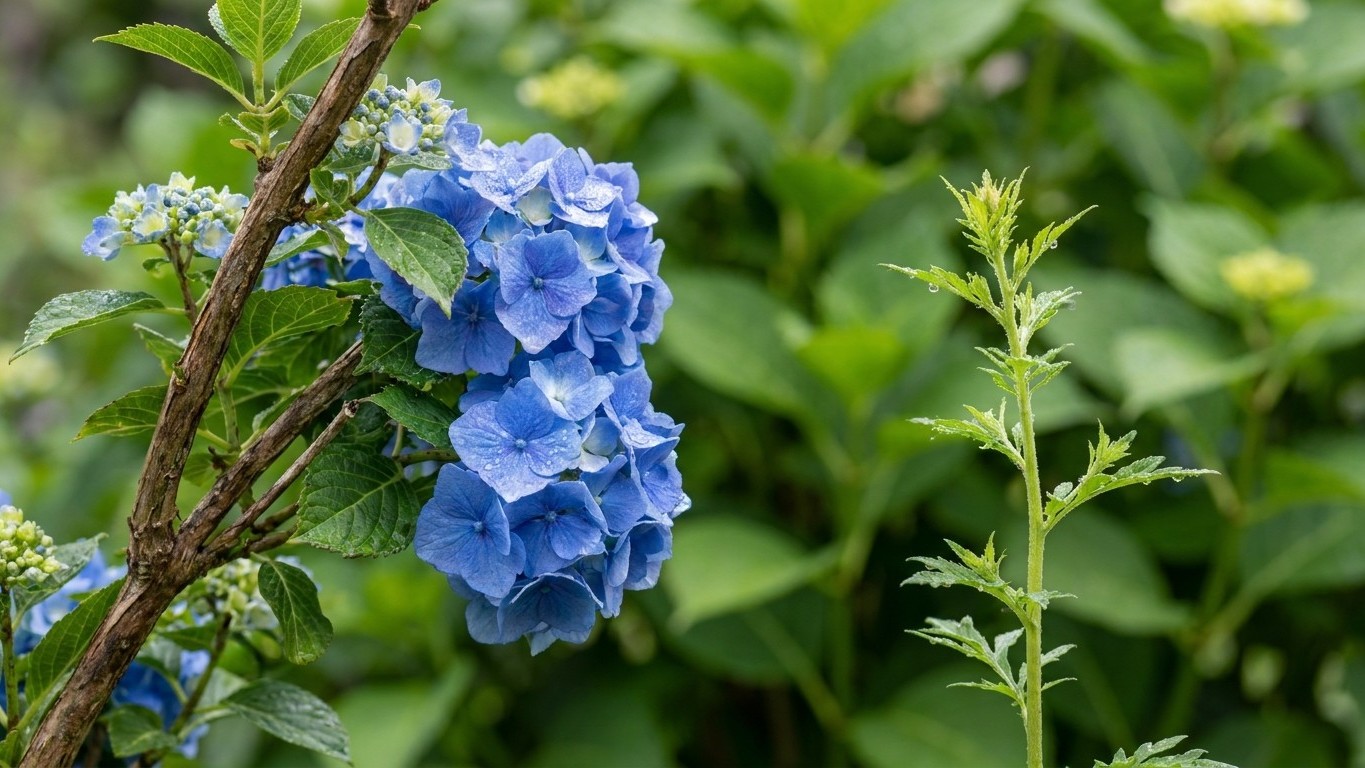

Pink hydrangeas are what most California gardens produce on their own, because the soil and the irrigation water lean neutral to alkaline. In that chemistry the plant can’t take up aluminum, and aluminum is what turns the pigment blue. Getting blue means lowering the soil pH around the roots and keeping phosphorus low. It’s a slow job, but a doable one, especially in a container.
What this comes down to in California

In Los Angeles, the reference city for this page, no freeze occurs in an average year: NOAA NCEI’s 1991-2020 Climate Normals list a frost-free season of 365 days. Cold has nothing to do with bloom color here, and soil chemistry settles it. The same goes for much of coastal and southern California, though not for the whole state (more on that below).
The pigment is the same, the aluminum is not
Bigleaf and mountain hydrangeas make one pigment. When aluminum ions reach the flower, they bind to it and the sepals shift from pink toward blue. When aluminum stays locked in the soil, the flowers stay pink or red. Aluminum is abundant in nearly every soil, but it dissolves into a form roots can absorb only when the soil is acidic. Push the pH up and it drops out of reach.
Much of California’s ground and tap water pushes the pH up. Dry climates leach fewer minerals out of the soil, so alkaline salts build up. Irrigation water carries more of them. Add lime from nearby concrete and stucco, plus a bag of all-purpose fertilizer heavy in phosphorus, and you have a pink machine.
Where the colors fall on the pH scale
These ranges are rough guides, and individual plants vary. Treat them as targets to test against, not guarantees.
| Soil pH (approximate) | Aluminum availability | Typical bloom color |
|---|---|---|
| Below about 5.5 | High | Blue |
| About 5.5 to 6.5 | Partial | Purple, or a mix of blue and pink on one plant |
| Above about 6.5 | Very low | Pink to red |
One limit applies before anything else. White hydrangeas don’t respond, and neither do panicle or oakleaf types, which carry no pigment that reacts to aluminum. If you’re after blue, you need a bigleaf or mountain hydrangea that came in as pink, blue or purple. The general care for those plants is covered in the guide to growing hydrangeas in California.
Working it out for your own garden
Start with a soil pH test, because guessing is how people burn roots. A home probe gives a rough number. A lab test through a garden center or a university-affiliated lab is more reliable, and it’s cheap compared with a plant you’ve had for years. Sample from the root zone, a few inches down and away from the trunk of the shrub, not from the surface where fertilizer has pooled.
Next, find out what’s coming out of your hose. Most California water utilities publish an annual water quality report, and the hardness and alkalinity numbers in it matter more than they look. Hard, alkaline water raises the soil pH a little with every watering. In a pot, it can undo your work within a season.
Then do the gap arithmetic. Say your test reads 7.4 and you want 5.4. That’s two full pH units, and because the scale is logarithmic, two units is a hundredfold change in acidity. A single dose of anything won’t get there in clay soil, which resists change. A raised bed or large container, where you control the mix, gets there much faster than a planting in the ground.
For the actual change, you have two main tools:
- Soil sulfur acidifies slowly as soil microbes convert it, so it works over months and is gentler on roots.
- Aluminum sulfate acts faster and also supplies aluminum directly, but it can scorch roots and add salts. Follow the label rate, and water it in well.
- Low-phosphorus fertilizer keeps phosphorus from tying up aluminum inside the plant. Look for a low middle number on the bag.
Expect to wait. Flower buds are already set by the time you treat, so the first visible shift usually shows up on the next round of blooms, and a full change can take a season or more. Retest the soil at the end of that season, and adjust from the reading rather than from the calendar. If you do any cutting back, check When to Prune Hydrangeas in California first, since removing the wrong stems removes the buds you’ve been working toward.
What changes across the state
California isn’t one climate, and it isn’t one soil. The USDA Plant Hardiness Zone Map (a system built on a single variable, the average annual extreme minimum temperature) puts the state anywhere from zone 5a to 11a. That range tells you how much the state varies, and Los Angeles is only one reference point inside it.
Soil chemistry follows geography. Wetter, cooler parts of the north coast, with their conifer forests and heavy rainfall, tend toward acidic soil, so blue comes easier there. Many Sierra foothill soils formed from granite and run on the acidic side too, though local variation is wide. The Central Valley and the desert-edge regions swing the other way, with alkaline soils and hard irrigation water that make pink the default and blue a constant fight.
Water matters as much as dirt. A coastal city drawing from a mountain reservoir may deliver soft water. A valley town pumping groundwater may deliver water loaded with minerals. Two neighbors a county apart can face opposite problems.
Cold does come into play outside the frost-free coast. Northern California, the Central Valley and the Sierra all freeze, and a hard freeze can kill the flower buds on bigleaf types, which bloom on old wood. In those areas, color is a second concern after getting buds through winter, a topic covered in Protecting Hydrangeas Through a California Winter. In the frost-free south, the main issue is the opposite: heat and water limits, and a soil mix that dries out fast.
The mistakes this state punishes

Treating without testing is the most expensive one. Gardeners read that aluminum sulfate makes hydrangeas blue, scatter it across alkaline clay, and burn the roots without moving the pH much. Test first, then apply in modest amounts, and split the application rather than dumping it all at once.
A close second is the wrong fertilizer. A standard all-purpose or bloom-booster blend is high in phosphorus, and it quietly cancels your effort every time you feed. Switch to a low-phosphorus formula before you touch the soil.
Planting right beside concrete causes slow trouble. Foundations, walkways and stucco walls leach lime into adjacent soil, and over the years the pH creeps up. A hydrangea tucked against a wall may turn pink no matter what you do. Set it a couple of feet out, or grow it in a container.
Water restrictions create a quieter problem. With less irrigation, salts accumulate in the root zone instead of flushing through. Heavy aluminum sulfate use adds to that load. Deep, infrequent soakings and a thick layer of mulch help, and so does using rainwater when you can collect it, since it’s naturally slightly acidic and low in minerals.
Finally, don’t chase blue with a hydrangea that can’t deliver it. A white or panicle variety will stay what it is. If you want blue, buy a bigleaf already blue-flowering, or start with a pink one you’re willing to work on for a season.
Checking this against your county
A statewide pattern is a starting point, not an instruction for your yard. Your soil, your water and your microclimate can differ from the next block’s, never mind another county’s. The local office of University of California Agriculture and Natural Resources can point you to soil testing services, water quality data and advice written for your area. For the rest of the care routine, the state guide to growing hydrangeas in California covers what this page leaves out.
Common questions
Do white hydrangeas turn blue if I acidify the soil?
No. White flowers lack the pigment that reacts with aluminum, and panicle and oakleaf types don’t use it either. Acidifying the soil won’t change them, and it may stress the plant.
How long does it take to turn a pink hydrangea blue?
Plan on a full growing season or more. Buds already formed keep their color, and new blooms show the change. Container plants respond faster than those in the ground, and clay soil is the slowest.
Do coffee grounds or rusty nails work?
Neither is reliable. Used grounds are close to pH neutral and contribute little, and nails won’t add meaningful aluminum. Soil sulfur or aluminum sulfate, paired with a pH test, gives results you can measure.
Will a blue hydrangea turn pink again?
It can. If alkaline tap water or lime leaching from concrete lifts the soil pH, aluminum becomes unavailable again and the flowers drift back toward pink. Blue takes maintenance, so recheck the soil each year.