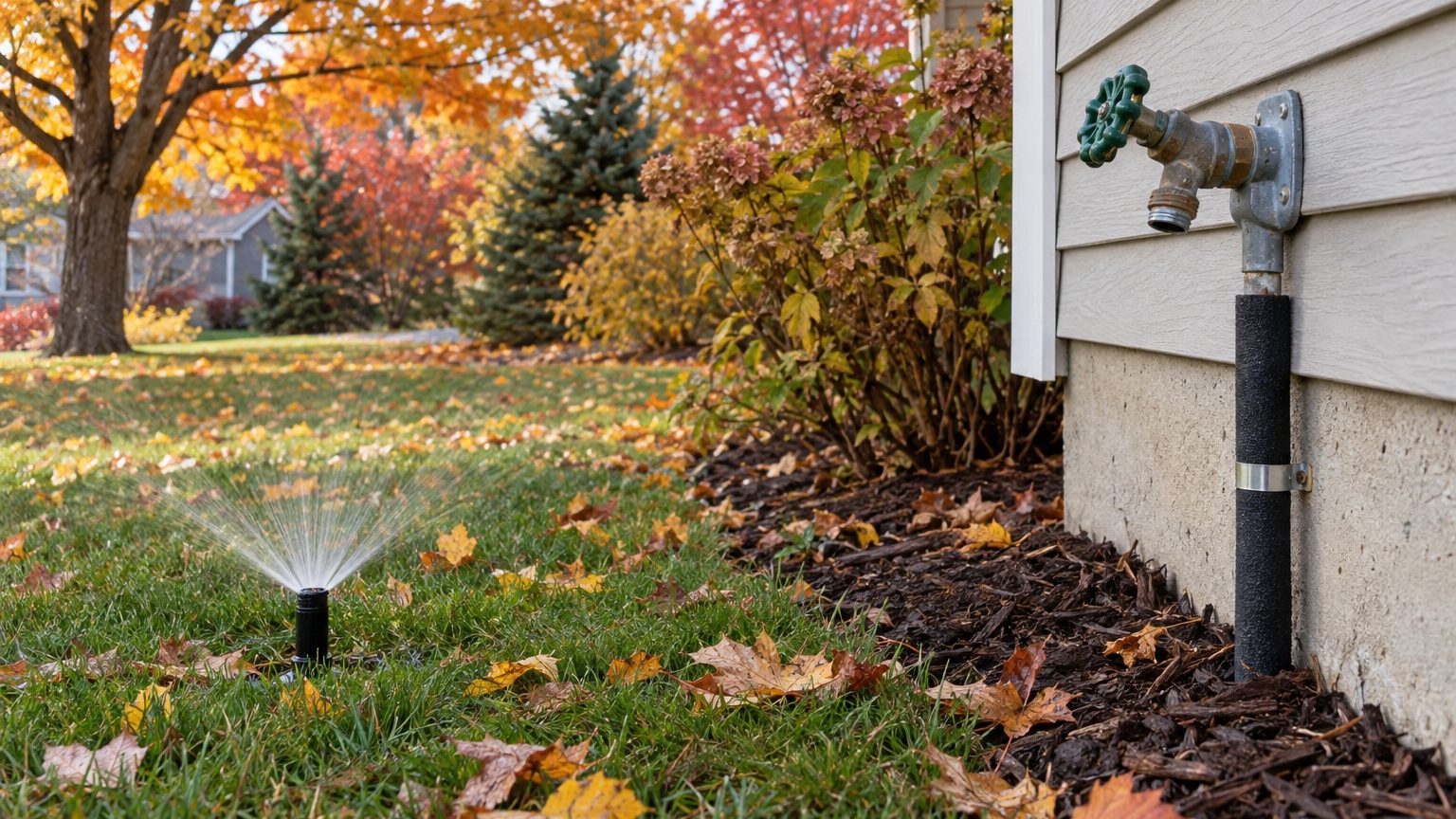

Rhode Island sprinkler systems and outdoor faucets need to be shut down before the first hard freeze, and the clock for that starts in October. NOAA’s 1991-2020 normals for the Providence airport station put the first fall frost between October 24 and November 3. Yards inland or on higher ground usually get there sooner. With that window still ahead, early October is a sensible time to begin, and a week or two of margin costs you almost nothing.
When to do it in Rhode Island
Plan to finish the sprinkler and faucet work before the first-frost window of October 24 to November 3, the range NOAA’s 1991-2020 normals give for the Providence airport station. The rule is before the first hard freeze, not after the first light one.
Those dates come from NOAA NCEI U.S. Climate Normals, which track the odds of a 32°F reading. October 24 to November 3 is the band where those odds run between 30 and 70 percent. That is the stretch when a frost goes from possible to likely, which is different from a date the cold promises to show up on. Some years it arrives early in the window, some years later, and a few nights can land ahead of it.
A full blowout is not optional here. The same NOAA normals (reference station: Providence) put the mean daily minimum of the coldest month at 22.1°F. That is the typical overnight low in January or February, not a record cold night, and it sits well below freezing. In a place where winter lows hover just above 32°F, you might get away with insulating an exposed backflow device and little else. Rhode Island gives water left in a line months of subfreezing nights to turn to ice, so the whole routine applies: clear the sprinkler lines, shut off and drain every outdoor faucet, bring the hoses in.
Why the first hard freeze is the line
A light frost, the kind that whitens the lawn and is gone by mid-morning, mostly touches things at the surface. Buried pipe sits in soil that holds heat longer than the air does. What a light frost can reach are the exposed parts: the above-ground backflow assembly, the fittings near it, the hose bibs on a north-facing wall. A hard freeze is different. It holds for hours, and the cold works into everything that has water in it.
Treating that first light frost as your alarm is a gamble on the order of events. It works if the hard freeze politely waits its turn. Nothing guarantees it will. Draining a few days early, on the other hand, costs only a few days of watering a lawn that is already slowing down for the season.
Adjusting for your own address
The October 24 to November 3 range is the Providence airport figure, a single reference point and not a statewide guarantee. Suburban and rural yards typically see the first fall frost earlier than an airport does, often by one to two weeks, and more at elevation. So the farther north and west you are, or the higher your lot sits, the earlier you should be done: ahead of the window, not inside it. Check frost dates for your own county, or watch the low on your own porch thermometer through October.
The USDA Plant Hardiness Zone Map (2023 edition) lists Rhode Island at 6a-7b, a territory-wide range. Zones are built on the average annual extreme minimum, which tells you what a shrub will survive. They say little about when a pipe needs draining, so the frost date is the better dial for this job. Other fall chores run on a similar clock, and Winterizing a Lawn covers the grass side of it. The Rhode Island guides collect the other seasonal timing questions for the state.
Sprinkler lines: drain or blow out
Water doesn’t shrink when it freezes. It expands, and a closed pipe has nowhere to put the extra volume. Something gives: a PVC fitting, a valve body, the housing of a spray head, the brass of a backflow preventer. The damage is quiet. You won’t see a thing until the system is pressurized in spring, and then a hairline crack becomes a geyser at the lawn edge or a zone that won’t build pressure at all.
The weak points are predictable. Valves and the backflow assembly hold water in a small chamber and often sit above ground or in a shallow box. Low spots in the piping collect water that gravity can’t pull any farther. Heads at the end of a zone can hold a little each. A system can be mostly empty and still lose one valve.
Three ways to clear the lines
Manual drain valves sit at the low points of the system. You open them after shutting off the water supply, and gravity does the work. Automatic drain valves are spring-loaded, opening on their own when line pressure drops. Compressed-air blowout uses a compressor connected to the system to push water out through the heads, zone by zone. Each has a place, and they are not equal in a climate where the coldest month averages 22.1°F overnight (NOAA NCEI Climate Normals 1991-2020, Providence).
| Method | How it works | Where it falls short | Fit for Rhode Island |
|---|---|---|---|
| Manual drain | Open low-point valves; gravity empties the lines | Only drains what slopes toward the valve; pockets stay full | Fine if the system was built for it and you know where every valve is |
| Automatic drain | Valves open when pressure drops | Can stick, clog with grit, or sit where water can’t reach them | Reasonable backup, not a plan on its own |
| Compressed-air blowout | Air pushes water out of every zone | Wrong pressure or volume can damage heads and fittings | The dependable choice for winters this cold |
My view: with winter lows this far under freezing, blowout is the method that matches the climate. Drain valves are good insurance, and some systems rely on them well enough, but a stuck valve or a pocket of water is exactly what a Rhode Island January finds. Air gets water out of places gravity can’t reach.
Doing it, and knowing when not to
The sequence matters. Shut off the water supply to the irrigation system first. Set the controller to its off or rain setting so it doesn’t try to run a zone. Connect the compressor at the blowout port, wear eye protection, and work through the zones one at a time in short bursts, cycling through them more than once until only mist comes out of the heads. Never let air run through a single zone for a long stretch, because the heads depend on water for lubrication and cooling. Finally, drain the backflow assembly by closing its shutoff valves and opening the test cocks, leaving them partly open for the winter so any last drops have room to expand.
Many people hit a snag at the compressor. Blowout depends on enough air volume, at a pressure the system manufacturer says the components can take. A small tool compressor often lacks the volume, and cranking the pressure to compensate is how fittings get blown apart. A licensed irrigation professional is the sensible call if you don’t own or can’t borrow the right equipment, if the system has many zones or long runs on a slope, if the backflow device is buried or you can’t find the shutoff, or if you’ve simply never done it. A call in early October beats one placed the morning after a frost. Either way, the decision to write down: a compressed-air blowout of every zone, finished ahead of the October 24 to November 3 first-frost window, and earlier if you are inland or on higher ground.
Outdoor faucets and hoses
Faucet shutdown is a five-minute job per spigot, and it only involves turning things. Start by disconnecting every hose, along with splitters, nozzles, and timers. Then find the interior shutoff valve for that faucet, usually in a basement, crawlspace, or utility room, and close it. Go outside and open the faucet fully so the line drains. If the interior valve has a small bleeder cap, open it over a bucket to let the last water out, then close it. Leave the outside faucet open for the winter.
If you can’t find the interior valve, can’t tell which valve serves which spigot, or find a valve that leaks or won’t turn, stop there and call a plumber. Cutting pipe, replacing a stem or washer, soldering, or swapping a faucet for a new one is plumber’s work, not fall maintenance. A Winterizing Outdoor Faucets Before the First Freeze walkthrough goes deeper on the standard faucet if you need it.
Why a frost-free faucet still fails
A frost-free hose bib has a long stem, so the valve seat sits inside the heated part of the house, not at the outside spout. When you shut it off, water in the barrel is supposed to drain out through the spout, which works only if the barrel tilts slightly downward and nothing blocks the outlet. A hose attached to the spout blocks it. So does a nozzle left closed on the end of the hose, or a splitter with its valves shut. The water stays in the barrel, in the stretch of pipe that is outside the warm zone, and when it freezes it splits the pipe.
The cruelty of this failure is where it happens. The split is often inside the wall, behind the part you can see. Nothing leaks in winter because the ice plugs the crack. Then in spring you turn the tap on and water sprays into the wall cavity, or drips from a basement ceiling. If you have one of these, read Frost-Free Outdoor Taps and treat the hose as the one thing that defeats the design.
Foam faucet covers are fine as a supplement. They aren’t a substitute for draining, and they do nothing for a faucet with water trapped in it. The decision to write down: hose off, interior valve closed, outside tap left open, at every spigot on the property, before the October 24 to November 3 window opens.
What goes wrong here
The most common failure is mundane: nobody got to it. The Providence frost band is a range of odds, not a deadline, and inland yards run colder. A stretch of cold nights can land ahead of the date you had in your head. The spring signature is a sprinkler zone that won’t pressurize, a geyser at one head, a soggy patch where no rain fell, or a cracked backflow body that sprays when the water comes on. Prevention is mostly calendar discipline: start in early October, not at the end of the window. If a forecast shows a night at or below 32°F before the job is done, drain the exposed backflow assembly and valves first, since that is the part most likely to be hit.
Second is the forgotten hose. Most properties have more spigots than anyone remembers: front, back, garage, the one behind the shrubs, the one on the side of the shed. One hose left attached to a frost-free bib is enough. In spring the faucet seems to work, then drips from inside the wall, or a damp spot appears on the basement ceiling below it. A quick walk around the house with a short mental count, every spigot and every hose, takes longer to describe than to do. When a pipe does freeze, Frozen Pipes covers what to do next.
Third is the flooded valve box. The in-ground box at the lawn edge that holds the zone valves can fill with water from rain or snowmelt, and a valve sitting in water that isn’t drained freezes along with it. Spring shows up as a valve that weeps, a zone that won’t shut off, or a solenoid that no longer clicks. Lift the lid in fall, clear out soil and debris, and note whether water is standing in it. If it is, drainage is a job for an irrigation professional, not a reason to leave the lines full.
Common questions
Is a light frost enough to damage sprinkler lines?
Rarely by itself. A light frost mostly reaches exposed parts like the backflow assembly and above-ground fittings. The risk is that you can’t tell a light frost from the leading edge of a hard freeze, and a hard freeze can follow soon after. Treat the first light frost as the point where the work is already late.
Can I wait until November?
At the Providence airport station, the first-frost range runs October 24 to November 3, and colder inland and higher spots hit it sooner. Waiting into November means being past the window for much of the state. Finishing in October is safer, and early October leaves room if the forecast turns.
Do automatic drain valves replace a blowout?
They help, but they can stick, clog, or sit where water doesn’t reach them. In a state where the coldest month’s mean daily minimum is 22.1°F (NOAA NCEI Climate Normals 1991-2020, Providence), a blowout is the reliable step, and drain valves are the backup.
Does a frost-free faucet need any fall attention?
Yes, one thing: remove the hose, and any splitter or nozzle. Left attached, the hose traps water in the barrel and the faucet’s drainage design stops working. The failure usually appears in spring as a leak inside the wall.