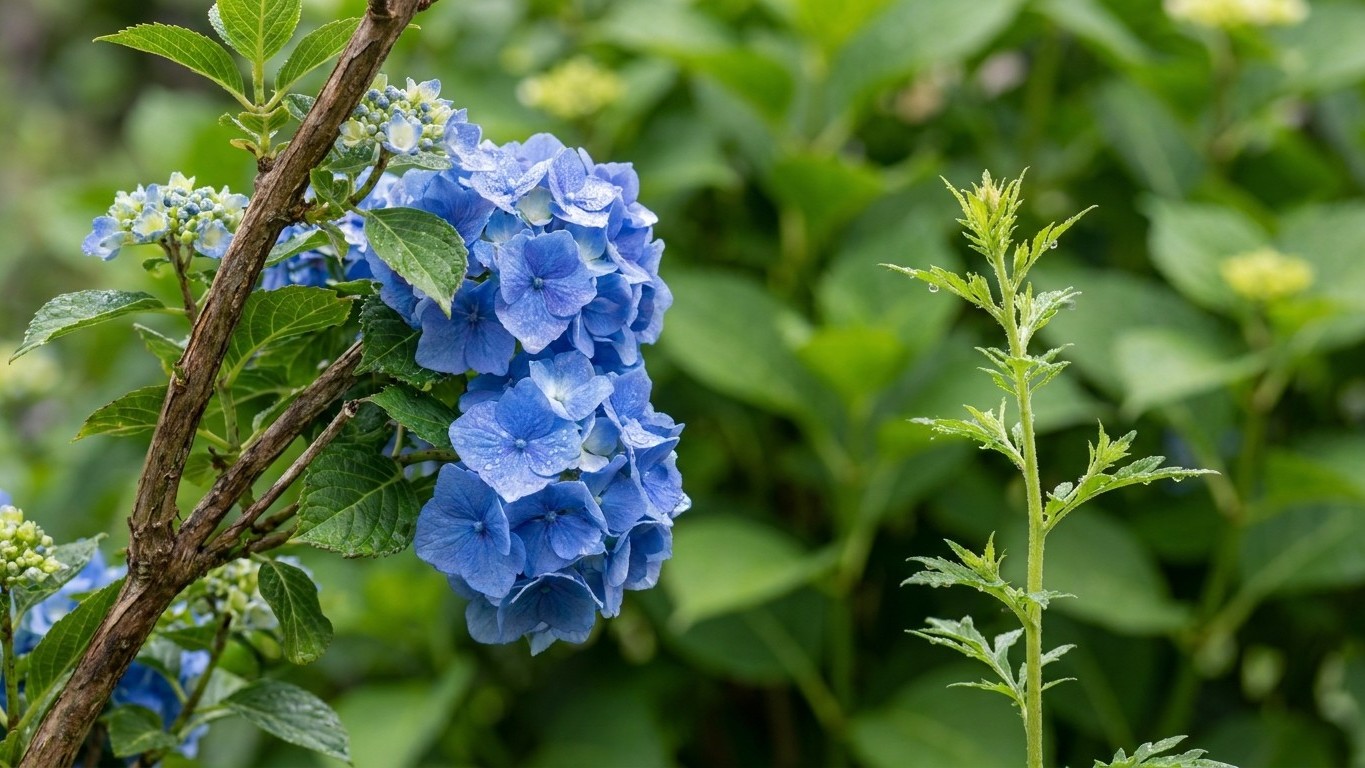

Yes, hydrangeas grow in Nevada, but the state decides which kind you can grow and where you put it. Panicle and smooth hydrangeas handle cold and strong sun best. Bigleaf types need afternoon shade, steady moisture and some winter protection. Planting happens in spring after your last frost or in early fall, and those dates differ by months between the Las Vegas valley and the high country. Color depends mostly on soil chemistry, and Nevada soil leans against blue.
When to plant Hydrangeas in Nevada

Nevada has no single planting date, and anyone who gives you one is guessing. The only frost numbers we can cite come from the Las Vegas airport station. NOAA’s 1991-2020 U.S. Climate Normals put the 30-70% probability band for the last 32°F freeze between January 7 and February 1, and the first fall freeze between December 8 and December 23. Those dates describe a desert urban heat island, the warmest extreme in the state. They are not a planting window for Nevada as a whole.
Reno, Carson City and every foothill or mountain town freeze months earlier in fall and months later in spring than that airport does. The practical move is to get the average last spring frost for your own county from University of Nevada, Reno Extension and build your schedule from that date. Everything below is arithmetic on that one number.
Seeds, cuttings and nursery plants
Starting hydrangeas from seed is a poor use of a windowsill. Named varieties do not come true from seed, and seedlings can take years to bloom. Most Nevada gardeners buy a container plant, or root softwood cuttings in early summer and grow them on in pots for a full season before planting out. Treat the potted cutting as your “seedling” and count back from the planting date like any transplant.
Hardening off
A plant raised in a greenhouse, a nursery shade house or a bright indoor window has never felt Nevada’s dry wind or thin high-elevation sunlight. Harden it off over 7 to 10 days. Start with two hours of morning sun in a sheltered spot, add an hour or two a day, and leave it out overnight only once the nights are staying above freezing.
The count-back arithmetic
Here is the math, using a placeholder date that is not a Nevada figure. Say your county office gives an average last frost of May 15. Panicle and smooth hydrangeas can go in about a week after that, so your transplant date is May 22. Subtract a 10-day hardening-off period and the plant goes outside for the first time on May 12. A rooted cutting that needs a season in a pot would have been started the previous June. Swap in your own frost date and the schedule rebuilds itself.
Fall planting works the same way, counted back from the first fall freeze. Many gardeners prefer it in the lower, hotter parts of the state, because roots establish through cool autumn soil and the plant meets its first summer with a head start. Finish planting in early fall, well ahead of the ground freezing, so roots have weeks to grow before winter. In the coldest high-elevation areas, spring is the safer choice. The Growing Hydrangeas in Idaho: Types, Colour and Winter guide shows how that spring-first logic plays out in a similar high-desert state.
Soil and site preparation
Site matters more than anything you add to the soil. Hydrangeas want morning sun and afternoon shade, which in Nevada usually means the east side of a house or fence, or the dappled edge of a tall deciduous tree. A west-facing wall in July is a poor home for a bigleaf hydrangea, because reflected heat and dry air scorch the leaf margins faster than any hose can compensate. Panicle types tolerate more sun, but even they appreciate relief from late-day heat in the southern valleys.
Soil texture and drainage come next. Hydrangeas like moisture but not wet feet, and many Nevada yards swing between sandy, fast-draining soil and compacted clay with a hard layer below. In the south, that layer is often caliche, a cemented band of calcium carbonate that water cannot pass. Test before you plant. Dig a hole about a foot deep, fill it with water, and let it drain. Fill it again the next day. If water is still standing the following morning, build a raised bed or plant on a broad mound.
Amendments, weeks ahead
Prepare the bed a month or more before planting if you can. Spread 2 to 3 inches of finished compost over the entire planting area and work it into the top 8 to 12 inches, not just the hole. Amending only the hole creates a pot-shaped pocket where roots circle and water collects. Compost improves both sandy soil (it holds water) and clay (it opens the structure), and it gives the soil a buffer against the salts common in desert irrigation water.
If you want to push soil acidity for bluer bigleaf blooms, test first. Sulfur is slow, taking months to shift pH, which is one reason to apply it in fall for a spring planting. Overdoing it can damage roots. Desert and basin soils tend to run alkaline, so consider growing bigleaf varieties in containers where you control the mix.
Spacing and planting day
Dig the hole about twice as wide as the root ball and no deeper, so the crown sits level with the surrounding soil. Loosen circling roots with your fingers. As a rule of thumb, give panicle types 4 to 6 feet of room, smooth hydrangeas 3 to 5 feet, and bigleaf types 3 to 4 feet. Crowding reduces airflow, and dense foliage invites powdery mildew when irrigation hits the leaves. Water slowly and deeply after planting, then lay mulch.
Varieties that suit Nevada
For a shrub, the traits that matter are when the plant forms its flower buds, how cold-hardy those buds are, how much sun it takes, and how its color responds to alkaline soil. Bloom timing is the big one. Hydrangeas that flower on new wood, growth made this spring, survive a late freeze or a hard winter and still bloom. Those that flower on old wood, last year’s stems, can lose an entire season of flowers when a cold snap kills the buds.
| Type | Blooms on | Sun tolerance | Good for in Nevada |
|---|---|---|---|
| Panicle (H. paniculata), such as Limelight, Quick Fire, Little Lime, Bobo | New wood | Highest of the group; afternoon shade still helps in hot valleys | The most reliable choice for cold winters and unpredictable springs; size options from compact to large |
| Smooth (H. arborescens), such as Annabelle, Incrediball | New wood | Moderate; prefers shade in heat | Cold-hardy and easy to cut back; Incrediball is bred for sturdier stems than the floppy older Annabelle |
| Oakleaf (H. quercifolia), such as Snow Queen | Old wood | Moderate | Handles drier conditions than bigleaf and gives fall leaf color; wants shelter in the coldest areas |
| Bigleaf (H. macrophylla), such as Endless Summer | Old wood, with some rebloomers also using new wood | Low; needs afternoon shade | The classic mophead color; best in sheltered, milder sites or in containers |
For most Nevada yards, start with a panicle. Limelight is one of the most widely sold, turns from lime to cream to pink-tinged as it ages, and holds its heads upright. Quick Fire opens early and blushes red, which suits shorter seasons. Bobo and Little Lime stay compact and fit small beds or large pots. They all bloom on new wood, so a spring freeze that nips the tips still leaves flowers coming.
Bigleaf varieties are the ones people fall in love with at the nursery and then struggle with. The rebloomers sold under names like Endless Summer give you a second chance, because they can set flowers on new growth if the old-wood buds are lost. In colder parts of the state, treat them as a gamble worth protecting with mulch and a wind break. The Growing Hydrangeas in Tennessee: Types, Colour and Winter guide covers a wetter climate where humidity and disease matter more than drying wind.
What about color?
White hydrangeas stay white. Pink and blue are a chemistry trick limited mainly to bigleaf types, controlled by how much aluminum the plant can absorb. Blue flowers need acidic soil that releases aluminum. Alkaline soil locks it up and gives you pink or mauve. Because much of Nevada’s soil leans alkaline, a blue variety planted in the ground often drifts pink within a season or two. If blue matters to you, plant in a container with acidic potting mix, or accept the pink.
What to plant alongside
The best neighbors share the hydrangea’s needs: partial shade, regular water and rich soil. Hostas are the standard pairing, since their broad leaves shade the soil around the hydrangea’s roots and cut evaporation. Ferns, coral bells (heuchera), astilbe and Japanese forest grass fill the same niche with different textures. Sweet woodruff or other low ground covers keep weeds out, provided you keep them from smothering the hydrangea’s base.
Daffodils and alliums bloom before the hydrangea leafs out, then their fading foliage disappears under its canopy. Evergreen shrubs such as boxwood make a dark backdrop for pale panicle blooms and provide a little wind shelter. For pollinators, the fertile flowers of panicle, smooth and lacecap types draw bees and small flies, while the big sterile mopheads offer much less.
Avoid neighbors that want the opposite of what a hydrangea wants. Lavender, rosemary, sage, agave and most xeric plants need dry feet and lean soil, and planted within reach of a hydrangea’s irrigation, they rot. Keep them on a separate irrigation zone. Large shallow-rooted trees compete for water and nutrients, so keep hydrangeas out of the heart of their root zone. Roses share a vulnerability to powdery mildew, so give both room for airflow.
Some popular pairings have no good evidence behind them. There is little proof that marigolds or garlic protect hydrangeas from insects, and coffee grounds do not shift soil chemistry enough to turn flowers blue, certainly not in alkaline soil.
Watering, feeding and support
Water deeply and less often rather than a little every day. A slow soak that reaches 8 to 12 inches down encourages roots to follow, while daily sprinkles keep them shallow and vulnerable. New plants need water several times a week through their first summer. Established shrubs can usually go a few days between deep soaks in summer heat. A midday droop that perks up by evening is normal. A plant still limp the next morning is thirsty.
Drip irrigation suits hydrangeas well. It keeps water off the leaves, which helps against mildew, and it delivers water at the root zone with less evaporation. Desert irrigation water also carries salts, so every so often give the bed a long, slow soak to flush them below the roots. Brown, crisped leaf edges that persist despite adequate watering can point to salt buildup.
Mulch and feeding
Mulch is the single most useful habit in a dry climate. Spread 2 to 3 inches of shredded bark, compost or leaf mold over the root zone, pulled back an inch or two from the stems to prevent rot. It slows evaporation, moderates soil temperature and feeds the soil as it breaks down. Refresh it each spring.
Feed lightly. One application of a balanced slow-release fertilizer as growth starts in spring is enough for most plants, with perhaps a second in early summer. Stop feeding by midsummer. Late nitrogen pushes soft new growth that the first fall freeze will burn, and too much nitrogen in general gives you leaves instead of blooms.
Pruning and support
Pruning rules follow bloom timing. Panicle and smooth hydrangeas bloom on new wood, so cut them back in late winter or early spring, before growth starts. Take panicles down by about a third for strong stems, and smooth types can be cut harder. Bigleaf and oakleaf types bloom on old wood, so prune right after flowering and only lightly. Remove dead stems in spring once you can see which ones leaf out. Cutting a bigleaf back hard removes the flower buds you were waiting for.
Staking matters mostly for heavy-headed smooth types and after a summer thunderstorm. A ring of stakes and soft twine, or a peony-style grow-through hoop set in early spring, holds stems up without strangling them.
Common problems

Most hydrangea trouble in Nevada traces back to water, sun or soil rather than disease. Read the symptom first and the cause usually follows.
Leaf and bloom symptoms
Brown, crispy leaf edges point to heat, wind or salt. Move the plant, add shade cloth in summer, or deepen the watering. Yellow leaves with green veins are iron chlorosis, common in alkaline soil, where iron is present but locked up. A chelated iron product gives a short-term fix, and acidifying the soil is the longer one. Midday wilting that recovers by evening is normal heat stress. A plant that stays flat in the morning is either under-watered or, if the soil is soggy, drowning.
No flowers at all is the most common complaint. Check the pruning first, since a bigleaf cut back in the wrong season loses its buds. Then think about late frost, which can kill the buds on old-wood types, and about too much shade or too much nitrogen. Panicles that fail to bloom are usually short on sun. White or gray powder on the leaves is powdery mildew. Improve airflow, water at the base and clear fallen debris. It looks bad but rarely kills the plant.
Insects
The University of Nevada, Reno Extension Pest Solutions page highlights squash bugs, aphids, Mormon crickets, hornworms, cabbage moths, earwigs, shield bugs, elm leaf beetles and Japanese beetles for home gardens. Several of those are vegetable or tree pests. The ones most likely to touch a hydrangea are aphids, which cluster on tender new growth and leave sticky residue, and earwigs, which hide by day and chew petals and leaves at night. Japanese beetles chew leaves into lace where they occur.
Start with the gentlest tool. A hard spray of water knocks aphids off, and a rolled-up newspaper left in the bed overnight traps earwigs for the morning. Hand-pick beetles into soapy water. Insecticidal soap works on soft-bodied insects when you cover them directly. If you cannot identify what is chewing your plant, take a sample to your county extension office rather than guess.
Harvest and end of season
Cut stems in the cool of the morning and plunge them straight into water. For fresh arrangements, cut when the blooms are fully open and the petals feel firm. For drying, wait until late summer, when the flower heads turn slightly papery and take on antique shades of green, pink or tan. Strip the leaves and hang the stems upside down in a dark, dry spot for a couple of weeks. Do not cut below the buds on old-wood types.
As the first fall frost approaches, ease the plant into dormancy. Keep watering through fall until the ground freezes, because dry winter soil harms shrubs and Nevada winters are dry. After the ground cools, add a fresh layer of mulch. Leave the dead flower heads on bigleaf and oakleaf types through winter, because they shield the buds below, and prune in spring once leaves emerge.
For bigleaf types in cold areas, circle the plant with chicken wire and fill the cage loosely with dry leaves or straw. Las Vegas’s first fall freeze band is December 8 to December 23, but in Reno, Carson City or at elevation, that day arrives months earlier, so use your county’s date. The Growing Hydrangeas in Wyoming: Types, Colour and Winter guide covers winter protection for an even harsher climate, and the techniques carry over to Nevada’s higher valleys.
Local help
Nevada’s climate shifts with every few hundred feet of elevation, so county-level dates and soil tests matter. University of Nevada, Reno Extension staff can give you the average last and first frost for your county, run a soil test and identify mystery insects. For the wider picture, see the Nevada guides and the full How to Grow Hydrangeas: The Complete Guide.
Common questions
Can hydrangeas grow in Las Vegas?
They can, with effort. The Las Vegas valley is hot and dry, with alkaline soil and intense sun. Choose a spot with morning sun and afternoon shade, usually east-facing, and prepare the soil with plenty of compost. Panicle types are the most forgiving. Bigleaf types need mulch, careful watering and sometimes a container so you can control the soil mix.
Why did my blue hydrangea turn pink?
Soil chemistry. Blue color depends on acidic soil that lets the plant absorb aluminum. Nevada’s alkaline soils tie that aluminum up, so the flowers drift toward pink or mauve over a season or two. Sulfur-based soil acidifiers can help but work slowly, and a container with acidic potting mix is the more reliable route to blue. Test your soil before adding anything.
How much shade do hydrangeas need in Nevada?
Morning sun with afternoon shade is the target for most types. Panicle hydrangeas take more sun, especially in cooler, higher areas, but they still do better with some afternoon shade in the low desert. Too much shade cuts flowering on panicles, so you are balancing the two.
When should I prune hydrangeas?
Panicle and smooth types flower on new growth, so prune them in late winter or early spring. Bigleaf and oakleaf types flower on old wood, so prune lightly right after they finish blooming. Remove only winter-killed stems in spring once you can see where the new leaves are coming from. Hard pruning at the wrong time is the top reason for a year without blooms.
Will hydrangeas survive winter in northern Nevada?
Panicle and smooth hydrangeas generally will, and since they bloom on new wood, even a hard winter does not cost you the flowers. Bigleaf types are the risky ones, because buds formed last summer can freeze. Mulch the root zone, wrap or cage the plant with dry leaves or straw, and plant in a sheltered spot out of the wind. Ask your county extension office what winter lows to expect where you live.