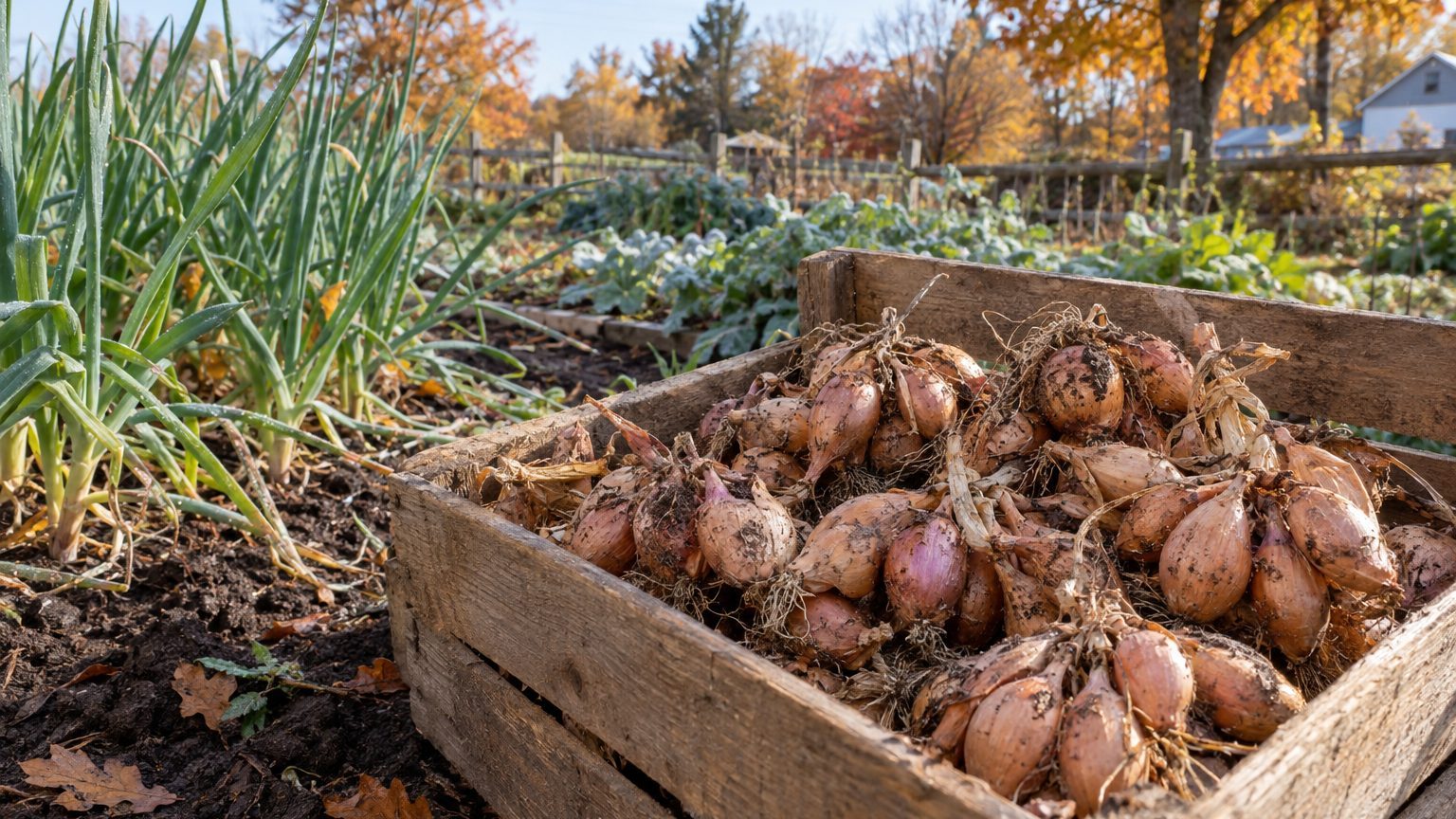

For most of Newfoundland and Labrador, the best shallots are the quick ones: multiplier types grown from bulbs, planted in spring, and finished before fall frost. Seed-grown types and slow storage varieties are a gamble in a season that is short at best. At St. John’s, the average last and first frosts sit about 140 days apart. Nearly every choice below follows from that number.
The short answer for Newfoundland and Labrador
Choose multiplier shallots, the kind sold as bulbs that split into a cluster, and favor the earlier-maturing ones in the catalog. Environment and Climate Change Canada’s 1981-2010 normals for the St. John’s airport station give an average last spring frost of May 30 and an average first fall frost of October 17. The gap between those two dates is the arithmetic behind the 140 days. A shallot started from a full bulb skips the slow seedling stage, which is exactly what a short season rewards.
Both dates are means, not safe dates. Half the years, a frost still arrives after May 30. Half the years, it arrives before October 17. Treat each as the middle of a window. Also, the figures come from a single station on the Avalon, and Canadian normals run 1981-2010, while the US figures elsewhere on this site cover 1991-2020.
Spring-planted multipliers lead the list
Bulbs planted as soon as the soil can be worked have the most days to size up. Shallots tolerate light frost once rooted, so you do not need to wait for May 30 to pass. The detailed timing is on the page about when to plant shallots in Newfoundland and Labrador. For the basics of the crop itself, start with growing shallots in Newfoundland and Labrador.
How the types compare here
| Type | Fit for this season | Why |
|---|---|---|
| Multiplier bulbs, spring-planted | Best bet | Full-size start, ripens well inside the frost-free window |
| Multiplier bulbs, fall-planted | Only on sheltered, well-drained ground | Must root before freeze-up and survive winter and thaw cycles |
| Seed-grown, started indoors | Workable, second choice | Needs weeks indoors before it earns any outdoor time |
| Seed sown outdoors | Poor | Not enough days left after soil warms |
| Late-maturing storage types | Poor | Run out of season, and curing needs dry weather |
One caveat on fall planting. The reference winter figure is a mean daily minimum of -8.7 °C in the coldest month. That is not brutal on its own, but it says nothing about freeze-thaw swings or snow cover, and this page has no data on either.
What will not work here
Slow types and late starts
Anything that needs the whole summer plus a long ripening period will fail you. Shallots sown from seed directly outdoors are the clearest case. If the soil is workable in May and the average last frost is May 30, you are starting a slow crop with perhaps 140 days of frost-free time at best, and some years far fewer. The bulbs may form, but they stay small and green-necked, and green necks do not store.
The same goes for late varieties sold for long-keeping elsewhere. A storage shallot only keeps if it is mature, cured, and dry when it goes into the shed. In a year when the first frost comes before October 17, which happens about half the time, a late type is caught still growing. Treating May 30 as a planting date, rather than the midpoint of a risk window, causes the opposite problem: tender transplants set out that day have even odds of meeting a later frost.
Wet soil and crowded rows
Shallots hate sitting in wet ground. This page has no rainfall or summer temperature figure for the province, so what follows is general reasoning, not a measured number. Where summers are cool and fall weather is damp, tight spacing keeps foliage wet and invites rot and fungal disease. Cluster-forming shallots also need elbow room for the bulbs to split and swell. Crowding them on heavy, poorly drained ground is a reliable way to grow a row of soft bulbs.
Raised beds, or a ridge of loosened soil, solve more problems here than any variety choice. Curing is the other trap. Pulled shallots need airflow and dry cover for a couple of weeks. A damp garage or a rainy porch in late September will undo a good harvest, so plan a spot with moving air before you pull the first bulb.
Fall-planted shallots fail in a particular way. If bulbs go in too late to root, or into soil that stays soggy, frost heave pushes them up and out. A thick mulch helps, but only where water drains away in spring.
What changes across Newfoundland and Labrador
This province is not one garden. The only hardiness figure this page has is Canadian zone 6a, from Natural Resources Canada’s 1991-2020 data for the St. John’s reference city. It is a Canadian zone, not a USDA zone, and the two systems do not convert. The Canadian one is built on seven climate variables, the USDA one on a single temperature. Zone 6a describes the reference city only. The island and Labrador contain other zones, so there is no single answer for the province, and this page does not have the full spread.
Pull up the Canada’s Plant Hardiness Site and look up your own municipality instead of assuming the St. John’s number applies to you. The frost dates matter more than the zone for a crop this short. The St. John’s dates are the ones this page has, and northern and upland districts run weeks behind them.
If you garden in Labrador, inland, or at altitude, shift three things. Favor the earliest multipliers. Give bulbs a head start by planting into pots under cover and moving them out once the ground is workable. And use row cover or a low tunnel to buy back some of the weeks you lose at both ends. Fall planting becomes a steeper gamble as winters get colder, so treat it as an experiment on a small corner of the bed, not the main crop.
Where to check this for your own county
The province’s agriculture department is the best next stop: Newfoundland and Labrador’s Department of Fisheries, Forestry and Agriculture. This page cannot point you to a shallot-specific calendar or a trial list from that office, because it does not have one. What to look for there is a local planting calendar for your area, and any list of onion-family varieties tested in your region.
Newfoundland and Labrador does not organize its gardening advice by county the way many US states do, so think in terms of your own district or nearest agricultural office. Ask whether shallots or bulb onions have been trialled near you, and which types ripened in a cool year.
A local recommendation beats a provincial one every time, and this page is the provincial one. It uses a single airport station’s averages from 1981-2010 and a hardiness zone for one reference city. A grower ten miles up a valley, or on an exposed headland, may see frost two or three weeks apart from those dates. When a local source and this page disagree, go with the local source.
Checking this against your own garden
Your own observations outrank every date here. Three are worth watching, and none need equipment.
- Soil by feel. Squeeze a handful in early spring. If it crumbles instead of forming a wet ball, and you can hold your hand in it without a chill, it is ready for bulbs. If one bed dries out two weeks before another, you have found your warm, well-drained spot.
- First green shoots. Note when chives, rhubarb, or early weeds show leaves, then compare year to year. A garden that greens up early has a longer season than the St. John’s averages suggest. A late one deserves the earliest types and some row cover.
- Where frost lingers. After the first cold nights in fall, see which corners stay white longest in the morning. Those are frost pockets, and they cost you days at both ends of the season.
Write the dates down for two or three seasons. A garden notebook beats any average, because it records your yard instead of an airport.
Common questions
Can I grow shallots from seed in Newfoundland and Labrador?
Yes, but only if you start them indoors and accept a smaller, later crop. Direct sowing outdoors leaves too little season, given an average last frost of May 30 at St. John’s. Bulbs or sets are the safer path.
Is fall planting a good idea here?
It is a maybe. The mean daily minimum of the coldest month at the reference station is -8.7 °C, and the page has no figures on freeze-thaw cycles or snow cover. Try a small test patch on well-drained ground with mulch before committing the whole bed.
Does hardiness zone 6a mean my garden is in zone 6a?
No. Canadian zone 6a is the figure for the St. John’s reference city, not for the whole province, and it is not a USDA zone. Look up your own municipality on Canada’s Plant Hardiness Site.
How do I know when my shallots are ready to pull?
Watch the tops. When most of the leaves have yellowed and flopped over, the bulbs are done sizing. Pull them on a dry day and cure them somewhere with moving air. If frost threatens before the tops fall, lift them anyway and finish curing indoors.