
Container-grown Hydrangeas go into New Brunswick ground from late May through June, once the average last spring frost has passed. At Moncton that average falls on May 23, a midpoint and not a guarantee. Panicle and smooth hydrangeas are the dependable choices because they flower on new growth. Bigleaf types can lose their buds to winter. The province is also not one climate, so northern and upland gardens run weeks behind the coast. This page is part of our How to Grow Hydrangeas: The Complete Guide, and it turns those facts into dates and habits.
When to plant Hydrangeas in New Brunswick

The dates, and what they do and don’t mean
The reference city here is Moncton. Environment and Climate Change Canada’s Canadian Climate Normals for 1981-2010 put the average last spring frost at May 23, the average first fall frost at October 2, and the frost-free stretch between them at 131 days on average. Those are mean dates. In one year out of two, the last frost falls later than May 23. Treat it as the middle of a window, not a safe date. The normals also cover 1981-2010, while the US figures elsewhere on this site cover 1991-2020, so the two sets are not a perfect match.
Moncton sits in the southeast. Northern and higher-elevation districts of the province trail it by weeks, and this page does not publish a figure for them. If you garden inland or up north, shift every date below later by however far behind Moncton your neighbors run. Watching when established gardeners nearby set out tender annuals is a decent local gauge.
A dormant hydrangea shrub shrugs off frost. What frost harms is soft new growth and, on bigleaf types, flower buds that have already swollen. That makes the planting date less rigid than it is for tomatoes. A nursery shrub can go in as soon as the soil is workable if you are willing to drape a sheet over it on a frost night. Planting on or after May 23 spares you most of that fuss.
Starting indoors, hardening off, transplanting
Hydrangeas from seed are slow and variable, and most gardeners buy a potted plant or root cuttings instead. If you want to try seed anyway, count back 12 weeks from May 23 and you land on February 28. Seedlings from that sowing will still be small in June. Plan on a full extra season in pots or a nursery bed before they take their permanent spot.
Hardening off matters more for the plants most people actually buy, since many are raised in greenhouses. Give them 7 to 10 days of gradual exposure, starting with an hour or two in shade and building to a full day outdoors. Counting back 10 days from a May 23 planting, you start on May 13. Bring them in if a frost is forecast.
There is a second window in early fall. Planting in early September, about a month before the October 2 average first frost, gives roots several weeks to grow before the ground locks up. Later than that, roots have little time to settle, and the shrub faces its first winter underprepared.
Soil and site preparation
Light decides more than people expect. Bigleaf hydrangeas do best with morning sun and afternoon shade. Panicle types accept full sun if the soil stays moist, and smooth hydrangeas tolerate the most shade of the group. A spot sheltered from the winter wind helps every type, and a place where snow settles gives roots and low buds a layer of insulation.
Texture and drainage come next. Hydrangeas want soil that holds moisture without staying soggy. To test a site, dig a hole about a foot deep, fill it with water, let it drain, then fill it again. Water still standing the next day means a drainage problem, and a raised bed or a different location is a better fix than hoping. Heavy clay can be loosened with compost, and sandy soil needs it just to hold water.
The weeks before planting
Preparation starts well before the shrub arrives. Strip the sod or weeds from a wide circle, then work 2 to 3 inches of compost into the top 8 to 12 inches across the whole planting area, not only the hole. Amending just the hole creates a bathtub that fills with water and discourages roots from leaving it. If you can, do this the previous fall, or at least a couple of weeks before planting in spring.
Take a soil sample now too. A pH reading tells you whether bigleaf colors will behave (more on that below) and whether iron deficiency is a risk. Dig the planting hole two to three times as wide as the root ball and no deeper than it, with the top of the ball level with the surrounding soil.
Spacing follows mature size, which varies by variety, so read the plant tag. Compact panicles can sit 3 to 4 feet apart, while large ones want 6 feet or more. Crowding invites mildew by cutting off air movement.
Varieties that suit New Brunswick
The trait that matters most in a short, cold-winter climate is which wood the plant flowers on. Panicle and smooth hydrangeas bloom on growth made this year, so a hard winter or a late frost cannot take away the whole show. Bigleaf hydrangeas set buds the previous summer, and a cold snap or a spring frost can kill them. The second trait is stem strength, because heavy blooms plus wet weather flatten weak shrubs. The third is bloom timing, which is covered in the ripening section below.
| Type | Blooms on | Winter risk | Good for |
|---|---|---|---|
| Panicle (e.g., ‘Limelight’, ‘Quick Fire’, ‘Bobo’) | New wood | Low | Reliable summer-to-fall bloom, full sun |
| Smooth (e.g., ‘Annabelle’, ‘Incrediball’) | New wood | Low | Shadier sites, big white flowers |
| Bigleaf (e.g., ‘Endless Summer’ series) | Old wood, and new wood on rebloomers | High for old-wood buds | Blue or pink color, with winter protection |
| Climbing (Hydrangea petiolaris) | Old wood | Low, but slow to establish | Walls, fences, shade |
Among panicles, ‘Limelight’ is a widely sold, vigorous choice. ‘Quick Fire’ is known for opening earlier than most, which suits a short season. ‘Bobo’ stays compact for small beds and containers. Among smooth types, ‘Annabelle’ is the classic but tends to flop after rain, while ‘Incrediball’ was bred for sturdier stems. Rebloomers like the ‘Endless Summer’ series flower on old and new wood, though in a climate like this the new-wood flowers are the ones to count on.
Color: blue, pink and white
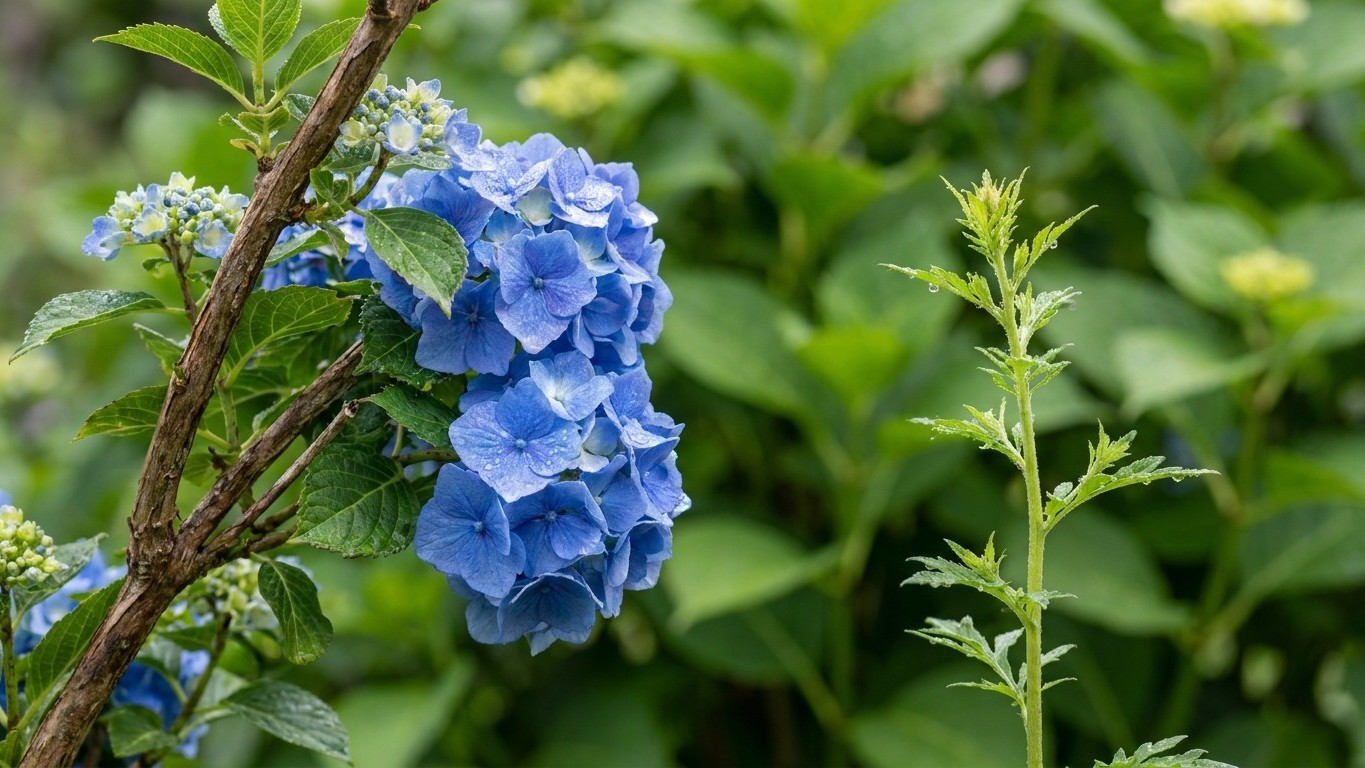
Panicle and smooth hydrangeas in white and green stay that way. Bigleaf flowers shift with soil chemistry. In acidic soil, roughly pH 5.5 or lower, aluminum is available to the plant and flowers lean blue. Closer to neutral, around 6.0 to 6.5 and above, they turn pink or red. A soil test tells you where you start, and aluminum sulfate or lime moves the color slowly over a season or two. Change it gradually, and expect results to vary.
For a maritime neighbor’s perspective, see Growing Hydrangeas in Prince Edward Island: Types, Colour and Winter. Gardeners in a much colder place can compare notes with Growing Hydrangeas in Yukon: Types, Colour and Winter.
What to plant alongside
Good neighbors for hydrangeas share their taste for moist, humus-rich soil and cover the ground beneath them. Hostas, ferns, astilbe and heuchera form a living mulch that shades roots and holds moisture. Spring bulbs such as daffodils flower before the shrub leafs out, and the hydrangea’s growth then hides their fading foliage. Rhododendrons and other acid-loving shrubs share the same soil needs, which simplifies fertilizing and pH management.
On the pollinator side, panicle and smooth hydrangeas carry small fertile flowers that bees visit. Mophead bigleaf types are mostly showy sterile sepals with little to offer. Planting lacecaps or panicles near a mix of perennials gives pollinators a longer menu through the summer.
Competition is the bigger concern. Shallow-rooted maples drain the soil and win every contest for water. Lawn grass pressed right up to the stems steals moisture and nitrogen. Black walnut roots release juglone, which stresses many garden plants, so keep new shrubs well clear of one. For disease, avoid crowding hydrangeas with phlox or bee balm, both prone to powdery mildew, in tight, airless beds.
One popular claim has little behind it: that marigolds or garlic around a shrub repel its pests. Evidence for pest confusion from those plants in ornamental beds is thin. Plant them because you like them, not as pest control.
Watering, feeding and support
Water and mulch
Hydrangea means “water vessel,” and the plants behave accordingly. For the first two summers, give a deep soak about once a week, more in heat, aiming at the base in the morning. Deep watering pushes roots down, while frequent sprinkles keep them shallow. Afternoon wilting in strong sun is normal and recovers by evening. Leaves still limp the next morning mean the plant is truly dry.
Mulch with 2 to 3 inches of shredded bark or leaves, pulled back a few inches from the stems. It cuts evaporation, moderates soil temperature and suppresses weeds, and as it breaks down it feeds the soil.
Feeding, support and pruning
Feed lightly. A slow-release balanced fertilizer when leaves emerge in spring is plenty, with a second light dose in early summer at most. Stop by midsummer so new growth can harden before frost. Heavy nitrogen yields lush leaves and few flowers, and soft late growth is what winter kills first.
Support matters for smooth hydrangeas like ‘Annabelle’. A peony ring set early in spring, or a few stakes with soft ties, keeps stems upright when blooms get waterlogged. Choosing a sturdier variety is easier than staking every year.
Pruning depends on type. Panicle and smooth hydrangeas bloom on new wood, so cut them back in late winter or early spring. Bigleaf and climbing types bloom on old wood, so limit pruning to dead stems after leaf-out, and shape right after flowering if needed. Suckers coming up from the base can be dug out, or divided and moved in spring for free plants.
Common problems

Several of the usual crop problems, such as blossom end rot, fruit cracking and fruit set, do not apply to a shrub grown for flowers. Here is what does show up.
Reading the symptoms
No flowers is the most common complaint. On bigleaf types the usual cause is winter kill of old-wood buds, or pruning at the wrong time. Too much shade or too much nitrogen can also be responsible. Wilting that does not recover overnight points to drought or poor drainage. Crisp, brown flower heads or leaf edges usually mean sun scorch, drought, or fertilizer or road salt burn.
Yellow leaves with green veins suggest iron chlorosis, most often tied to soil pH that is too high, and a soil test confirms it. Brown or purple spots on leaves are usually fungal leaf spot, and a white powdery film is mildew. For both, improve airflow, water the soil and not the foliage, and clean up fallen leaves in autumn. Deer browse hydrangeas readily in rural areas, and fencing works better than repellents.
Pests
No Canadian province publishes a home-garden pest list of its own. The best documented list for the region comes from University of Maine Cooperative Extension, a neighboring US source, and the insects cross the border even if the calendar does not always. It names browntail moth, cabbage maggot, Colorado potato beetle, emerald ash borer, lily leaf beetle, seedcorn maggot, spotted wing drosophila, squash vine borer, striped cucumber beetle and winter moth.
Most of those target vegetables, ash trees, lilies or soft fruit and are not hydrangea pests. Winter moth and browntail moth are the two defoliators of woody plants worth watching, though this list does not claim hydrangeas are a favorite host. Browntail caterpillar hairs can cause a rash, so wear gloves and long sleeves if you find nests. For any unfamiliar insect, take a photo or sample to your provincial agriculture office for identification, and do not assume a pest is absent from your area.
Ripening before the frost comes back
A hydrangea does not ripen fruit, so the tomato version of this question does not apply. The same arithmetic still decides two things: whether the shrub flowers before frost, and whether its wood hardens before winter.
Start with the 131 frost-free days at Moncton. Panicle and smooth hydrangeas generally open in July or August, roughly 8 to 12 weeks after spring growth starts. That is a working assumption, not a published figure. Twelve weeks is 84 days, and 131 minus 84 leaves 47 days of cushion. Eight weeks is 56 days, and that leaves 75. Either way, new-wood bloomers finish with weeks to spare, and the cushion is what lets stems harden before the October 2 average first frost.
Redo the sum for your own district. Take the frost-free days you can reasonably expect, subtract 84, and look at what remains. A garden with 100 days has 16 days of margin, which is thin. There, favor early bloomers like ‘Quick Fire’, avoid relying on new-wood flowers from bigleaf rebloomers, and treat any bloom as a bonus. Remember that all these figures are means, so half of all years are shorter.
The tools that buy extra weeks differ from tomato growers’ tricks. A tunnel or black plastic does not suit a shrub this size. Frost blankets over leafing-out bigleaf shrubs do the same job in spring. A larger nursery plant blooms sooner than a small one, a spot against a south-facing foundation warms earlier, and a fall planting the year before gives roots a head start.
Harvest and end of season
Cut panicle and smooth hydrangeas for vases when blooms are mostly open, in the morning, with long stems and the cut ends set straight into water. To dry them, wait until the flowers start to shift color in late summer, then cut and stand them in an inch of water to dry slowly, or hang them upside down in a dark, airy room. Panicles fade to pink and russet on the shrub, which many gardeners prefer to cutting early.
As fall approaches, remember that October 2 is only the mean. In one year out of two the first frost lands later, and in the other half it arrives sooner. A first light frost browns the leaves but does not hurt an established shrub.
Water deeply before the ground freezes, and put down a thick layer of shredded leaves or bark around the base. Leave the spent flower heads on bigleaf types, since the old stems shelter next year’s buds. A cage of chicken wire stuffed with leaves, or a wrap of burlap, protects old-wood bloomers. Young plants in their first winter deserve that protection whatever the type. Heavy, wet snow can split the stems of large panicles, so loosely tie the stems together with soft twine before the first big storm.
Local help
For dates tied to your own district, plant identification and advice on soil testing, start with Agriculture and Agri-Food Canada, then ask for your provincial agriculture office. The federal department is linked here because the provincial site could not be verified. More regional pages are collected in our New Brunswick guides.
Common questions
Will hydrangeas survive a New Brunswick winter?
Panicle and smooth types are generally reliable because they flower on new wood, even if stems die back. Bigleaf types need protection. Check the Canadian plant hardiness zone for your postal code, since this guide does not publish zone numbers.
Which hydrangea blooms most dependably here?
Panicle varieties such as ‘Limelight’ and ‘Quick Fire’ and smooth types such as ‘Incrediball’ set flowers on current-year growth. That makes them the safest picks for a short season and cold winters.
Why won’t my bigleaf hydrangea flower?
Winter kill of old-wood buds is the usual cause. Pruning at the wrong time, too much shade, or too much nitrogen can also be responsible. Leave stems alone in fall, protect them over winter, and prune only dead wood in spring.
How do I turn my hydrangeas blue?
Only bigleaf types respond. Acidic soil, around pH 5.5 or lower, favors blue, and aluminum sulfate can help over a season or two. Test first, because the change is gradual and results vary.
Is it too late to plant in October?
It is risky. With an average first frost of October 2 at Moncton, roots have little time to settle. Early September is safer for fall planting, and if you do plant late, mulch heavily and protect the shrub through its first winter.