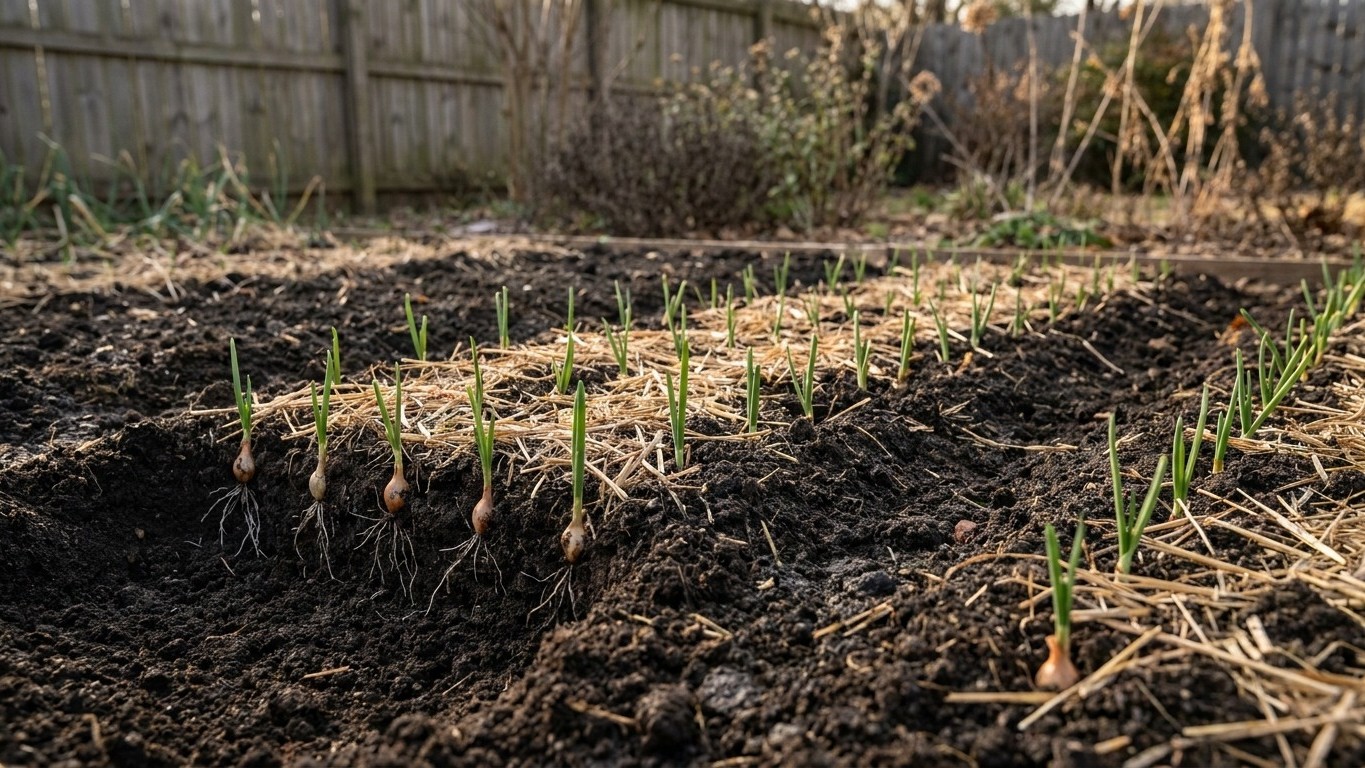

Most of what eats a vegetable garden leaves garlic alone, so Indiana growers lose bulbs to a short list of culprits. Voles and squirrels strike between planting and the first hard winter. Onion maggots and bulb mites work in spring. Thrips build as summer heat arrives, just before the bulbs come out of the ground. Stem and bulb nematodes, the worst of the group, usually ride in on seed cloves. Each pest has its own calendar, and every one of them starts at fall planting.
The short answer for Indiana
The pest calendar for Indiana garlic starts with planting, and planting is anchored on the first fall frost: October 21 to October 30 at Indianapolis, from the NOAA NCEI 1991-2020 Climate Normals (the 30% to 70% probability band for a 32F freeze). That range is a midpoint, not a safe date. In one year out of two, the frost falls later.
Garlic is planted in autumn and lifted the following summer, so the crop spends most of a year in the ground. That long exposure explains the pest list. Each stage of growth meets a different animal. Freshly turned soil in fall draws squirrels and chipmunks. Winter mulch becomes housing for voles and mice. Spring warmth wakes wireworms and brings egg-laying flies to the base of the plants. Early summer belongs to thrips, which feed on leaves while the bulbs finish sizing up. Mites and nematodes cut across every stage because they live in the cloves themselves.
The dates move for two reasons. Indianapolis is a reference point, and southern Indiana runs earlier in spring and later in autumn than the north by a fortnight or more. A warm autumn also stretches the gap between planting and frost, which gives rodents longer to find a bed and gives fall shoots more time to emerge before winter. Where you sit in the state decides how much of that applies to you.
Working it out for your own garden
Start from your own frost date
Take the Indianapolis band as the baseline: October 21 to October 30. If your garden sits well north, move it earlier. If it sits near the Ohio River, move it later. Suppose the gap is a fortnight, which the NOAA-based reference treats as a minimum between the north and south ends of the state. That would put a northern frost date around October 7 to October 16 and a southern one around November 4 to November 13. Those are illustrations of the arithmetic, not published station figures. Your county’s own normals will be tighter, and the extension office near the end of this article can point you to them.
Then remember what the number means. Half of all years bring frost after it. Planting “on the frost date” is therefore a coin flip about how much warm weather you get afterward, and a warm tail on autumn matters for pests. Cloves that sprout early can be nibbled before winter, and bare, loosened soil keeps attracting digging animals.
Lay the pest calendar over it
Once you have your date, count forward through the garlic year. The table sets out when each pest typically acts, in terms of what the garlic is doing at the time.
| Pest | When it acts | What you see |
|---|---|---|
| Squirrels and chipmunks | Right after planting, in fall | Dug-up soil, cloves lying on the surface |
| Voles and mice | Winter, under mulch | Missing cloves, small tunnels, gaps in the row |
| Wireworms | Spring, worst in beds converted from sod | Bored cloves and bulb bases, thin stands |
| Onion maggot | Spring, when adult flies lay eggs near plants | Wilting shoots, rotted or hollowed bulbs |
| Thrips | Early summer, as weather warms and dries | Silvery streaks and pale flecks on leaves |
| Stem and bulb nematode, curl mite | All year, carried in seed cloves | Twisted, swollen or stunted growth, soft bulbs |
Use the table as a scouting schedule. If you plant late in your window, the fall rodent stage shrinks, but the cloves have less time to root before ground freezes. If you plant early, the reverse is true. Either way the spring and summer entries stay put, because they follow the weather and not your planting date.
One practical overlap: floating row cover keeps egg-laying flies off in spring, and it doubles as frost protection. Purdue notes that roughly a 10% chance of a 32F event remains after the published spring date, so a cover you already own is worth having ready.
What changes across Indiana
Northern Indiana runs behind. Counties such as St. Joseph, Elkhart and Allen have the earliest autumn freezes in the state, so planting happens sooner and the whole pest sequence starts sooner too. Snow cover is the complication. A steady blanket insulates the ground, and voles can tunnel along beneath it for weeks without being seen, which makes winter damage in the north easy to miss until spring thaw.
The Lake Michigan shore works differently. Lake, Porter and LaPorte counties sit under the lake’s moderating influence, which tends to delay the first freeze near the water. Frost there can arrive later than a few miles inland, so the planting window shifts and the warm tail of autumn can run longer. Sandy soils near the lake also carry wireworm populations in beds cut from old turf.
Central Indiana, where Indianapolis sits, is the baseline for the dates above. Southern Indiana, along the Ohio River and through counties like Vanderburgh, Clark and Floyd, sees later autumn freezes and an earlier spring by a fortnight or more. That gives thrips and egg-laying flies an earlier start, and it gives fall pests a longer season to work in. The hillier country south of Bloomington adds a local twist: cold air pools in low hollows, so a valley bed can freeze while a ridge a few hundred feet higher does not. Elevation changes the date even over short distances.
For a sense of how far the same crop shifts in a colder state, compare Iowa’s schedule in When to Plant Garlic in Iowa: Counting Back From the First Frost and the cultivar guidance in Garlic Varieties That Suit Iowa Winters. For Indiana’s own versions, see When to Plant Garlic in Indiana: Counting Back From the First Frost and Garlic Varieties That Suit Indiana Winters. The overview page, Growing Garlic in Indiana, ties the whole season together.
The mistakes this climate punishes
Indiana winters are cold enough to punish carelessness and wet enough to reward good drainage. The costliest error is buying seed garlic from an unknown source. Stem and bulb nematodes live inside cloves and persist in soil afterward, and once a bed is infested you cannot fix it with a spray. Start with clean seed stock, and do not replant cloves saved from a bulb that showed twisted or soft growth.
Mulching too early comes next. A thick straw layer laid while the ground is still warm turns into vole housing before the first hard freeze. Wait until the soil has chilled, then apply the mulch. Keep it loose, and pull it back from the shoots in spring so rodents lose their cover.
Planting too early is the third trap. Warm autumns are common enough in central and southern Indiana that cloves planted well before the frost midpoint can send up green tops. Those leaves are exposed to cold damage and to browsing, and they use up energy the plant needs for roots. Planting too late is just as bad. Cloves that have not rooted by the time the ground freezes can heave in the freeze-thaw cycles that mark Indiana late winter, which pushes them up toward the surface where animals can reach them. Plant deep enough to stay well buried, and see the planting calendar page for depth.
Last, ignoring rotation. Putting garlic back into the same bed, or after onions and leeks, builds up soil pests and disease. Wireworms in new beds taken from lawn are a related problem: a bed cut from sod is rarely a good first-year garlic site without some prep.
- Do not use cloves from garlic that showed distorted growth.
- Delay mulch until the ground has cooled.
- Rotate away from onions, leeks and shallots.
- Scout in spring for wilting shoots and in early summer for silvery leaf streaks.
Checking this against your county
County-level frost dates and local pest reports vary more than any state summary can show. Purdue Extension keeps an office in nearly every Indiana county, and the staff there can confirm your frost window, identify a damaged bulb from a sample, and tell you whether a pest such as the allium leaf miner has been reported near you. Bring a photo or the affected plant when you ask.
Common questions
What eats garlic most often in Indiana?
Rodents cause the most visible damage in fall and winter, while thrips are the common summer pest on leaves. Nematodes and mites do the worst hidden damage because they travel in the seed cloves.
Do deer and rabbits eat garlic?
Rarely. The sulfur compounds in garlic put most browsers off, so fencing for deer and rabbits is seldom needed. Voles, mice and squirrels are the animals to plan around.
When should I check for thrips?
Start looking in early summer, once the weather turns warm and dry and the garlic is still growing. Silvery streaks on the leaves are the signal. The crop is lifted soon after, so the damage window is short.
Is the first frost date a safe planting date?
No. The October 21 to October 30 range is a midpoint from NOAA NCEI normals for Indianapolis, so half of all years bring frost later. Treat it as an anchor for counting, then adjust for your region of the state.