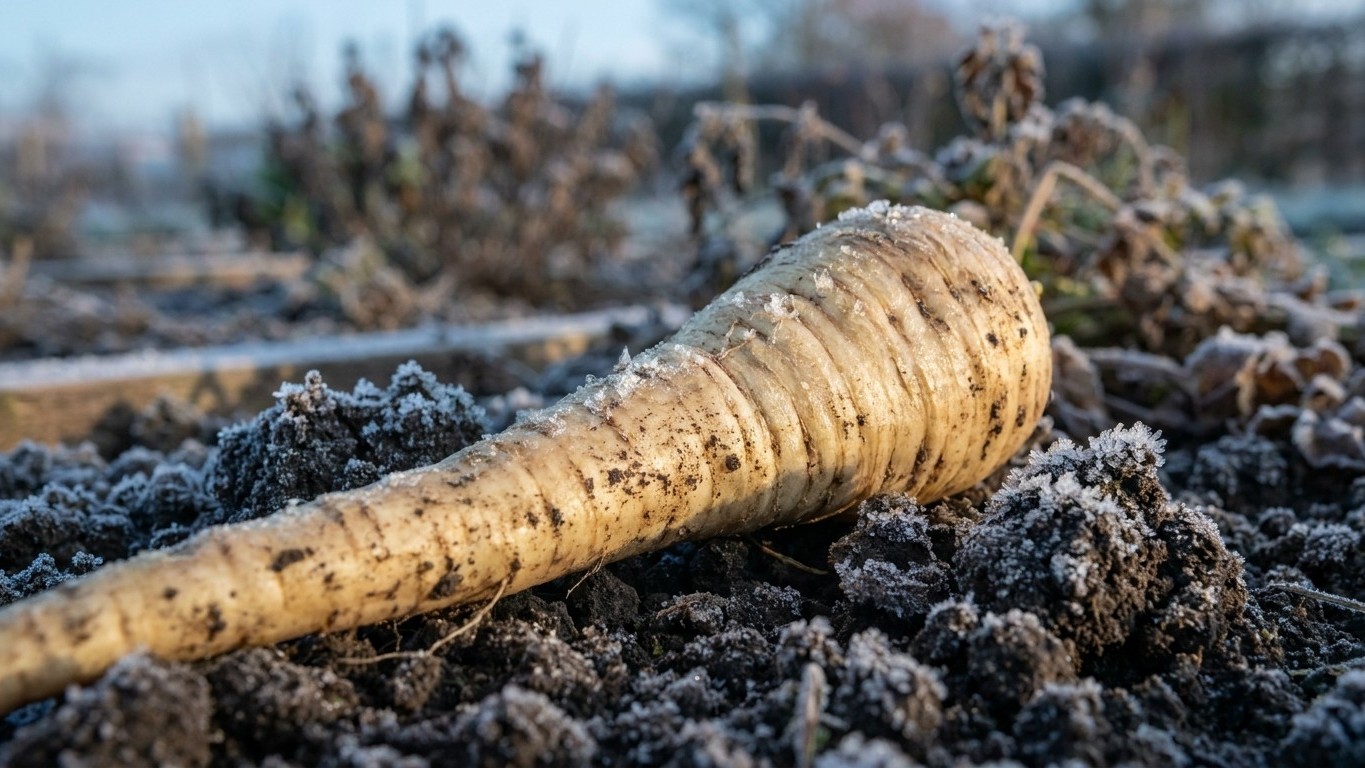

Lift parsnips after several weeks of frost. On the coast near Vancouver, that means late autumn onward, not the morning after the first cold night. A spring sowing is technically ready 100 to 120 days after seeding, months before that. Waiting is about flavor, not size. Once dug and topped, roots keep four to six months, but only if they stay cold, humid and well away from ripening fruit. Here is how those pieces fit together for British Columbia gardeners.
The short answer
Does this territory deliver several frosty weeks? On the coast, barely. At the Vancouver reference station, the mean daily minimum of the coldest month is 0.8 °C (about 33.5 °F). That is the average night at the cold end of winter, and it sits above freezing. Individual nights dip below zero, but a run of several frosty weeks is not what the average describes. How many sub-zero nights a typical winter delivers is not published here, so treat any claim of a precise count with suspicion.
So a parsnip grown here will grow without trouble and sweeten only modestly. Utah State University Extension puts the crop’s flavor payoff in plain terms: parsnips taste best after several weeks of cool, frosty weather, which converts stored starch to sugar. The trigger is exposure to frost. A comfortable hardiness zone does not supply it, and a plant that survives winter easily is not the same thing as a root that has been chilled long enough to turn sweet. Gardeners in colder upland and northern districts of the province, where the nights run colder than at the coastal station, have a better shot at the full effect. For more on the mechanism, see Will Parsnips Sweeten in British Columbia?
When to lift
The mean last spring frost at the Vancouver station falls on March 18 and the mean first fall frost on November 10. Both are midpoints, not guarantees: in one year out of two the frost arrives later than the date given. They also come from a single coastal airport station, and a province is not one climate. Inland and northern gardens run weeks behind.
Within that window, the practical rule is to wait. Roots reach usable size by midsummer or so, but nothing is lost by leaving them in the ground through the first cold snaps of autumn. Dig what you need from late autumn through winter, and clear the rest before new top growth starts in spring. If you are fighting pests along the way, What Eats Parsnip in British Columbia, and When covers the calendar. The general growing picture is in Growing Parsnips in British Columbia.
How long they keep, and the fruit bowl problem
USDA Agricultural Handbook 66 gives four to six months for parsnip roots held at 0 to 1 °C (32 to 34 °F) with 98% relative humidity. That is a long keeper by any standard. It also assumes those conditions are held steady, which almost no house manages. A garage swings, a fridge dries roots out, and a basement drifts with the seasons.
Cold is not the danger. The handbook states that parsnips are not chilling sensitive. The danger is ethylene. Roots produce very little of it themselves, but low levels of the gas in cold storage cause bitterness, likely through a buildup of a compound called xanthotoxin. Keep them away from apples, pears and any ripening fruit, even when the temperature is right. And top them after harvest without trimming into the crown.
Does the season fit?
It fits, and by a wide margin. The crop needs 100 to 120 days from seeding, counted from a sowing made 2 to 3 weeks before the last frost. Parsnips are sown in place, so there is no transplant to shorten the count. The arithmetic, using the Vancouver station’s mean dates, runs like this:
- Start with the mean last spring frost, March 18. Two to three weeks earlier is roughly February 25 to March 4, the earliest sowing window the guideline allows. Cold soil is slow, so seed often goes in somewhat later, and germination takes 14 to 21 days. Do not dig up bare soil at day ten and re-sow.
- Add 100 days to a March 4 sowing and you reach about June 12. Add 120 days to a February 25 sowing and you reach about June 25. A sowing on March 4 stretched to 120 days lands near July 2. So the earliest roots come to full size between early June and early July.
- Compare that with the mean first fall frost, November 10. From July 2, that leaves about 131 days, more than four months of slack.
- Stress-test it. Seed sown a full six weeks late, on May 1, needs until about August 29 at 120 days, which still leaves roughly ten weeks before the first frost arrives on average.
Season length is not the problem on the coast. Frost exposure is. The long runway means you can lift at your leisure, but it also means the roots sit ready for months with little cold to sweeten them. In colder districts the picture reverses: the first fall frost comes weeks before November 10, the arithmetic tightens, and a late sowing may run out of season. Remember, too, that the Canadian normals behind these dates cover an older period than the US figures used elsewhere on this site, so a direct comparison across the border is rough at best.
What goes wrong here
Most parsnip failures in British Columbia come from four places: the ground, the water, the calendar and the winter. Each has its own fix, and they should not be lumped together.
- Forked roots from heavy or stony ground. A root that meets a stone or a layer of compacted clay splits or twists around it. Utah State University Extension calls for deep sandy soil, and says heavy soil must be double dug. If the plot is clay or stony, loosen it deeply before seeding and pull out stones. A raised bed filled with loose, deep soil is the fallback when digging is not enough.
- Forked roots from overwatering. This is a separate cause from the one above, and digging deeper will not cure it. Constantly wet soil encourages a shallow, branching root system. Water steadily but do not keep the bed soggy, and ease off once the roots are bulking up.
- A season that runs out. On the coast this is rare, since a sowing even in early May finishes comfortably. In upland and northern districts, where frost comes weeks earlier than at the Vancouver station, a late sowing may not reach 100 days. Sow in the first workable weeks of spring and count from the day seed goes in.
- A winter too mild to sweeten. A parsnip grown near the coast will be a perfectly good root that never turns very sweet. Leave roots in the ground until the coldest stretch of winter before digging, and cook them in ways that bring out their own sugars, such as roasting. Do not expect the sweetness of a prairie parsnip.
- Bitter roots from the fruit bowl. Storage next to apples or other ripening fruit exposes parsnips to ethylene, which brings out bitterness. Store them separately, cold and humid, with the crown left intact after topping.
Common questions
How soon after the first frost can I dig parsnips?
Not right away. A single frost does little. The sweetening needs several weeks of cool, frosty weather. On the coast, where the mean first frost is November 10 and the coldest month’s mean minimum is only 0.8 °C, waiting until midwinter gives the best chance of extra sweetness, and the roots hold well in the ground until then.
Can I store parsnips with apples?
No. Parsnips are not bothered by cold, but even small amounts of ethylene in storage cause bitterness. Apples and other ripening fruit are the usual source. Keep the roots in their own container, away from the fruit.
How long will lifted parsnips last?
Four to six months at 0 to 1 °C (32 to 34 °F) with 98% relative humidity, according to USDA Agricultural Handbook 66. Home conditions rarely match that, so expect less. Top the roots after digging, but do not cut into the crown.
Does my hardiness zone tell me whether parsnips will sweeten?
No. The zone describes how cold a winter a plant can survive. Sweetening depends on how many weeks the roots are exposed to frost, and a mild coastal winter can sit in a perfectly comfortable zone while delivering little of it. Check the real frost record for your own district rather than the zone label.