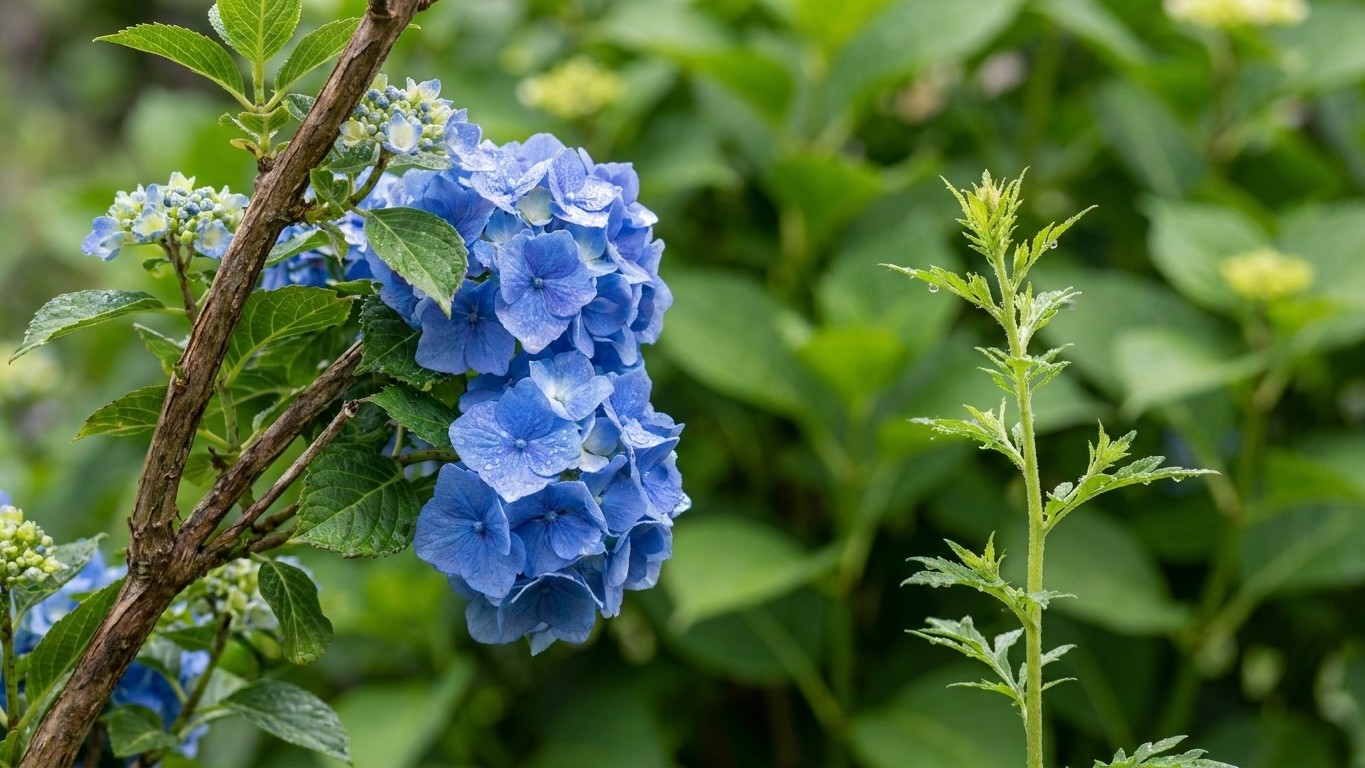

Pink hydrangeas in British Columbia usually mean the aluminum in the soil is out of the roots’ reach. Bigleaf hydrangeas make blue pigment only when they can absorb aluminum, and that happens in acidic ground. On the wet coast, soil often starts out acidic, so pink there tends to point to something that raised the pH, such as lime, mortar or wood ash. In the drier Interior, alkaline soil does the same thing without any help. Blue is possible, but it is slow, and it only works on some hydrangeas.
What this comes down to in British Columbia
A hydrangea’s color is set while the plant is growing, and at Vancouver International Airport, the reference station for this page, that stretch runs between an average last spring frost of March 18 and an average first fall frost of November 10. Both are mean dates, so in one year out of two the frost arrives later than the date given. Read them as the midpoints of a window, never as a safe date.
The chemistry in one pigment
The flower pigment in bigleaf hydrangeas (Hydrangea macrophylla) and mountain hydrangeas (Hydrangea serrata) is the same molecule in pink and blue flowers. What differs is whether aluminum has joined it. In acidic soil, aluminum dissolves and the roots take it up, which turns the sepals blue. In soil closer to neutral or alkaline, aluminum stays bound to soil particles, and the same pigment shows pink or red.
The ranges usually quoted by gardeners are a pH of roughly 5.2 to 5.5 for true blue, and roughly 6.0 to 6.5 and above for pink. Purple and muddled mauve sit in between. These are rules of thumb rather than hard lines, because the amount of phosphorus and the plant’s own genetics also shift the result.
Why pink shows up on a coast known for acidic soil
You might expect blue everywhere in a region of heavy rainfall and conifer forest. Coastal soils do tend to lean acidic, and plenty of Lower Mainland gardens grow blue or purple hydrangeas with no effort at all. Pink appears when something has pushed the pH up around the roots. Lawn lime applied for moss is a common culprit, since moss control is a regular chore in a mild, wet climate. Concrete footings, mortar, wood ash and imported topsoil or compost can do it too, and so can a variety that was bred to be pink and resists turning blue.
Further inland, the situation reverses. Many Interior soils are neutral to alkaline, so pink is the default, and blue takes real intervention.
Canadian hardiness is a separate matter. The reference city sits in Canadian hardiness zone 9a (that is the Canadian system, which does not convert to a USDA zone). For the general care of the plant, see the guide to growing hydrangeas in British Columbia. This page covers color only.
Working it out for your own garden
Start by finding out what you have, not by buying a bag of something. A pink hydrangea in the ground tells you the pH is high enough to block aluminum, but not by how much, and the gap decides everything. A cheap test kit from a garden centre gives you a rough reading, and a commercial soil lab gives you a better one. Test near the root zone, a few inches down, away from the foundation, and take samples from two or three spots.
The arithmetic of changing the pH
Say your test reads 6.5 and you want 5.5. That is one full pH unit, and because the scale is logarithmic, one unit means roughly a tenfold change in acidity. It is a large ask, not a small tweak. Sandy, low-clay soil with little free lime responds fairly well. Heavy clay, or soil that was limed for years, resists, and you will be adding acidifier again and again.
The usual tools are aluminum sulfate, which acts quickly and supplies aluminum directly, and elemental sulfur, which works slowly as soil microbes convert it. Follow the label for rates. A commonly cited home mix for aluminum sulfate is about a tablespoon per gallon of water, applied to moist soil over several applications spaced weeks apart, because a heavy single dose can burn roots. Pair this with a low-phosphorus fertilizer, since phosphorus ties up aluminum inside the plant.
Putting treatments on the calendar
Work from the frost window. If growth resumes around the March 18 midpoint, and you wait two to four weeks for leaves to expand, your first application falls somewhere from early to mid April. Repeat every few weeks through early summer. In a cold spring, treat that range as sliding later, since the March date is a midpoint and half of years run behind it. Treatments applied after flower buds have formed for the season will do little. Expect the full color shift to take a season, and sometimes two.
Now the case that does not finish. Picture soil that tests at 7.5 or higher, common in drier Interior districts. Dropping it to blue range in open ground is a losing fight, because the soil keeps pushing back toward alkaline. A large container filled with acidic potting mix gives you control of the pH. Otherwise, accept pink and enjoy it.
One more limit: white-flowered hydrangeas and the panicle and smooth types (Hydrangea paniculata and Hydrangea arborescens) will not respond to any of this. Check what you own before you spend a season on it.
What changes across the state
British Columbia is not one soil or one climate, and the numbers on this page come from a single reference point on the south coast. Elsewhere, the picture moves in both directions.
On the south coast and Vancouver Island, heavy rain leaches calcium out of the soil over time, which favors blue or purple unless you have limed. That does not mean the work is done, though. Local pockets near old foundations, brick walls or heavily amended beds can still run pink, even on the same street as a blue plant.
In the Okanagan, Thompson and Kootenay districts, lower rainfall leaves more minerals in the soil, and the pH tends higher. Pink is the natural result, and the effort required for blue climbs. Irrigation water can add to this in places where it carries dissolved minerals, though that varies by source, so a water test is worth asking about.
Elevation and distance from the coast move the calendar. Upland and northern districts run weeks behind the Vancouver figures, so every treatment date above shifts later, and the growing season is shorter. Colder winters also bring a more serious problem than color: bigleaf hydrangeas bloom on buds formed the previous summer, and hard frost can kill those buds entirely. A plant with no flowers has no color to adjust. If you garden in a colder district, read Protecting Hydrangeas Through a British Columbia Winter before you worry about pH.
The mistakes this state punishes
Liming the lawn right up to the hydrangea bed is the most common one on the coast. Moss control is a regular job here, and lime does not stay where you spread it. Runoff and wind carry it into neighboring beds, and a blue plant turns pink the following year. Keep lime well away from hydrangeas, or switch to moss control that does not raise the pH.
Another is treating too late. Gardeners see pink flowers in July and pour on aluminum sulfate, expecting an instant change. The open blooms stay put. Treat in spring, when growth resumes, and judge the result the following summer.
A third is overdoing it. Heavy or repeated doses of aluminum sulfate can burn roots and leave plants stressed, with scorched leaf edges. Slower, smaller applications are safer, and checking the pH again after a season tells you whether to continue.
Some gardeners also prune hard in spring and wonder why the blooms vanish. Bigleaf types flower on old wood, so cutting stems at the wrong time removes the flower buds along with them. Timing matters, and When to Prune Hydrangeas in British Columbia lays out the window.
Finally, there is fighting the soil in the Interior. If your bed tests strongly alkaline, a better move is a container or a raised bed with acidic mix, or a species that suits the soil you have. Pink is not a failure.
Checking this against your county
The frost dates here come from one station and apply to Vancouver, not to the whole province. Neither does the hardiness zone, which is Canadian and not USDA. British Columbia has no county extension offices, so your best local sources are the B.C. government’s agriculture and seafood pages, your regional district, and local garden clubs and Master Gardener groups. A local soil test will tell you more than any provincial average. For the rest of the plant’s needs, go back to the guide on growing hydrangeas in British Columbia.
Common questions
Why are my hydrangeas pink when my neighbor’s are blue?
Soil pH can differ a lot over a short distance. Lime from a lawn, a concrete footing, or a bed filled with imported soil can raise the pH around your plant while your neighbor’s ground stays acidic. A different variety, or a plant that was bred pink, can also explain it.
Will aluminum sulfate turn every hydrangea blue?
No. It works on bigleaf and mountain hydrangeas. White-flowered plants, and panicle and smooth hydrangeas, do not change color with soil chemistry. Even on the right type, a heavily limed or clay soil can resist for years.
How long does it take to see blue flowers?
Plan on a full growing season, and sometimes two. Open flowers do not change much. The new color shows up in blooms that develop after the soil and plant have shifted, so treat in spring and judge the following summer.
Is it easier to make hydrangeas blue in pots?
Yes. A container lets you choose an acidic potting mix and control the pH directly, without fighting the surrounding soil. It is the best route if your ground tests alkaline, as many Interior soils do.