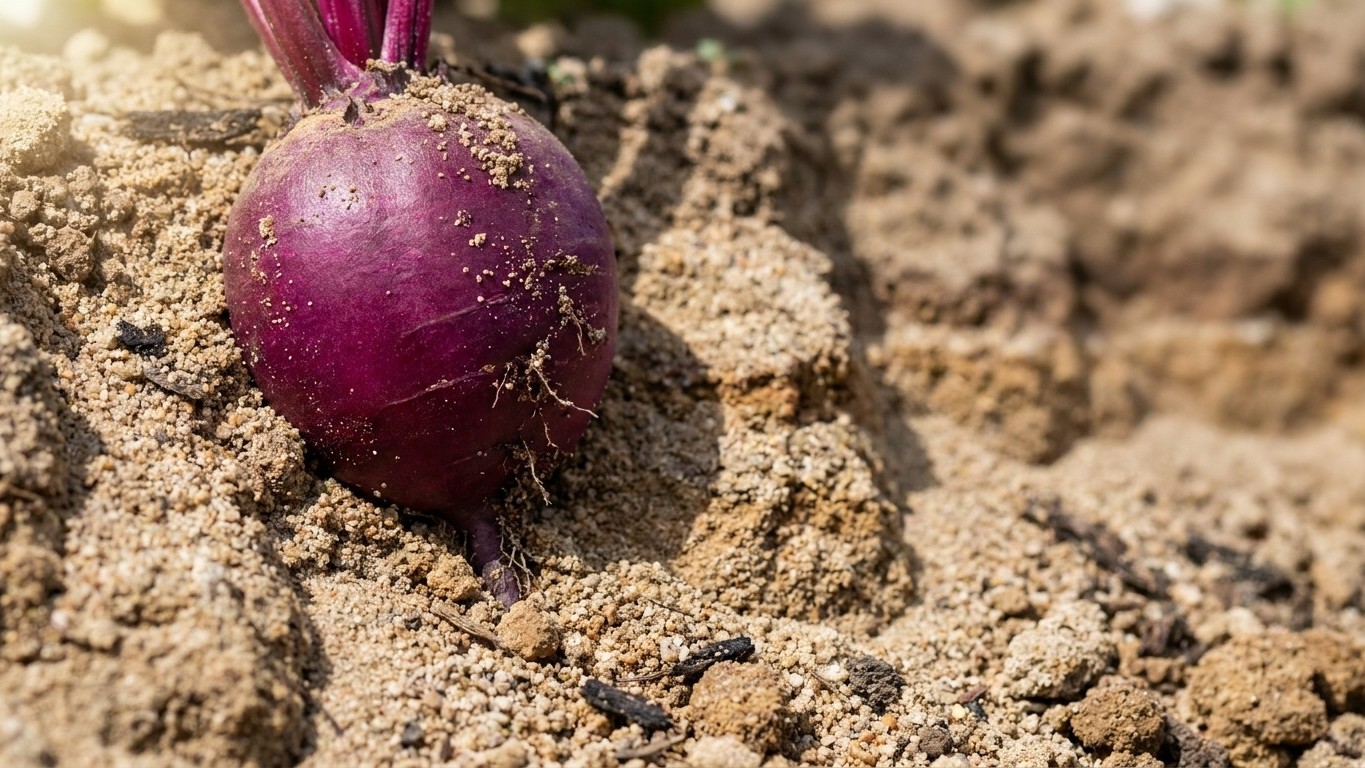

In Rhode Island, what eats into a beet crop is mostly water and heat, not a long list of enemies. A dry stretch in the first six weeks pushes plants to flower early. Hot weather plus thirst later turns the root woody. A third loss happens after harvest, in storage that is too cold. Insect pests are not covered by the sourced figures behind this page, so it sticks to what the soil, the weather and the cellar do. For the wider picture, start with Growing Beets in Rhode Island.
The short answer
The soil USDA lists as representative of Rhode Island is the Narragansett series, an Inceptisol, meaning a young soil that has not developed strong horizons yet. Its surface layer runs 34 percent sand, 6 percent clay and 60 percent silt, which makes it a loam to silt. Organic matter sits around 4.0 percent, the pH is about 5.3 (strongly acid), and the drainage class is well drained. Those are the representative surface values USDA records for the major components of the series as mapped, not a reading from a worked garden bed.
What does that mean for a beet? Utah State University Extension describes the crop as wanting deep, sandy, well-drained soil rich in organic matter. Narragansett gets two of those right: it drains well and carries a decent share of organic matter. It misses on texture, since silt outweighs sand almost two to one. With only 6 percent clay, the ground is unlikely to set up like brick, so a taproot has room to swell. Well-drained ground also lets water leave quickly, and a quick-draining bed is one that can go thirsty in a dry week.
Treat all of this as a starting point. A state spans hundreds of soil series, and your back garden may look nothing like Narragansett. River bottoms, hill country and any lot a builder has scraped or filled will behave differently. The 5.3 pH belongs to the mapped series, not to your bed, so a soil test is the only way to get your own number. More on what the root meets underground is in Beet Soil in Rhode Island: What the Root Will Meet.
Then there is heat. The brief for this page asked for the number of days a year the reference city passes 90 F, and that count is not published here, so I won’t guess at one. What the sourced material does give is a lower bar: Utah State Extension says heat above 85 F combined with water stress makes the root woody. A day need not reach 90 F to cause trouble if the bed is dry. That is a summer problem for roots still in the ground, and it is a separate failure from the early flowering that spring thirst causes.
Keep the two apart in your head, because the fixes differ. Early thirst is about the first six weeks after seeding. Woodiness is about later heat on a root that is already sizing up. Beets are sown in place, so the 60 to 80 days to harvest run from the day the seed goes in the ground, never from a transplant date.
The six weeks that decide it here
Sowing 2 to 3 weeks before the last frost is the usual early start for beets. For the reference airport station, NOAA NCEI U.S. Climate Normals put the last spring freeze (32 F) between April 7 and April 17, using the 30 to 70 percent probability band. Count back two to three weeks and the sowing window falls roughly between March 17 and April 3. The full reasoning on timing is in When to Sow Beets in Rhode Island.
That window matters because Utah State Extension ties early flowering to water stress in the first 6 weeks. A seed in the ground by late March or early April has its critical stretch running through April and into mid-May. So where does Rhode Island’s spring put the risk?
Spring here tends to swing. Cool, damp spells are common, and so are runs of mild, breezy, drying days that arrive without much warning. No rainfall totals are sourced for this page, so treat that as a general pattern rather than a forecast. The bolting risk sits in the dry gaps. A well-drained silt loam like Narragansett shrugs off a wet week, but it can also dry out at the seed and seedling depth during a sunny, windy stretch, and beet seedlings have shallow roots in those first weeks. A wet March makes the early part look safe, which is exactly when people stop checking the bed.
One adjustment is worth making. The April 7 to April 17 range comes from an airport station. Suburban and rural gardens typically see the last spring frost later, often by one to two weeks, and more at elevation. If you garden inland or on higher ground, shift the sowing window later by a similar margin, and check your own county rather than trusting a reference-city date. Sown too early into a late frost pocket, a bed spends its six-week clock fighting cold instead of building roots.
Count forward, too. Seeds sown in that window reach harvest in roughly mid-May to late June, going by 60 to 80 days from seeding. That finish line lands before the hottest part of summer in most years, which is a quiet advantage of an early start. It does not erase woodiness risk for a late sowing, or for a bed left standing into July.
What goes wrong here
- Bolting after a dry spell in the first six weeks. Water stress early in the crop’s life triggers premature flowering. Remedy: from seeding through week six, check the bed by digging a finger down a couple of inches, and water when it is dry there. Do not wait for a wilted leaf. A bed that drains as fast as Narragansett does needs checking after any run of dry, windy days.
- Woody roots in summer heat. This is the later failure, and it is a different one. Heat above 85 F with water stress makes the root woody. Remedy: time the sowing so roots finish before the hottest weeks, harvest on schedule instead of leaving roots to get big, and keep the bed evenly moist when a hot spell does arrive.
- Too much compost. Utah State Extension advises no more than 1 inch of composted organic matter per 100 sq ft. More is not better. Remedy: spread a thin layer, work it in, and let a soil test, not habit, decide whether to add more. The mapped surface of Narragansett already carries about 4.0 percent organic matter, though your own bed may differ.
- Strongly acid ground. The mapped pH for the series is about 5.3, which is strongly acid. Your bed could be close or far from that. Remedy: get a soil test through your state’s Extension service before you add anything, and follow its recommendation for your own number.
- Scraped, filled or compacted lots. New-construction yards often have subsoil spread on top, and a taproot can’t push through it. Remedy: loosen the bed deeply before sowing and test the soil, because the state soil figures will not describe this ground.
- Storage that is too cold. Colder is not better for beets, and that runs against most other root crops. USDA Agricultural Handbook 66 says storage at 32 to 34 F produces more black spot and rot than slightly warmer conditions. Topped roots belong at 33 to 36 F and 98 percent humidity. Cellars and clamps should stay between 31 F and 41 F. Remedy: set the target a degree or two above freezing, not at it.
- Storing them with the leaves on. Bunched beets, tops attached, last only 10 to 14 days at 32 F and above 98 percent humidity. Remedy: top the roots first if you want to keep them longer.
- Keeping the wrong roots. Small roots lose water and shrivel faster than large ones. Remedy: eat the small ones first and put the big roots in storage.
Common questions
Is the Narragansett soil what I will find in my garden?
Maybe, maybe not. It is the series USDA lists as representative of Rhode Island, and the figures are mapped surface values for that series. A state spans hundreds of series, so use it as a starting point and send a sample for testing to get your own pH and texture.
When do beets bolt, and when do they turn woody?
They are two separate failures. Bolting, or premature flowering, follows water stress in the first 6 weeks after seeding. Woodiness comes later, when heat above 85 F combines with water stress on a developing root. Watering well in spring does not cancel the summer risk, and vice versa.
How cold should I store topped beets?
Aim for 33 to 36 F at 98 percent humidity. USDA Agricultural Handbook 66 reports more black spot and rot at 32 to 34 F than at slightly higher temperatures. Pits and cellars should not drop below 31 F or climb above 41 F.
Which beets should I keep, and which should I eat first?
Keep the large roots. The source is explicit that large roots keep much better than small ones, since they lose water and shrivel more slowly. Eat the small ones first, and remember that bunched beets with leaves attached last only 10 to 14 days at 32 F.