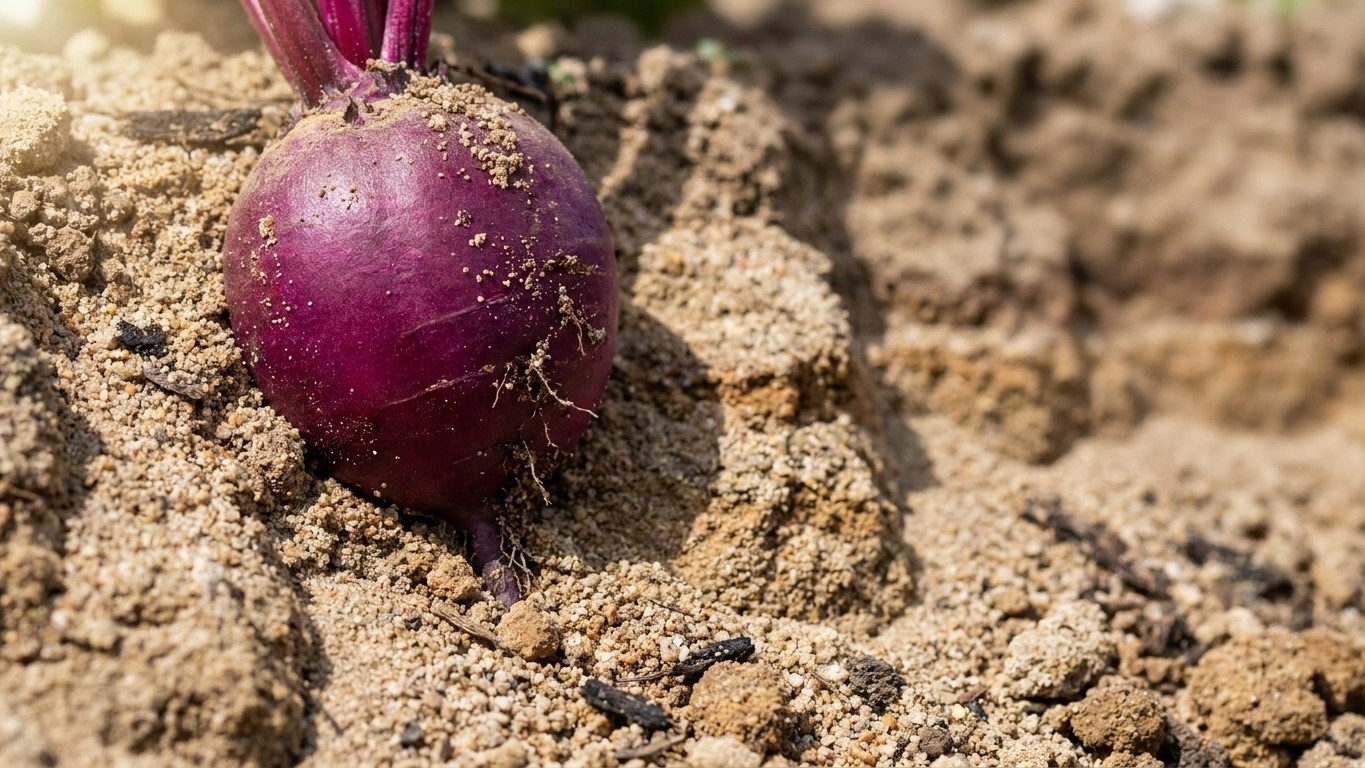

Three things eat into a Saskatchewan beet crop, and each one has its own date. Thirst in the first six weeks sends plants to flower. Heat above 85 F combined with thirst turns the root woody. Storage that is too cold brings on black spot and rot. The province’s dominant soil forgives a lot of mistakes. This page covers those timing problems, not insect pests, because no pest figures are on file here.
The short answer
Start with the ground. The most common soil in Saskatchewan’s mapped agricultural regions is a Chernozem, the deep, dark grassland soil of the prairies, covering 68 percent of the mapped surface, with Solonetzic soils next. Its median surface texture is loam to silt: 43 percent sand, 22 percent clay and 35 percent silt. Organic matter sits near 4.0 percent, median surface pH is about 6.8 (near neutral), and the drainage class is well drained. Those numbers come from the Canadian Soil Information Service at Agriculture and Agri-Food Canada, drawn from 3,675 mapped soil components. Canada has no official provincial soil in the American sense, so there is no single named series here. This is the dominant profile, a median of many measurements.
A province spans hundreds of soils, so treat this as a starting point and not a diagnosis of your bed. River bottoms, low wet ground, and any lot a builder has scraped or filled can look nothing like it. The survey also covers farmland only, so the far north is not represented. A soil test gives you your own pH, and that is the only number that counts for your garden.
Set against what beets want, the dominant profile scores well. Utah State University Extension describes the ideal as deep, sandy, well-drained soil rich in organic matter. Saskatchewan’s typical ground is not sandy, since 43 percent sand makes it a loam. But it drains well and starts with plenty of organic matter, which are the two traits that matter most. A loam also holds more moisture than true sand, which helps in a dry May. The same extension source caps compost at no more than 1 inch of composted organic matter per 100 sq ft. On a Chernozem already near 4.0 percent organic matter, you may want to stay well under that cap. The Beet Soil in Saskatchewan: What the Root Will Meet page goes deeper on what the root meets as it pushes down.
Heat is the second half of the answer, and here the data runs short. The number of days a year that Saskatoon passes 90 F is not published here, so I won’t guess at it. The extension source uses a lower line anyway: heat above 85 F combined with water stress makes the root woody. Hot weather alone does not do it, and neither does thirst alone. It takes both together, which is why a July heat wave is a problem mostly for a bed that has dried out.
The six weeks that decide it here
Beets are sown in place, and the usual advice is to seed 2 to 3 weeks before the last spring frost. Environment and Climate Change Canada puts the average last spring frost at May 18 for the Saskatoon SRC station. Count back and the sowing window runs from about April 27 to May 4. The first six weeks after seeding then run to roughly June 8 through June 15.
Read that May 18 date carefully. It is a mean, not a safe date. In one year out of two, the last frost lands later. Treat it as the middle of a window, not the edge of one. The figure also comes from a single station, and a province is not one climate. Northern and upland districts run weeks behind Saskatoon. The normals also cover an older 30-year period than the figures the US pages on this site use, so don’t line the two up too tightly.
What does the spring in that window usually do? On the open prairie it tends to lean dry, with sharp temperature swings, so a warm, bright week can be followed by a hard cold snap. That pattern puts the bolting risk in the dry stretches between rains. Utah State University Extension says water stress during the first 6 weeks causes premature flowering. A seedbed that dries out in late May or early June is where it happens. A bed watered evenly through those six weeks does not carry that risk.
Woodiness is a separate failure on a separate calendar. Counting from seeding, beets need 60 to 80 days. Seed sown in that window therefore reaches harvest size from about late June to late July, which is peak summer heat. Bolting is decided in the cool, dry weeks of spring, and woodiness is decided later when the roots are sizing up under hot sun. A gardener who waters faithfully in May and then lets the bed dry out in a July heat wave has fixed one problem and left the other open. For a fuller look at dates, see When to Sow Beets in Saskatchewan, and for the crop as a whole, Growing Beets in Saskatchewan.
What goes wrong here
- Bolting after a dry spring. Early water stress sends plants to flower, and a flowering beet is a poor root. Keep the seedbed evenly moist through the first six weeks, and check it during any dry stretch in late May and early June.
- Woody roots in July. This comes from heat above 85 F with water stress, and it is not the same as bolting. Water deeply when a hot spell arrives and the weather has been dry, rather than waiting for the leaves to wilt.
- Frost after sowing. Because May 18 is only the midpoint, half of all years bring a frost later than that. Keep a light cover on hand for the first weeks, and sow nearer the later end of the window if your district runs cold.
- Over-amended or unexamined ground. Heavy compost on a soil that already carries about 4.0 percent organic matter is wasted effort. Stay under 1 inch per 100 sq ft, and send a soil sample off first. If the test shows something far from the typical profile, such as a Solonetzic patch, rely on your own numbers and not the provincial median.
- Cold-storage rot. Every other root crop likes to be stored as cold as possible, but not this one. USDA Handbook 66 says more black spot and rot occur at 32 to 34 F than at slightly higher temperatures, and sets the target for topped roots at 33 to 36 F with 98% humidity. Pits and cellars should stay between 31 F and 41 F. Top the roots first, because bunched beets with leaves last only 10 to 14 days. Keep the big roots for storage, since they lose water and shrivel more slowly, and eat the small ones first.
Common questions
Do I need to add sand to my Saskatchewan garden for beets?
No. The dominant soil is a loam to silt with 43 percent sand, and it already drains well. Adding sand to loam can make the mix set harder. Your own soil test comes first, and loosening the bed deeply does more for a root crop than changing its texture.
Is May 18 a safe date to plant beets in Saskatchewan?
It is the average last spring frost at the Saskatoon SRC station, not a guarantee. In one year out of two the last frost falls later. Beets are normally seeded 2 to 3 weeks before it, so keep a cover handy, and add a few weeks if you garden in a northern or upland district.
How long from seeding to harvest?
Plan on 60 to 80 days, counted from seeding. Beets are sown in place and are not transplanted, so there is no head start from a nursery pot. A late April or early May sowing puts harvest in the hot weeks of summer, when woodiness is the thing to watch.
Should I store beets as cold as my cellar will go?
No. Hold topped roots at 33 to 36 F with very high humidity, because 32 to 34 F brings more black spot and rot. Cut the tops off first, and keep the large roots for storage. The USDA handbook also warns that pits and cellars should not drop below 31 F, so a cellar that creeps below freezing on a hard January night is a bigger risk than one a few degrees warm.