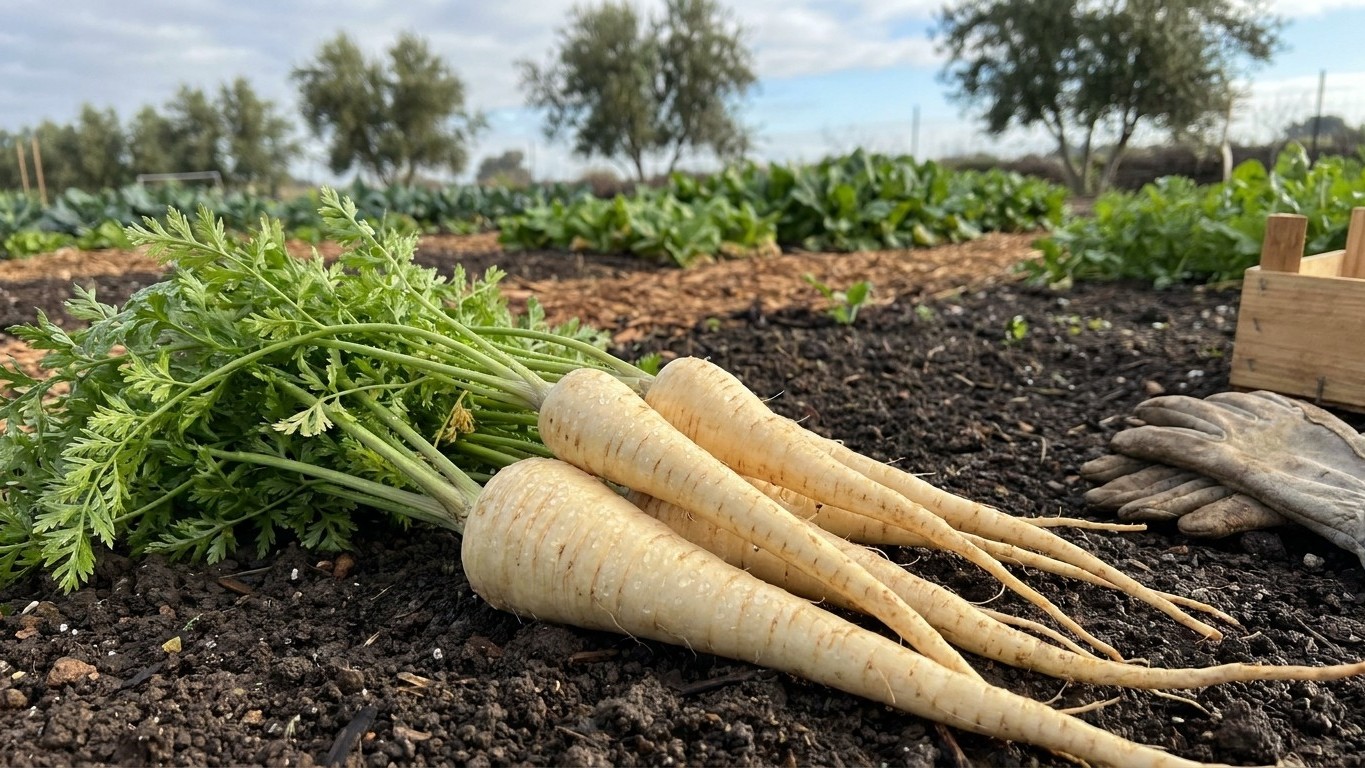

In Georgia, lift parsnips after several weeks of frosty nights. In most of the state that means late December into January, not the first cold snap in November. Seed sown in place needs 100 to 120 days, and germination alone takes 14 to 21 days of bare-looking soil. Once dug, a root can keep four to six months, but only at 32 to 34°F and 98% humidity, and never beside apples. The reasoning behind each number follows.
The short answer
Does Georgia deliver several frosty weeks in a row? Not reliably. At the Atlanta reference station, NOAA NCEI Climate Normals put the mean daily minimum of the coldest month at 35.6°F. That sits above freezing, so the typical January night does not frost. Frost comes in pulses between mild stretches, with the first fall freeze landing somewhere between November 13 and December 1.
That matters because of how the crop works. According to Utah State University Extension, parsnips taste best after several weeks of cool, frosty weather, which converts stored starch to sugar. The trigger is exposure to frost. It is not the hardiness zone, which only tells you whether a plant survives the winter. A parsnip survives Georgia without trouble. It just may not get pushed hard enough to turn sweet.
So the plain verdict: across much of the state, expect a parsnip that grows well and sweetens modestly, if at all. Atlanta is an urban airport heat island, so north Georgia and the mountains freeze several weeks earlier in fall and have better odds. The coastal plain runs milder and has worse ones. The longer discussion lives in Will Parsnips Sweeten in Georgia?, and the full crop calendar is in Growing Parsnips in Georgia.
When to lift
Count from the first frost, not from a calendar date. With the first fall freeze arriving November 13 to December 1 at the Atlanta reference station, a few weeks of frosty weather pushes the first worthwhile digging to mid-December at the earliest, and more often January. Farther north, start earlier. Lift what you need and leave the rest. My own judgment (Utah State gives no date for this) is to clear the bed before the last spring frost window opens in March, which runs March 11 to March 29 here, because roots left through warming weather lose their value.
How long they keep
USDA Agricultural Handbook 66, the commercial storage reference, says parsnip roots can be stored 4 to 6 months at 0 to 1°C (32 to 34°F) with 98% relative humidity. Read that as a ceiling. It assumes those conditions held steady, which almost no house manages. You can read the original in the USDA handbook.
The surprise is what spoils them. Parsnips are not chilling sensitive, so cold is not the danger. Ethylene is. A parsnip makes almost none itself (under 0.1 µL per kg per hour at 68°F), but low levels from nearby apples or ripening fruit cause bitterness, likely through a compound called xanthotoxin. Keep them away from the fruit bowl. Top the roots after harvest, but do not trim into the crown.
Does the season fit?
The arithmetic is short, and it works out in Georgia’s favor. Here it is step by step, using the Atlanta reference station dates.
- Start with the last spring frost: March 11 to March 29.
- Back up two to three weeks to find the sowing window. Three weeks before March 11 is about February 18. Two weeks before March 29 is about March 15. Sow in place, since parsnips resent transplanting, and the 100 to 120 days run from seeding.
- Allow for germination: 14 to 21 days. Nothing visible for two to three weeks is normal. Do not dig up the row and re-sow.
- Add 100 to 120 days from seeding. A February 18 sowing is ready between about May 29 and June 18. A March 15 sowing is ready between about June 23 and July 13.
- Compare with the fall frost window, November 13 to December 1. Even the latest-maturing root is ready months before that, so a spring sowing leaves roughly five to six months of standing time between maturity and the first freeze.
On days alone, the season fits comfortably. It does not run out. If anything, it runs the other way: the crop is finished long before the cold arrives, and the roots wait through a Georgia summer in the ground. That wait is where trouble starts, and What Eats Parsnip in Georgia, and When covers who shows up for them.
Counting backward from the fall frost gives another window, mid-July to late August, if you wanted roots to finish just as cold weather begins. That puts seed in the ground during Georgia’s hottest weeks. The source behind this page does not address summer sowing, and I will not vouch for it. Treat it as an experiment, not a plan.
The real tightness is not in the calendar. It is in the winter that follows, which may offer too few frosty nights for the sugar conversion to finish.
What goes wrong here
- Forked roots from heavy or stony ground. Much of the Piedmont is clay, and clay stops a taproot and splits it. Utah State recommends deep sandy soil and says heavy soil must be double dug. Remove stones as you go. Treat the state soil as a starting point: dig one spade-deep hole in your own bed and see what you actually have.
- Forked roots from overwatering. This is a separate cause with a separate fix. Constantly wet soil can fork roots even in good ground. Water evenly, but let the top of the bed dry between waterings instead of keeping it soggy.
- A season that runs out. Rare in Georgia on paper, but late sowings can get there. Sow between mid-February and mid-March at the Atlanta reference station. Do not mistake the 14 to 21 days of germination for a failed row.
- A winter too mild to sweeten. With a coldest-month mean minimum of 35.6°F, a parsnip can finish as a fine, mild root that never turns sweet. Leave the roots in the ground until frosty weeks have accumulated, and expect better results in north Georgia and the mountains than near the coast. A comfortable hardiness zone is not a substitute for frosty weeks.
- Bitter roots in storage. Ethylene from apples or other ripening fruit is the culprit even at the right temperature. Store parsnips apart from fruit, top them but never cut into the crown, and aim for 32 to 34°F with high humidity.
Common questions
How long until parsnip seed comes up?
Plan on 14 to 21 days. That is slow enough that many gardeners assume the seed failed and dig it up. Keep the row marked and the soil evenly moist, and wait the full three weeks before deciding anything.
Can parsnips stay in Georgia ground all winter?
Cold is not the threat. Parsnips are not chilling sensitive, and Georgia’s coldest-month mean minimum of 35.6°F at the Atlanta reference station is mild. The reason to dig is timing: lift after several frosty weeks, and clear the bed before the March last-frost window of March 11 to March 29 opens. That cutoff is my judgment, not a published threshold.
Can I store parsnips next to apples?
No. Low levels of ethylene in cold storage cause bitterness, and apples and ripening fruit give off exactly that gas. Keep parsnips in a separate drawer or bag, at the right temperature and with high humidity.
How long will parsnips really keep at home?
Four to six months is the figure from USDA Handbook 66, but it assumes 32 to 34°F at 98% humidity held steadily. A home refrigerator rarely holds that, so expect less. This page has no sourced figure for a household fridge, and I will not invent one.