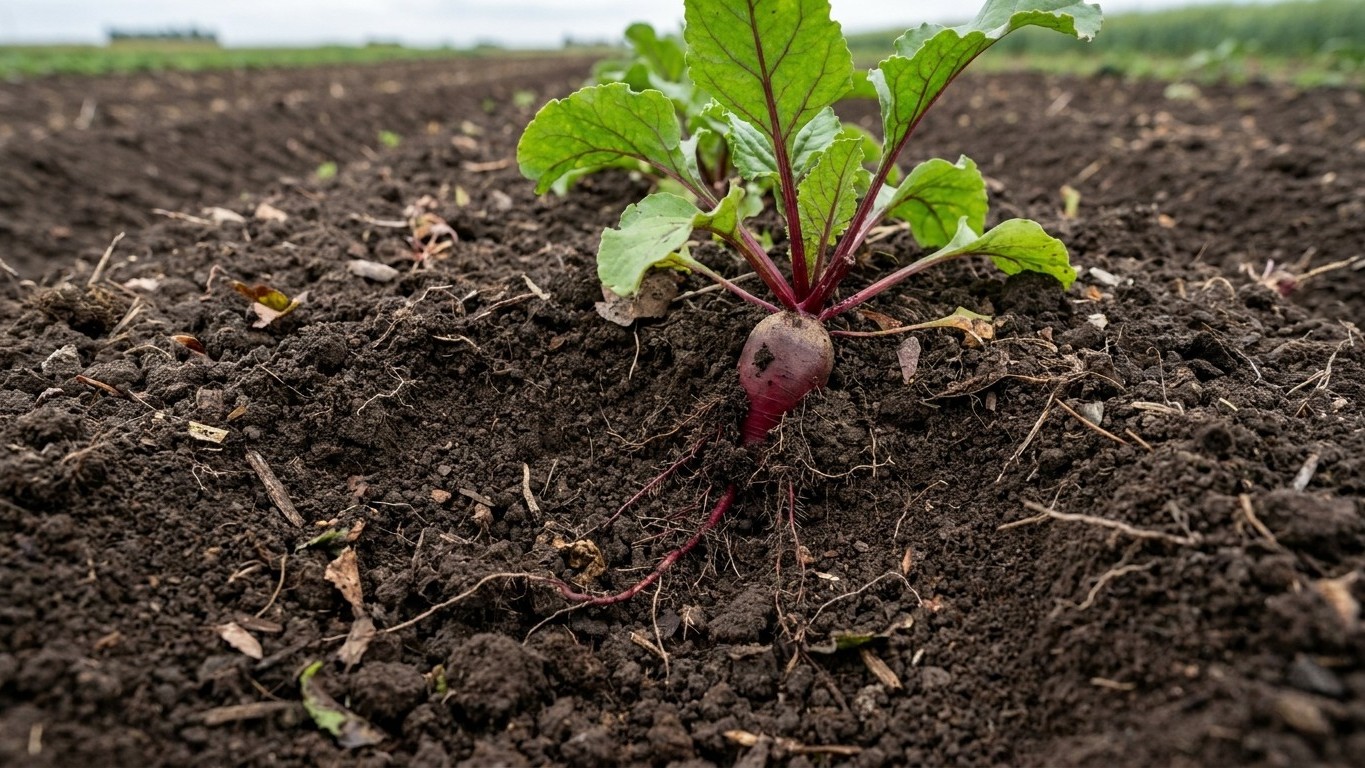

Pull beets 60 to 80 days after seeding, and do it before heat above 85 F catches the bed dry. Then store the topped roots at 33 to 36 F, not at the 32 F that works for carrots and parsnips. Beets in the 32 to 34 F range develop more black spot and rot than beets kept a little warmer. In New Mexico, the sandy ground and the spring winds decide whether you reach harvest with a sweet root or a tough one.
The short answer
Start with the ground. The soil USDA lists as representative of New Mexico is the Penistaja series, an Aridisol, which is a dry-climate soil that is usually alkaline and often carries salts. Its surface layer runs about 69 percent sand, 15 percent clay and 16 percent silt, with a surface pH of about 7.5 and organic matter near 1.4 percent. It is well drained. These are USDA’s representative values for the surface horizon of the series’ major components as mapped (47 components went into the figures). They do not describe a worked garden bed, and they are not your pH.
For a beet, that profile is half good news. Utah State University Extension describes the ideal as deep, sandy, well-drained soil rich in organic matter, and Penistaja delivers the sandy and the well-drained parts. The organic matter is the gap. At 1.4 percent, the soil has little to hold water between irrigations, and sand lets water slip past the roots quickly. A root that wants steady moisture gets feast and famine instead. Extension’s guidance on amending is restrained: no more than 1 inch of composted organic matter per 100 sq ft. More is not better.
One caution before going further. A state spans hundreds of soil series, and this is a starting point, not a diagnosis. River-bottom gardens along the Rio Grande, hill-country lots, and any yard a builder has scraped or filled can differ completely. A soil test gives your number. Our guide to Beet Soil in New Mexico: What the Root Will Meet goes deeper on what to do with the result.
Then comes the heat. The reference station for this page is Albuquerque’s airport, with a last spring frost between March 31 and April 12 according to NOAA NCEI’s U.S. Climate Normals (the 30 to 70 percent probability band). How many days a year that station passes 90 F is not published in the data behind this page, so I won’t guess at a number. The threshold that matters for beets is lower anyway. Extension says heat above 85 F combined with water stress makes the root woody. Woodiness is a late-season failure, tied to the root’s final weeks, and it is a different problem from the early bolting covered below.
Put together, the practical answer is to get the crop out of the ground before the hot, dry stretch arrives. Beets are sown in place, so the 60 to 80 days count from the day the seed goes in. They are not counted from a transplant. A mid-to-late March sowing points to a harvest from roughly early May to mid-June. A beet that sits past that window in sandy ground with irregular water is the one that turns woody.
The six weeks that decide it here
Sowing two to three weeks before the last frost is the usual advice for beets. Against the Albuquerque frost window, that lands between roughly March 10 and March 29. The first six weeks after seeding therefore run through the back half of March, all of April and into early May. Treat those dates as the reference-city figure, not a state-wide guarantee. Suburban and rural gardens typically see the last spring frost one to two weeks later than an airport station, and more than that at elevation. Check your own county before you fix a sowing date.
That stretch of spring in New Mexico is usually dry and swinging. Warm afternoons, cold nights, wind that strips moisture from bare soil. It is not a season that waters a seedbed for you. Anyone who sows and then relies on the sky is gambling.
The bolting risk sits right here. Extension is specific that water stress during the first six weeks causes premature flowering. A beet that flowers puts its energy into a seed stalk instead of a root, and you do not get the root back. In a sandy, low-organic-matter bed, the soil can go from damp to dry in a few days of March wind. So the six-week window is less about the calendar and more about keeping the seedbed evenly moist from germination through the first true leaves and beyond.
Notice what this is not. It is not the heat problem. Early thirst makes a plant bolt. Later heat, past 85 F with the bed running dry, makes a root woody. If you only manage to remember one of them, you will lose a crop to the other. A gardener who waters faithfully in April and then lets the bed dry in June can still pull a fibrous beet from a perfectly healthy plant.
There is a trade-off in the date itself. Sowing earlier gives the root more cool weeks before heat arrives, but it puts the seedbed into the windiest, driest part of spring. Sowing later shortens that risk and lengthens the heat risk at the other end. Since the harvest window is 60 to 80 days from seeding, each week you push the sowing date later pushes the pull date toward the weeks when 85 F becomes ordinary. For a first attempt, aim for the early side of the frost window and put the effort into the watering.
For pests that show up during these weeks, see What Eats Beet in New Mexico, and When. For the full growing calendar, start with Growing Beets in New Mexico.
What goes wrong here
Most failures here trace back to water arriving unevenly or heat arriving before the root is out. A few come after harvest. Here is each one with its fix.
- Bolting in spring. Early water stress in the first six weeks sends the plant to flower. The remedy is a seedbed that never dries out during that window: water shallowly and often at first, since sand empties fast, and mulch lightly once seedlings are up. Check the soil by hand, not by the calendar.
- Woody roots in warm weather. Heat above 85 F with water stress toughens the root. This is a later failure from a separate cause. Pull on schedule, 60 to 80 days from seeding, rather than letting roots stand in the ground through the first hot stretch.
- Sand that drains too well. The Penistaja-type surface is sandy, well drained and low in organic matter, so water and nutrients leave the root zone quickly. Work in composted organic matter, but keep it to no more than 1 inch per 100 sq ft. Then confirm what your own bed needs with a soil test, because your garden may not resemble the state soil at all.
- Storing colder than necessary. This is the mistake that surprises people. USDA Agricultural Handbook 66 notes that at 32 to 34 F, more black spot and rot occur than at higher temperatures. The target for topped beets is 33 to 36 F at 98 percent relative humidity. A fridge crisper set to its coldest and a cellar corner near freezing are both wrong for beets. Cellars and pits should stay between 31 F and 41 F, and the lower end of that range is a limit, not a goal.
- Storing them with the tops on. Bunched beets, leaves attached, keep for about 10 to 14 days at 32 F and above 98 percent humidity, and no longer. Top them first if you want them to last. The greens can be eaten right away.
- Storing the small ones. Large roots keep much better than small ones, because they lose water and shrivel more slowly. Eat the small beets first and put the big ones away. It runs against instinct, since gardeners tend to save the best-looking ones, but the shrivel math favors size.
Handbook 66 is a commercial storage reference, so a home setup will not match its conditions exactly. The direction it gives is still clear: a touch above freezing, very humid, tops removed.
Common questions
How many days after sowing should I pull beets in New Mexico?
Plan on 60 to 80 days counted from seeding, since beets are sown directly in the bed and not transplanted. In the Albuquerque frost window, a sowing between about March 10 and March 29 puts harvest from roughly early May to mid-June. Your own dates will shift with elevation and with how late your last frost runs.
Why is a colder fridge or cellar worse for beets?
The USDA’s storage handbook reports more black spot and rot at 32 to 34 F than at slightly warmer temperatures. It recommends 1 to 2 C, or 33 to 36 F, with 98 percent relative humidity for topped roots. Carrots and other roots are often kept right at freezing, which is why this catches people out. For beets, a degree or two of extra warmth does the job better.
Should I store the big beets or the small ones?
Store the big ones and eat the small ones first. The handbook says large roots keep much better because they lose water and shrivel more slowly. Remove the leaves before storing either size, since bunched beets with tops attached last only about 10 to 14 days.
Does the Penistaja soil description apply to my garden?
Probably not exactly. It is the soil USDA lists as representative of New Mexico, and the state spans hundreds of soil series. A river-valley bed, a hillside lot or a yard filled by a builder can behave very differently, in texture, drainage and pH. Treat the sand, the fast drainage and the alkaline lean as tendencies, then get a soil test for your actual bed. And check your county’s frost dates too, since the March 31 to April 12 window comes from an airport station and rural gardens often run one to two weeks later.