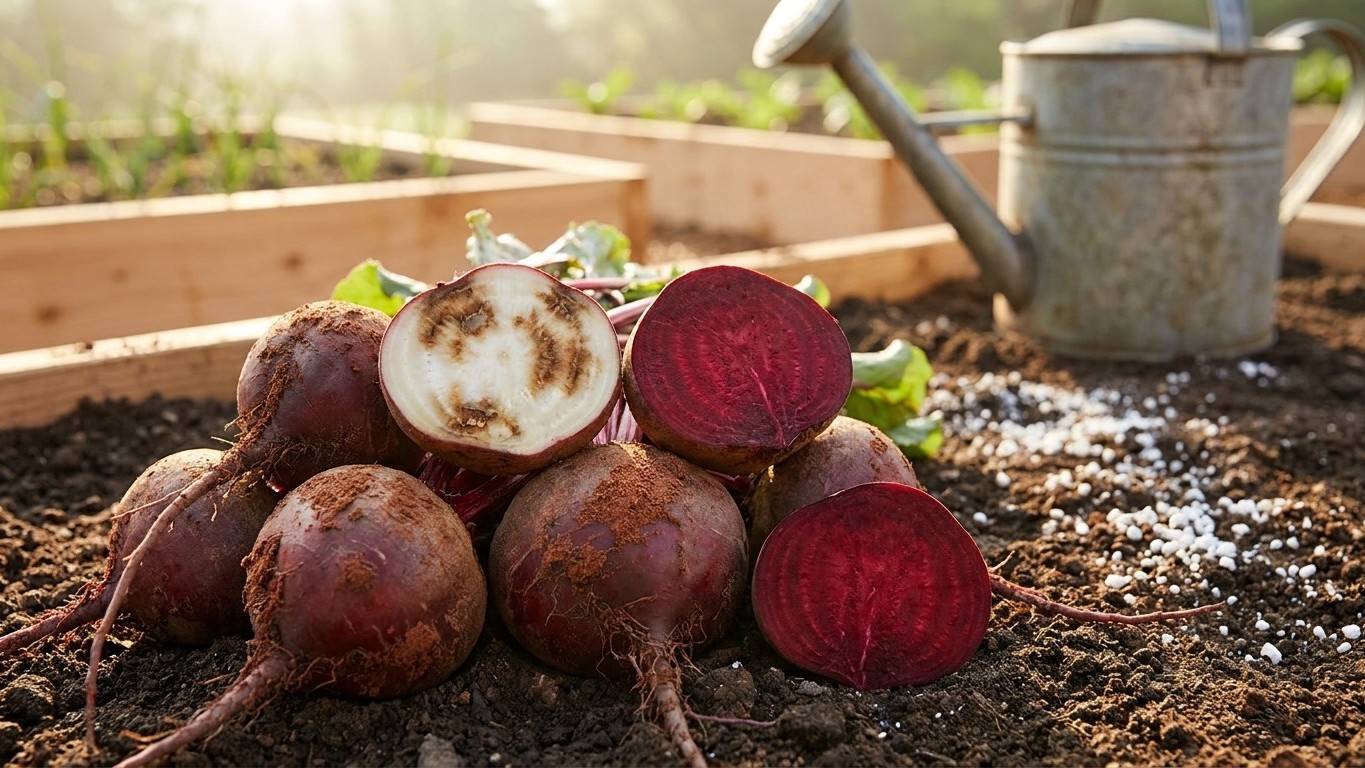

Three things damage beets in Yukon gardens before any insect gets a vote, and each has its own season. Thirst in the first six weeks sends the plant to flower instead of swelling a root. Heat above 85 F, paired with thirst, turns the root woody. A root that survives both can still rot in storage if you keep it colder than instinct says. Pest identification is outside the verified data on this page, so your local extension office is the place for that.
The short answer
The commonest ground in Yukon’s mapped farmland is a Brunisol, a young soil whose horizons are only beginning to separate, typical of recent or coarse parent material. It covers 41 percent of the mapped surface, with Gleysolic soils next. Canada has no official soil series for a province the way each American state does, so this is a dominant profile rather than a named series. The median surface horizon is loam to silt: 47 percent sand, 15 percent clay and 38 percent silt. Its pH is about 6.8, near neutral. Organic matter is about 12.0 percent, and drainage is imperfect. The figures come from Agriculture and Agri-Food Canada’s Canadian Soil Information Service, read from the surface layer of 100 mapped soil components.
Set that against what Utah State University Extension says beets want: deep, sandy, well-drained soil rich in organic matter. The match is partial. Forty-seven percent sand is a decent share, but 38 percent silt holds water, and “imperfectly drained” sits one notch below “well-drained.” Water lingers after a heavy rain. Organic matter is already high, which matters because the same source caps compost at no more than 1 inch per 100 sq ft. A Yukon bed built on this profile rarely needs a thick blanket of amendment. For the full picture of what the root meets underground, see Beet Soil in Yukon: What the Root Will Meet.
Treat all of this as a starting point. A province spans hundreds of soil series, and your garden may look nothing like the median. River bottoms, muskeg and any ground a builder has scraped or filled will behave differently. The survey also covers only the agricultural regions, so the far north isn’t represented at all. The 6.8 is not your pH. A soil test gives you your own number, and it is the only thing that does.
Heat is the other half of the question, and here the honest answer is a gap. The number of days a year the reference city, Whitehorse, passes 90 F isn’t published in the verified data for this page, and I won’t guess one. What the extension source does give is a threshold: heat above 85 F combined with water stress makes the root woody. That is a late failure. Beets are sown in place, never transplanted, and the 60 to 80 days to harvest run from seeding. A sowing in the second half of May therefore has its roots sizing up from mid-July into the second week of August, which is when any hot spell would find them. Woodiness is a different problem from bolting, and the two need different habits.
The six weeks that decide it here
Sow beets 2 to 3 weeks before the last spring frost, and the first six weeks of the crop’s life land in a predictable stretch of the calendar. Environment and Climate Change Canada’s climate normals for the Whitehorse A station put the average last spring frost on June 5. That makes the sowing window roughly May 15 to May 22, and the six weeks run out to late June or the first days of July. For a closer look at timing, When to Sow Beets in Yukon works through the dates.
That June 5 is a mean, not a safe date. In one year out of two the last frost falls later. Treat it as the midpoint of a window, and expect that seedlings sown in mid-May will, in many years, be up and growing before the last frost has passed. The station is also one point on a very large map, and northern or upland districts run weeks behind it. Canadian normals cover a different thirty-year span than the US figures used elsewhere on this site, so comparing a Yukon date with a Lower 48 one is looser than it looks.
What the spring does, whether dry, wet or swinging between the two, isn’t in the verified data here. The sources carry a frost date and no rainfall record, so I won’t characterize it. What can be said is where the risk sits. Utah State University Extension is explicit that water stress in the first six weeks causes premature flowering. The trigger is thirst, not a date on the calendar, so the bolting risk covers the whole of that six-week stretch, from the day the seed goes in until roughly the turn of June into July.
The soil leans in the gardener’s favor on this one. A loam-to-silt surface with high organic matter and imperfect drainage tends to hold moisture rather than shed it. That is the opposite of the hazard on sandy ground. But a median is only a tendency. A raised bed filled with purchased mix, or a patch of coarse river gravel, will dry out much faster than the profile above, and the plant won’t care what the survey says. Check the top few inches by hand in the first weeks, and water when it’s dry rather than on a schedule. Heat damage and the woody root come later, in July and August, and they are a separate matter (see Growing Beets in Yukon for the full season).
What goes wrong here
- Premature flowering. Water stress in the first six weeks pushes the plant to bolt. The remedy is steady moisture from seeding through early July, checked by touch, not by the calendar. A bolted plant won’t go back to making a root.
- Woody roots. Heat above 85 F paired with water stress toughens the root, and this is a different failure from bolting, arriving weeks later. Keep watering through hot spells in July and August, and harvest within the 60 to 80 days from seeding rather than leaving roots to coast.
- Waterlogged ground. The dominant profile is imperfectly drained, one step short of what the extension source wants. If water pools in your bed after rain, build it up above grade rather than hoping, and don’t treat extra compost as a fix.
- Over-amending. With organic matter already near 12.0 percent in the median profile, heaping on compost is unnecessary. Stay at or under 1 inch per 100 sq ft, and let a soil test tell you whether your own bed differs.
- Storing too cold. This one runs against every other root crop’s advice. USDA Agricultural Handbook 66 says more black spot and rot occur at 32 to 34 F than at slightly higher temperatures. Topped roots belong at 33 to 36 F and 98% relative humidity. In a pit or cellar, keep it from dropping below 31 F or rising above 41 F.
- Storing them with their tops on. Bunched beets, leaves attached, keep only about 10 to 14 days at 32 F and above 98% humidity. For anything longer, twist off the tops first.
- Storing the small roots. Large roots keep much better because they lose water and shrivel more slowly. Eat the small ones first and send the big ones to the cellar.
Common questions
Do I sow beets or transplant them?
Sow them in place. The 60 to 80 days to harvest count from seeding, and there is no transplant stage to subtract from that. Aim for 2 to 3 weeks before the last frost, which on average at Whitehorse A is June 5, with the caveat that half of all years run later.
Is the 6.8 soil pH my garden’s pH?
No. It is the median of surface measurements across 100 mapped soil components in Yukon’s agricultural regions. River bottoms, muskeg and disturbed ground will read differently, and the far north isn’t surveyed. Test your own bed before deciding anything about amendments.
Why not store beets as cold as possible?
Because the USDA handbook records more black spot and rot at 32 to 34 F than at a little warmer. Topped roots do better at 33 to 36 F and 98% humidity. In a pit or cellar, stay between 31 F and 41 F. The source is the USDA Agricultural Handbook 66.
Which roots should go into storage?
The big ones. Large roots lose water and shrivel more slowly, so they outlast small ones. Eat the small beets fresh, and keep the leaves on only for the 10 to 14 days that bunched beets will last.