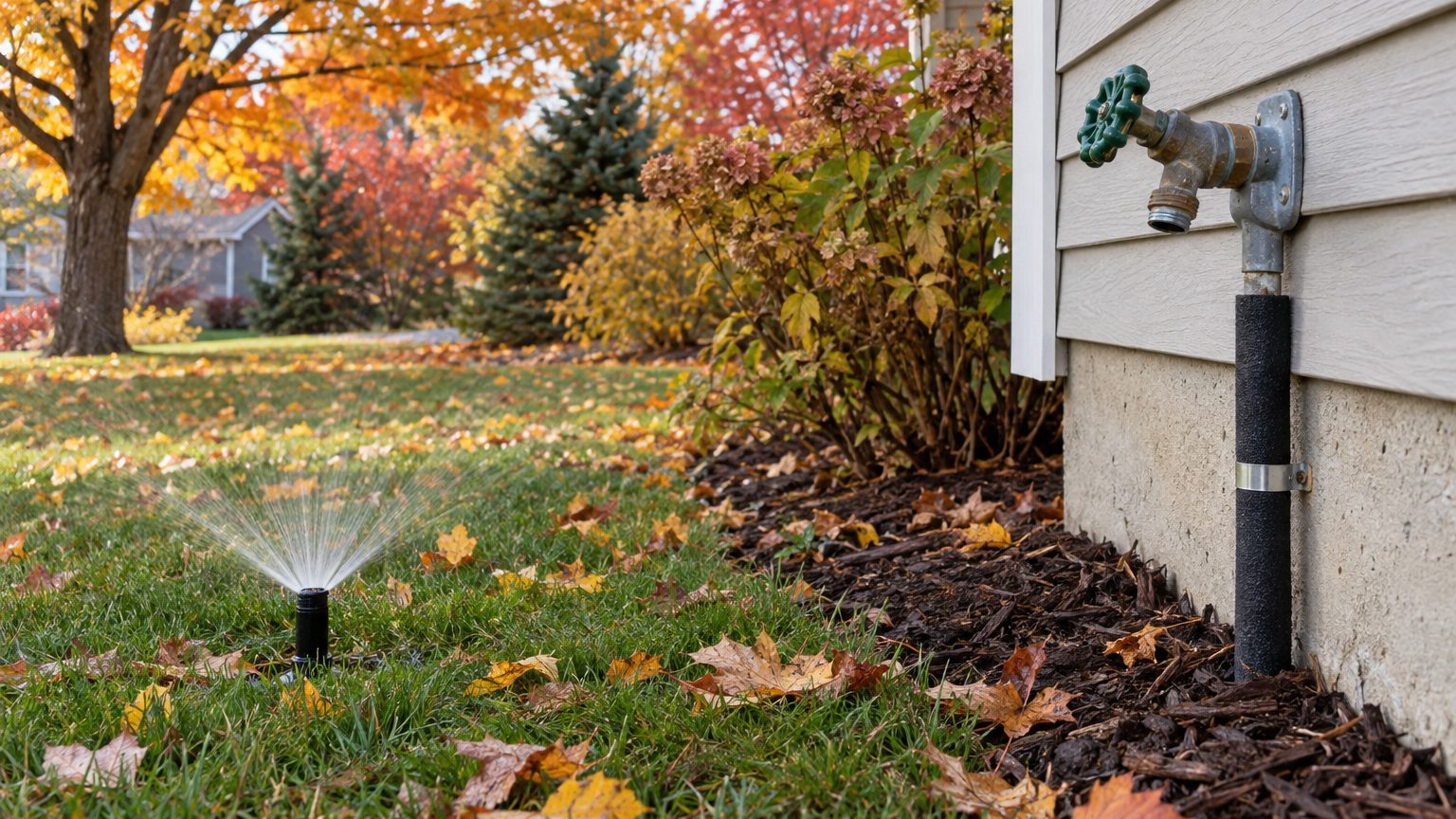

Finish winterizing before the first fall frost. At Albuquerque’s airport weather station, NOAA’s 1991-2020 climate normals put that frost between October 29 and November 9. Higher and colder ground, such as northern mountain towns, gets there sooner, so the work moves earlier too. Hoses come off, sprinkler lines get cleared, and outdoor taps get shut off and drained. The details below cover the timing, the method, and the failures to watch for.
When to do it in New Mexico
Plan to finish before the first fall frost range of October 29 to November 9 opens, and earlier if you live at higher elevation. The rule is before the first hard freeze, not after the first light one. A light frost on a lawn at dawn is a warning. A hard freeze is the night the water inside a pipe turns solid and splits it.
The range comes from NOAA’s NCEI U.S. Climate Normals for 1991-2020, measured at the Albuquerque airport. It marks the band where the odds of a 32°F freeze run between 30 and 70 percent. Treat it as the reference-city figure and not a statewide promise. Suburban and rural properties usually see their first fall frost earlier than an airport runway does, often by one to two weeks, and more at elevation. Your county’s own frost dates are the better guide, and the New Mexico guides cover how conditions shift from region to region.
Why a full winter shutdown is not optional here
Some mild states can skip the blowout. New Mexico is not one of them. The average daily minimum in Albuquerque’s coldest month is 26.4°F (NOAA NCEI Climate Normals, 1991-2020), so the typical low in midwinter sits well below freezing. Plenty of nights run colder than that average. Water left in a sprinkler line or a faucet barrel will have repeated chances to freeze, and it only has to lose once.
The state also covers a huge range of climates. The USDA Plant Hardiness Zone Map (2023) runs from 4b to 9a, built on the average annual extreme minimum temperature. That spread is the reason a neighbor in the desert valley and a friend in a mountain community can’t share one calendar date. In the colder part of the state the first frost comes earlier, so the draining comes earlier as well.
What to do in the weeks before the window
Work backward from the frost range. Give the lawn its last deep watering while the system still runs, then plan the shutdown for a stretch of mild afternoons ahead of the range. If you’re also putting the yard to bed, the steps in Winterizing a Lawn fit into the same weekend. Start watching the extended forecast once the window approaches. A forecast low near freezing means the work should already be done.
One habit worth adopting: don’t wait for a warm spell after the first light frost to finish up. Fall weather in the high desert swings quickly. A mild week can end with a clear, still night, which is the kind that drops temperatures fastest.
Sprinkler lines: drain or blow out
Water expands when it freezes, and a closed pipe has nowhere to put the extra volume. The pressure builds until the weakest point gives way. In an irrigation system that is usually a fitting, a valve body, a sprinkler head, or the above-ground backflow assembly. The damage stays hidden all winter, then shows itself the first time you turn the system on in spring.
Three ways to clear the water
A manual drain uses valves at the low points of the system. You open them, let gravity pull the water out, and close them again in spring. It works on systems that were built with those valves and slope their pipes toward them. An automatic drain valve opens by itself when line pressure drops, releasing water near the valve. It saves effort, but debris can hold one open or closed, and water can stay trapped in sections that do not slope toward the valve.
A compressed-air blowout pushes the water out through the sprinkler heads, one zone at a time. It is the most thorough method because it clears flat runs, uphill sections, and heads that gravity alone leaves wet. It is also the method that can hurt a system when done carelessly. Too much air pressure or running a zone dry for too long can damage heads and fittings. Eye protection matters, because a head can fire debris. Follow the maximum pressure for your pipe type, which is printed in manufacturer documentation and varies with material.
Which one fits this climate
With freezing nights routine from late fall through winter, a blowout (or a careful manual drain on a system designed for it) is the right call for most properties. Automatic drains help, but treat them as a backup, not the whole plan. Whichever method you use, shut off the water supply to the system and clear the lines before the October 29 to November 9 frost window opens at the airport reference station, and sooner at elevation.
Don’t forget the pieces above ground. The backflow preventer, usually a brass or bronze assembly near the house, is the part that freezes and splits most readily because it sits in open air. Close its supply valve, release the water as the manufacturer directs, and consider an insulated cover. Set the controller to its off or rain mode instead of unplugging it, so the schedule survives until spring.
When a professional is the sensible choice
Hire someone if your system has a large number of zones, if you have no compressor large enough to move air through them, or if you aren’t sure where the low points are. The same goes for drip lines, which carry their own quirks, and for any system that split in a previous winter. A professional will have the right equipment and the habit of working zone by zone without overdriving the heads. Book the visit before the cold arrives. The days after a first freeze forecast are a poor time to start calling around.
Outdoor faucets and hoses
The job takes about ten minutes per faucet and involves nothing more than turning valves. Disconnect every hose, splitter, and timer. Find the interior shutoff valve that feeds the outdoor tap (often in a basement, crawlspace, garage, or utility room) and close it. Then open the outside faucet and leave it open, so any water trapped between the two valves drains out. A tap left open with the supply closed has no water behind it to freeze.
Hoses need attention too. Drain each one fully and store it indoors or in a shed. A hose with water in it can freeze solid and burst, and if it stays attached it can carry that freeze straight into the faucet. Lightweight foam covers add some insulation on exposed taps, but they do not replace draining. They slow heat loss. They don’t stop a hard freeze.
Why a frost-free faucet still fails
A frost-free faucet has a long stem that puts the shutoff seat deep inside the warm interior of the wall. The pipe barrel is meant to slope slightly downward, so the water left after you shut it off runs out through the spout. That design works only if the water can leave. A hose left screwed on holds water in the barrel, and the end of that barrel sits where the cold reaches it. The water freezes, the pipe splits, and nothing shows until spring, when the faucet is turned on and the leak runs inside the wall.
The fix is the same as for any other outdoor tap. Remove the hose from every faucet, frost-free or not, before the Oct 29 to Nov 9 first-frost window opens in Albuquerque, and sooner in colder, higher country. For more on how these fixtures work and why they fail, see Frost-Free Outdoor Taps. The full seasonal routine is laid out in Winterizing Outdoor Faucets Before the First Freeze.
If you can’t find an interior shutoff, if the valve won’t close all the way, or if a faucet drips after you have shut it off, call a plumber. Anything beyond turning valves, such as cutting pipe, replacing a faucet, or adjusting the slope of the barrel, is a plumber’s job. Mistakes there can leave water running inside a wall.
What goes wrong here
The most likely failure is timing. A cold snap arrives before anyone has gotten to the work. The airport’s October 29 to November 9 range is an average across years, and colder ground sees its first frost earlier. A homeowner in a higher, colder area who waits for the airport date can find the lines already frozen. In spring the signs are a zone that won’t build pressure, a geyser from a cracked fitting, or a wet patch that won’t dry. Walk the property and close up the system the first time the forecast shows lows approaching freezing, whatever the calendar says.
The forgotten hose comes second. It sits on a faucet through the first freeze, and nothing seems wrong. Then the first spring watering sends water spraying behind a wall, into a basement, or under a floor. Look for damp drywall, a musty smell near the faucet, or a drop in water pressure when you turn the tap on. Prevention is a habit: do a lap of the house and pull every hose, including the one behind the shed. If a pipe has already frozen, Frozen Pipes covers what to do next.
The third failure hides underground. Valve boxes sit low in the soil and collect runoff, so valves inside can stand in water through a freeze. The result is cracked valve bodies, split fittings, or a zone that leaks at the box the day you start the system. Check box lids before winter, make sure each lid is in place and not cracked, and look for standing water. If you find any, have a professional look at the drainage. When you turn the system on in spring, open the supply slowly and watch each zone before trusting it.
Common questions
Can I wait until the first freeze actually hits?
That is the riskiest approach. The goal is to finish before the first hard freeze, and in colder, higher parts of the state, that can arrive earlier than the October 29 to November 9 range NOAA gives for the Albuquerque airport. Work to a date that leaves room, then adjust for your county’s frost data.
Is the Albuquerque date right for my town?
Only roughly. The figures come from one airport weather station. Suburban and rural properties often see a first fall frost one to two weeks earlier, and elevation pushes it earlier still. Check your own county’s frost dates and use the airport range as a starting point.
Do I need a blowout if I have automatic drain valves?
Often yes. Automatic drains release water near the valve, but they can stick, and some pipe runs hold water that never reaches them. A blowout (or a careful manual drain) clears what the automatic valves leave behind. If your system is large or older, a professional can tell you whether the drains are enough.
Do frost-free faucets still need winterizing?
Yes, though the job is shorter. Disconnect the hose, drain it, and store it. A hose left attached traps water in the faucet barrel, and that trapped water is what freezes and splits the pipe. If the faucet has an interior shutoff, closing it and opening the outside tap is the usual extra step. Anything beyond turning valves is work for a plumber.