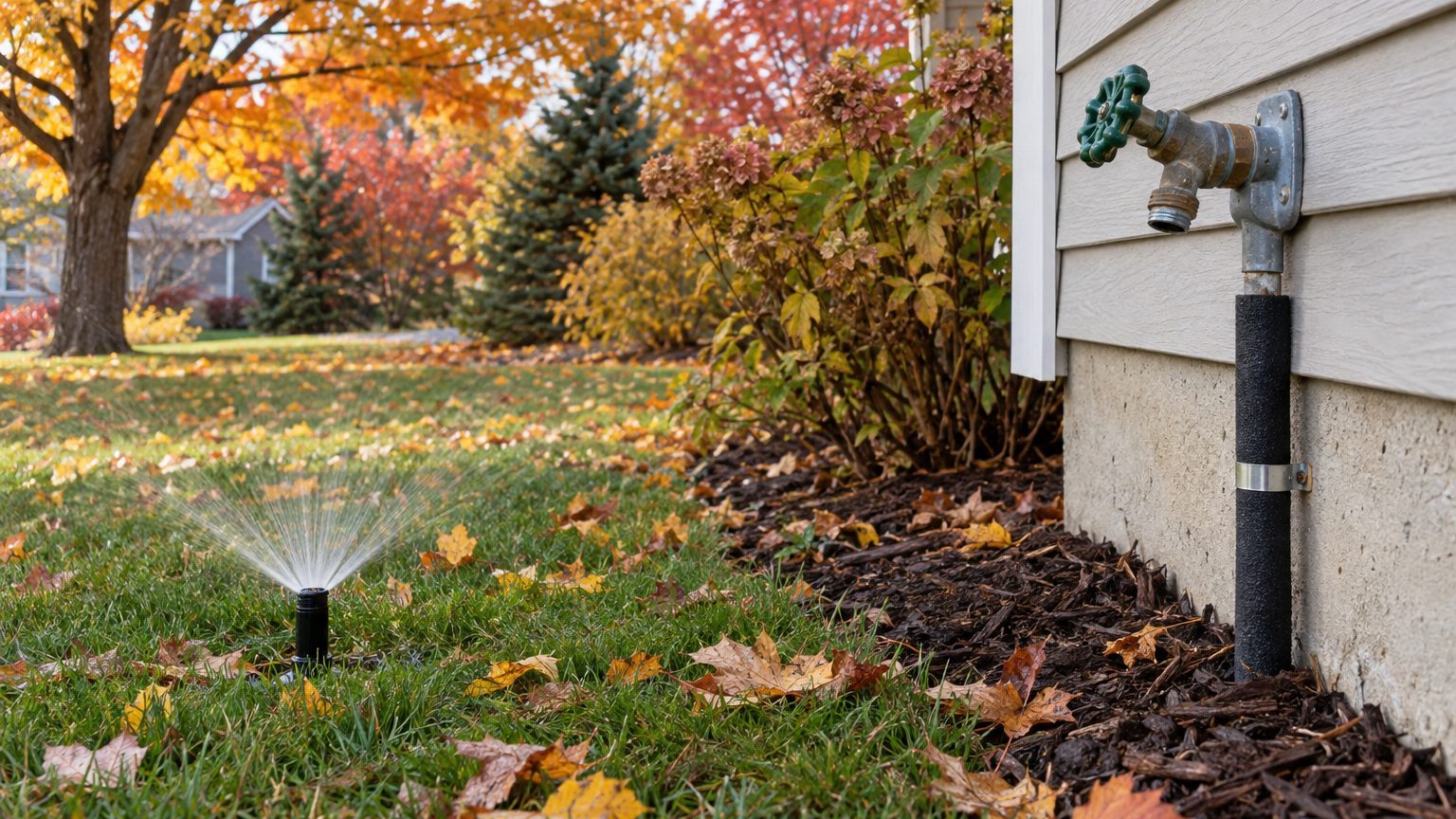

Sprinklers and outdoor spigots should be shut down in the weeks before the first hard freeze, which in central Oklahoma arrives around the turn from October to November. A frost that melts by mid-morning seldom threatens buried lines. A freeze that holds through the night can split a fitting before breakfast. Treat the calendar as a starting point and the forecast as a backstop, and do the work on a mild weekend rather than during the first cold warning.
When to do it in Oklahoma
Winterize before the first hard freeze, not after the first light one. For Oklahoma City, that means having everything drained before the October 29 to November 8 window, the stretch NOAA’s 1991-2020 Climate Normals give for the first fall frost.
NOAA builds that range from 32°F freeze probabilities at the Oklahoma City airport station. It spans the dates when the odds of a freeze having already happened run between 30 and 70 percent. In some years the cold shows up before the range begins, and in others it holds off past the end. The dates describe the middle of the distribution, not a deadline the weather has agreed to honor.
Why Oklahoma doesn’t get a pass
Warm-winter states can often skip the full blowout. Oklahoma can’t. The mean daily minimum of the coldest month at the same reference station is 27.0°F (NOAA NCEI Climate Normals 1991-2020). On an average winter day, then, the overnight low sits below freezing, and averages hide the colder nights on either side. A system left charged all winter will meet plenty of nights cold enough to freeze standing water.
The USDA Plant Hardiness Zone Map 2023 places the state in zones 6a-8a. That is a statewide range, and it tells you the northern and southern parts of Oklahoma live through different winters. The USDA system rests on the average annual extreme minimum, so it describes the coldest night of a typical year. That is the night a pipe splits.
Adjusting the window for your own address
The airport numbers are a reference, not a guarantee. Suburban and rural properties typically see the first fall frost earlier than the airport does, often by one to two weeks, and more at elevation. Farther north or higher up, the first hard freeze comes sooner, so fall tasks like draining move earlier, never later. Look up your own county’s frost dates, then pick a weekend ahead of the earliest date you find, not the middle one.
Sprinkler shutdown also marks the end of the lawn’s watering season, so it pairs naturally with the rest of Winterizing a Lawn. For other seasonal jobs across the state, browse the Oklahoma guides.
Sprinkler lines: drain or blow out
Water expands as it freezes, and a sealed pipe has no room for the extra volume. Ice forms a plug first, and the water trapped between that plug and a closed valve or capped end gets squeezed until something gives. The failure is usually a fitting, a valve body, a riser or the backflow preventer standing above ground. Nothing looks wrong in December. The damage surfaces in spring, when the first zone you run sprays from a crack or the system won’t hold pressure.
Three ways to empty the lines
| Method | How it works | Where it fits in Oklahoma |
|---|---|---|
| Manual drain | You open drain valves at the system’s low points and gravity empties the lines | Systems built with those valves and lines that slope toward them |
| Automatic drain | Valves open on their own when line pressure drops | A safety net, not a primary plan |
| Compressed-air blowout | Air pushed through each zone forces water out of pipes and heads | The thorough choice for most systems, especially when drain points are unknown |
Manual draining costs nothing and makes no noise. It works only if the lines were laid to slope toward the valves and someone remembers where those valves are. Automatic drain valves are a decent backup. Grit and age can leave them stuck, and heads with built-in check valves hold back the water in the pipe above them. That is why they shouldn’t carry the whole job.
Compressed air is the thorough option. With the water supply to the system closed, a compressor connected at the blowout port pushes air through one zone at a time and forces water out through the heads. Stop each zone when the heads spit only mist. Sprinkler heads are built to run wet, and sustained dry air can damage them. Wear eye protection, and stay clear of the backflow preventer and any pressurized pipe while the air is on.
In a state where the average January night bottoms out at 27.0°F (NOAA NCEI Climate Normals 1991-2020, Oklahoma City), the safe default is air. Choose a blowout unless your system has working manual drain valves at every low point. Afterward, set the controller to off or rain mode instead of unplugging it, so the schedule survives until spring. Leave the backflow preventer’s valves in the position its manufacturer recommends, usually partly open, so any leftover water has room to expand.
When a professional is the sensible choice
Plenty of homeowners do this themselves, but some situations call for a pro. If you can’t find the main shutoff or the blowout port, hire one. The same goes for a system with many zones, one that split a line in a previous winter, or one with a buried backflow assembly you’ve never serviced.
The compressor matters too. A small unit may lack the air volume to clear a zone, and an oversized one can exceed what the pipes and heads can take, which bursts them and puts a flying fitting at head height. A licensed irrigation contractor brings the right equipment and knows each zone’s quirks. Schedule the visit well ahead of the first-frost window instead of the week a freeze shows up in the forecast.
Outdoor faucets and hoses
Faucets are the easiest part of the job, and nothing beyond turning valves is required. The sequence is short:
- Pull every hose off its spigot, along with splitters, timers and spray attachments, then drain the hose and coil it indoors.
- Find the interior shutoff valve that feeds each outdoor spigot, usually in a basement, crawlspace or utility room, and close it.
- Open the outdoor spigot fully so the water between the interior valve and the faucet drains out.
- Leave the spigot open through winter, and check that it stops dripping a short while after the interior valve is closed.
If you can’t find the interior shutoff, or the spigot keeps running with that valve closed, stop there. Cutting into pipe, replacing a valve or reworking a fixture is a plumber’s job. For a longer walkthrough, see Winterizing Outdoor Faucets Before the First Freeze.
Why a frost-free faucet still fails with a hose attached
A frost-free faucet puts the valve seat deep inside the heated wall, so the water shuts off in the warm zone. The long barrel in front of that seat is pitched slightly downward, so whatever remains in it runs out each time you close the faucet. The design works only if the barrel can drain, and a connected hose defeats it. Water sits in the hose, and even a hose with its nozzle closed holds enough to keep the barrel from emptying and keep air from entering.
That trapped water freezes in the outer part of the barrel, the part exposed to the weather. The ice can split the pipe, and because the valve is closed, the leak stays hidden until spring. You turn the faucet on and water sprays inside the wall. Disconnect every hose, even from a frost-free faucet, before the first hard freeze. The hardware behind this is covered in Frost-Free Outdoor Taps. If a faucet drips after the hose is off and the interior valve is closed, a plumber should look at it before winter, not after.
What goes wrong here
Oklahoma’s problems rarely come from ignorance of the process. They come from timing and from the one hose somebody forgot. Three failures account for most of the spring surprises.
The cold snap that beats the calendar
The October 29 to November 8 range comes from a 30 to 70 percent probability band, so in some years the first freeze arrives before it. People who plan to winterize “around Halloween” get caught by the early year. The spring evidence is a sprinkler head cracked at the base, a zone that sprays from the ground, or a system that won’t build pressure.
The fix is to schedule the work for a mild weekend before the window opens. If a freeze is already forecast and nothing is drained, shut off the water to the system, open any drain valves, take the hoses off and open the outdoor spigots. That is a partial rescue, not a substitute. If something does freeze, Frozen Pipes covers what to do and what to leave alone.
Forgotten hoses and flooded valve boxes
The forgotten hose is usually at the back of the house, in the garage, or tied to a rain-barrel pump. It shows up in spring as a damp wall, a stained ceiling below a spigot, or a drip you hear in the crawlspace once the water is back on. The prevention is a walk around the whole property the day you winterize, with a list of every spigot.
Valve boxes fail more quietly. A box that fills with water over fall rains leaves its valves sitting in water that can freeze solid. In spring that looks like a valve that cracked, a zone that won’t shut off, or a hiss from the box. Check every valve box for standing water after the blowout and before the first-frost window. Clear what you can reach, seat the lid firmly, and call a pro if a box keeps flooding, since a repair there means cutting into buried pipe.
Common questions
Can I wait until a freeze shows up in the forecast?
You can, but you’ll be working against the clock. The point is to finish before the first hard freeze, and a forecast gives only a short warning. The NOAA first-frost range of October 29 to November 8 for Oklahoma City comes from a 30 to 70 percent probability band, so some years the cold comes early. Do the job ahead of that range.
Do I still need a blowout after a mild winter?
Yes, because you can’t know a winter is mild until it’s over. The coldest month’s mean daily minimum at the Oklahoma City reference station is 27.0°F (NOAA NCEI Climate Normals 1991-2020), and one hard night is enough to split a fitting. A blowout is far cheaper than digging up a line.
Do the dates change outside Oklahoma City?
They do. The figures come from an airport weather station, and suburban and rural properties typically see the first fall frost one to two weeks earlier, with more of a gap at elevation. Farther north and higher up, the first hard freeze comes sooner, so move the work earlier. The USDA Plant Hardiness Zone Map 2023 lists the state at 6a-8a, a reminder that conditions vary a lot. Check your own county’s frost dates.
What if a freeze has already hit and I haven’t drained anything?
Remove the hoses, close the interior valves and open the outdoor spigots. If the system might still hold ice, don’t run it to test. Wait for a thaw and look for cracks first. When the weather warms, blow out or drain the lines as soon as you can, because the next freeze is rarely far behind. Slow, careful steps beat flipping the system on to see if it works.