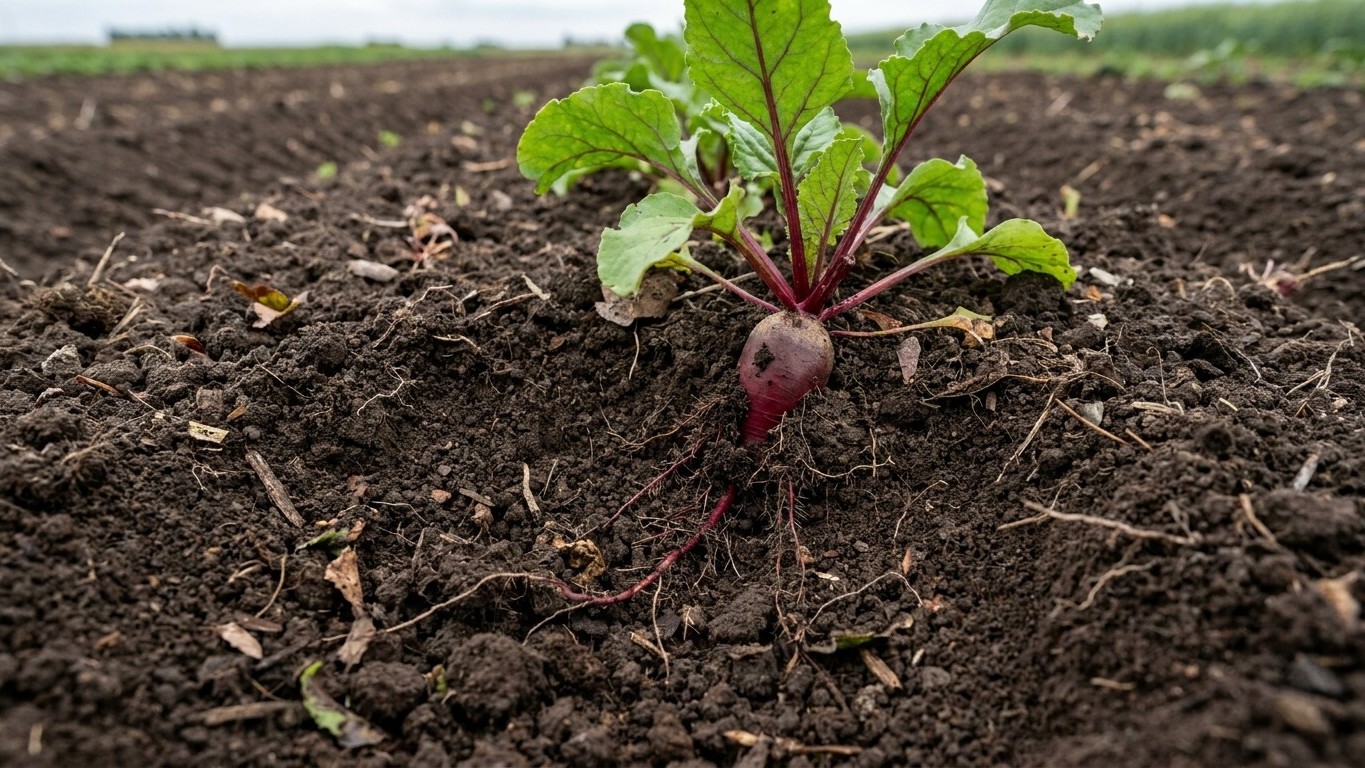

Count 60 to 80 days from the day the seed goes into the ground, and pull beets inside that window, before summer heat and dry spells turn the root woody. At the Toronto reference station, an early-to-mid April sowing lands that window between early June and early July in an average year. Roots headed for storage break the usual root-crop rule: top them, then hold them at 33 to 36 F. Colder than that produces more black spot and rot.
The short answer
Start with the ground. In the Canadian soil survey run by Agriculture and Agri-Food Canada, the commonest soil order among Ontario’s mapped surface horizons is a Luvisol: a forest soil where clay has washed down out of the surface layer, leaving the top lighter and the subsoil denser. Luvisols cover 39 percent of the mapped surface, with Gleysolic soils next. The median surface horizon is loam to silt, at 43 percent sand, 17 percent clay and 41 percent silt. Organic matter sits near 4.3 percent, the median pH is about 6.5 (slightly acid), and the drainage class is well drained.
Treat that as a starting point, not a diagnosis. Canada has no official provincial soil the way each American state does, so this is the dominant profile, the median of 846 mapped soil components. Ontario spans hundreds of soils. River bottoms, wet pockets and any lot a builder has scraped or filled can look nothing like it, and the survey covers the agricultural regions, not the far north. The 6.5 is the province’s median, not your pH. A soil test gives you your own number, and the Beet Soil in Ontario: What the Root Will Meet page goes deeper on what to do with it.
Here is what the median means for a beet. Utah State University Extension, the authority this page leans on, wants deep, sandy, well-drained soil rich in organic matter, amended with no more than 1 inch of composted organic matter per 100 sq ft. Ontario’s typical surface is well drained and decently rich in organic matter, which is good news. It is also about as silty as it is sandy, so it is less loose than the ideal, and a denser subsoil waits below the lighter top layer. A beet is mostly root, so that denser layer is where the root meets resistance.
Heat is the second half of the answer. The source ties woody roots to heat above 85 F combined with water stress. How many days a year the Toronto reference station passes 90 F is not published in the figures behind this page, so no number is offered here. The source’s trigger sits lower than 90 anyway, so a hot, dry stretch can start the damage before the thermometer reaches that mark.
Two separate failures hide in that guidance, and they should not be merged into “keep it watered.” Water stress in the first six weeks causes premature flowering, which is bolting. Heat with water stress later makes the root woody. One happens early in the crop’s life, the other as the roots size up. The way to dodge the second is to pull on time, in the 60 to 80 day window from seeding. Beets are sown in place, so those days never run from a transplant. For the full picture of the crop, see Growing Beets in Ontario.
The six weeks that decide it here
Sowing 2 to 3 weeks before the last frost fixes a crop’s first six weeks to a known stretch of spring. Environment and Climate Change Canada’s climate normals put the average last spring frost at the Toronto Lester B. Pearson station on April 30. Two to three weeks earlier is April 9 to April 16, and six weeks on from there runs to roughly May 21 to May 28.
That April 30 is a mean date, not a safe one. In one year out of two, the last frost falls later. Think of it as the midpoint of a window. The figure also comes from one station, and a province is not one climate: northern and upland districts run weeks behind Toronto. The Canadian normals also cover an older 30-year period than the US figures used elsewhere on this site, so don’t compare the two line for line.
What does that stretch of spring usually do? The figures behind this page hold no rainfall record, so this is the general pattern, not a measured one. Ontario springs tend to swing, with cold, soggy spells that give way to sudden warm, windy days. For a beet, the risk is the swing. A surface that was soaked on Tuesday can dry fast by the weekend, and that is where early thirst, the trigger for bolting, shows up. The silty loam described above can also form a crust as it dries, a barrier for seedlings still coming up. Bolting risk therefore sits in the dry half of the swing during those first six weeks, not in the cold, wet half.
The pest side of that spring is a separate story, covered in What Eats Beet in Ontario, and When.
Count forward from the sowing date. Seed that goes in between April 9 and April 16 is ready 60 to 80 days later, so from about June 8 to July 5. Delay the sowing a week because the soil is cold and wet, and the whole window slides a week toward summer heat. That is the real cost of waiting for a “safe” date: the harvest window drifts toward the days when heat and thirst turn roots woody. Pulling at the early end of the window, while the roots are tender, is a better bet than leaving them to size up through a hot July.
What goes wrong here
- Bolting from early thirst. Water stress in the first six weeks sets plants flowering. Ontario’s swinging spring makes dry spells likely, even on well-drained ground. Remedy: water steadily through those six weeks, especially after the surface dries between rains. Check the soil an inch or two down, not just the crust.
- Woody roots from later heat. This is a different failure, driven by heat above 85 F plus water stress once the roots are sizing up. Remedy: harvest inside the 60 to 80 day window, and do not leave roots in the ground through a hot, dry stretch.
- Roots that meet the dense layer. A Luvisol’s lighter top sits over a denser subsoil. Remedy: loosen the bed deeper than the surface layer, and don’t try to fix it with heavy compost. Utah State University Extension caps amendment at 1 inch of composted organic matter per 100 sq ft.
- Wet ground. Gleysolic soils, the second most common mapped order, are the ones that stay wet, and they differ from the well-drained median. Remedy: if water pools in your bed, raise it or pick a drier spot.
- Treating April 30 as safe. It is the midpoint of a window, and half of years bring frost after it. Remedy: sow within the 2 to 3 week window ahead of it, and expect to adjust if you are north of Toronto or on higher ground.
- Storing them too cold. USDA Agricultural Handbook 66 reports more black spot and rot at 32 to 34 F than at slightly warmer temperatures. Remedy: hold topped roots at 33 to 36 F and 98% relative humidity.
- Storing them with the leaves on. Bunched beets keep only about 10 to 14 days, at 32 F and above 98% humidity. Remedy: top them first.
- Saving the small roots. Small roots lose water and shrivel faster. Remedy: eat the small ones first, and keep the big roots for storage.
Common questions
What temperature should stored beets be kept at?
For topped roots, USDA Agricultural Handbook 66 gives 33 to 36 F (1 to 2 °C) with 98% relative humidity. Freezing point is not the goal. The same source reports that storage at 32 to 34 F brings more black spot and rot than a little warmer does, so a fridge crisper set to its coldest is not an upgrade. The handbook is available at the USDA Agricultural Research Service.
How long do beets last with the leaves on?
Bunched beets keep for about 10 to 14 days at 32 F and above 98% humidity, and no longer. That is why topping comes first. Cut the leaves off before storing, and eat the greens in that first stretch.
Which beets should I store, and which should I eat first?
Keep the big roots for storage and eat the small ones soon after harvest. The handbook notes that large roots keep much better because they lose water and shrivel more slowly. Small roots dry out quickly, so they are the ones to cook first.
Can I store beets in a cellar or a pit?
Yes, with a limit at each end. The handbook says the temperature in pits (clamps) and cellars should not drop below 31 F or exceed 41 F. Because 32 to 34 F brings more black spot and rot, aim for the 33 to 36 F band inside that range, not the bottom of it.