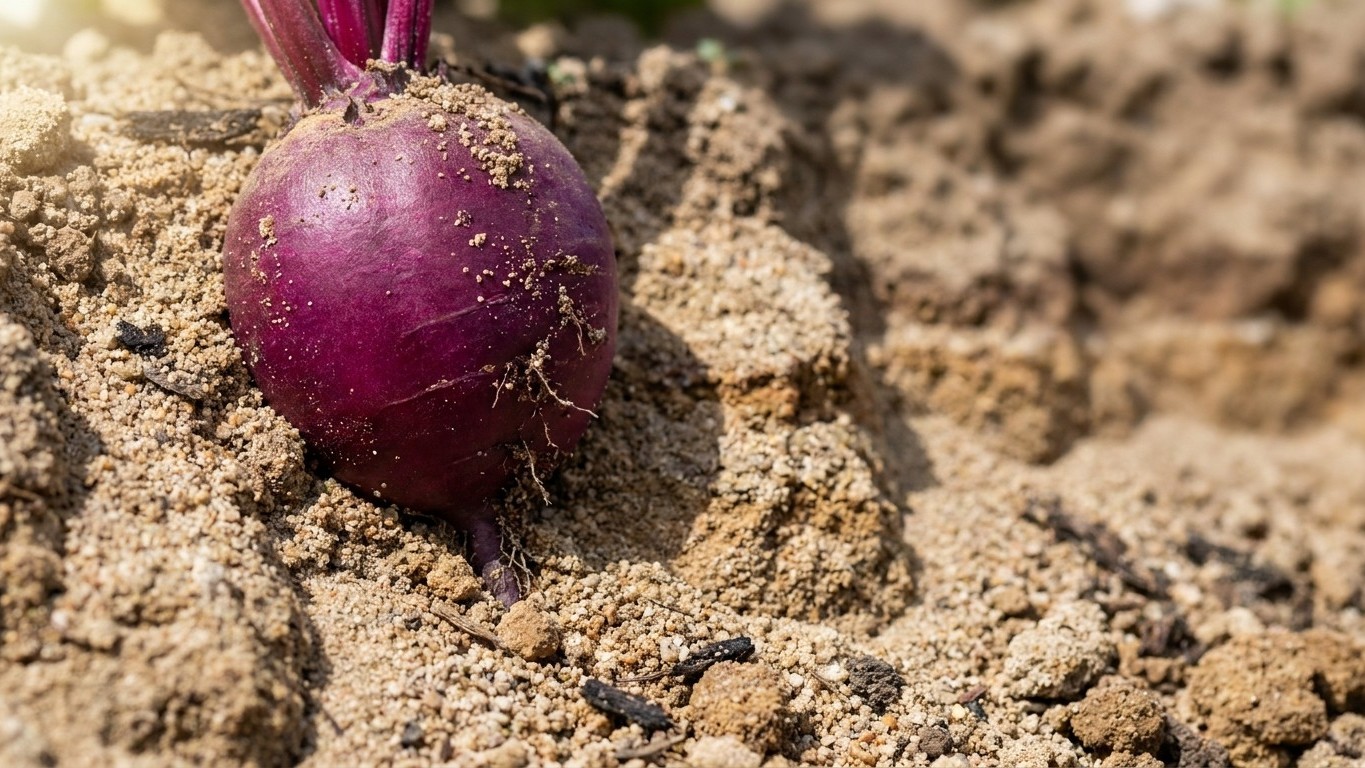

Count 60 to 80 days from the day the seed goes into the ground, not from any transplant, because beets are sown in place. Around Montreal, a row sown in mid-April in an average spring is ready between mid-June and the second week of July, and later sowings simply move the clock. Roots meant for storage follow different rules. Lift them in autumn, top them, and hold them at 33 to 36 °F, not as cold as you can manage. Colder storage invites black spot and rot.
The short answer
Quebec’s most common mapped soil is a Podzol, the acid, leached ground that forms under conifers, where rain has washed the bases out of the surface. It covers 36 percent of the mapped surface, with Gleysolic soils next. The median surface layer in Agriculture and Agri-Food Canada’s soil survey (248 mapped components, agricultural regions only) has a pH of about 5.5, which is slightly acid. Its texture is a loam of 51 percent sand, 15 percent clay and 34 percent silt. Organic matter runs about 6.2 percent, and drainage is rated well drained.
Treat all of that as a starting point. Canada has no official provincial soil the way each US state does, so this is the dominant profile, not a single named series. The province spans hundreds of soils, the far north is not in the survey, and river bottoms, muskeg and any lot a builder has scraped or filled will behave nothing like the median. That pH is not your pH. A soil test gives you your own number, and Beet Soil in Quebec: What the Root Will Meet walks through what to do with it.
Set against what a beet wants, the median looks friendly. Utah State University Extension describes the ideal as deep, sandy, well-drained soil rich in organic matter. Sand is the biggest fraction here, clay is low enough that a swelling root rarely hits a brick wall, and organic matter is generous. The same extension guide caps compost at no more than 1 inch of composted organic matter per 100 sq ft, which means a garden already near the median has little reason to pile more on.
Fast drainage cuts both ways, though. Ground that never stays soggy also dries quickly, and that matters because of the two separate ways a beet can fail. Water stress in the first 6 weeks causes premature flowering, which is bolting. Later, heat above 85 F combined with water stress makes the root woody. One happens to seedlings and young plants, the other to a root already sizing up, and a single “keep it watered” does not cover both.
How often Montreal passes 90 F in a year is not among the figures published for this page, so I won’t guess at it. What the source does give is the 85 F line, and a sandy, quick-draining bed is exactly the kind that lets a heat spell and a dry spell arrive together. Beets sown in the Growing Beets in Quebec calendar and harvested on schedule tend to dodge the worst of this, but the schedule starts with the frost date.
The six weeks that decide it here
Sowing 2 to 3 weeks before the last spring frost is the standard timing, and the reference point is the average last frost near Montreal: May 6, from Environment and Climate Change Canada’s climate normals at the Montreal/St-Hubert A station. Count back and you get roughly April 15 to April 22 for the first sowing in an average year. The first six weeks then run to about the end of May or the first days of June.
Read May 6 carefully, though. It is a mean date, the midpoint of a window, not a safe date. In one year out of two the last frost falls later than that. And a province is not one climate: the St-Hubert station sits in the Montreal lowlands, while northern and upland districts run weeks behind it. If you garden in the Laurentians or north of Quebec City, shift your own calendar later and watch your local thermometer rather than the Montreal number.
What does that early stretch of spring usually do? It swings. Snowmelt leaves the ground wet in April, but a well-drained Podzol sheds that water faster than a heavy clay would, so the damp window is short. Warm afternoons and cold nights trade places through May, and a week of dry wind can follow a soggy one without much warning. For a beet on this kind of ground, the bolting risk sits in the dry gaps. The seed germinates on April moisture, then the topsoil dries out in the second or third week, exactly when the seedlings are small and shallow-rooted.
That makes the first six weeks a watching job more than a watering schedule. Check the soil a couple of inches down rather than judging by the surface, which dries first. If it is dry at that depth, water. A light mulch between rows slows evaporation on sandy ground. Pests also hit young plantings hard in this stretch, and What Eats Beet in Quebec, and When covers who shows up and when.
Count the days from seeding, and write the sowing date on a plant tag or in a notebook. A beet sown in mid-April and one sown a month later are not on the same clock, and guessing from the size of the tops is how people pull too early or leave roots until they turn tough. The 60 to 80 day range is wide for a reason: cool spring weather stretches it, a warm one shortens it.
What goes wrong here
- Bolting after a dry gap in spring. Fast-draining ground can dry out within days, and thirst in the first 6 weeks is what triggers premature flowering. Remedy: check moisture a couple of inches down, water when it is dry there, and mulch lightly once seedlings are up.
- Woody roots in a hot stretch. Heat above 85 F with water stress is the cause, and it strikes later than bolting, on roots already sizing up. Remedy: keep water steady through any hot spell, and pull on schedule instead of leaving roots in the ground out of habit.
- Trusting May 6 as a safe date. It is a mean from one station, and the frost comes later in one year out of two. Remedy: treat it as the middle of a window, and hold back a second sowing if the forecast still shows frost.
- Over-amending a soil that is already rich. The median surface layer carries about 6.2 percent organic matter, and the extension limit is no more than 1 inch of composted organic matter per 100 sq ft. Remedy: test first, then add compost only if the result calls for it.
- Assuming your bed matches the median. A Podzol is only the commonest profile, and Gleysolic soils, the next most common, form where water lingers. Scraped or filled lots differ again. Remedy: get your own soil test before you adjust anything.
- Storing too cold. At 32 to 34 °F, the USDA handbook reports more black spot and rot than at slightly warmer temperatures. Remedy: aim for 33 to 36 °F and 98 percent humidity for topped roots, and keep pits and cellars between 31 and 41 °F.
- Storing with the leaves on. Bunched beets last only 10 to 14 days at 32 °F and above 98 percent humidity. Remedy: top the roots first if you want them to last into winter.
- Saving the small roots. Large roots keep much better because they lose water and shrivel more slowly. Remedy: eat the small ones first and put the big ones away.
Common questions
How long after sowing can I pull beets?
Plan on 60 to 80 days from seeding. Beets are sown directly in the garden, so there is no transplant date to count from. Sown around April 15 to 22 in an average Montreal-area spring, that points to mid-June through the second week of July.
Is a colder storage spot always better for beets?
No, and that surprises people who store carrots or cabbage. The USDA Agricultural Handbook 66 puts topped beets at 33 to 36 °F with 98 percent humidity, and notes that storage at 32 to 34 °F produces more black spot and rot than somewhat warmer conditions. For pits and cellars the stated floor is 31 F and the ceiling 41 F.
When do I get a fall frost date for Quebec?
This page does not publish one. The only frost figure here is the average last spring frost of May 6 at the Montreal/St-Hubert A station. For fall, use your own local forecast and lift roots on your schedule, keeping the handbook’s 31 F cellar floor in mind as the coldest a stored root should ever meet.
Which roots should I keep and which should I eat?
Keep the big ones. The handbook states that large roots keep much better than small ones, which lose water and shrivel faster. Eat the small beets in the first weeks after harvest, and top everything before it goes into the cellar, since bunched beets with their leaves attached last only 10 to 14 days.