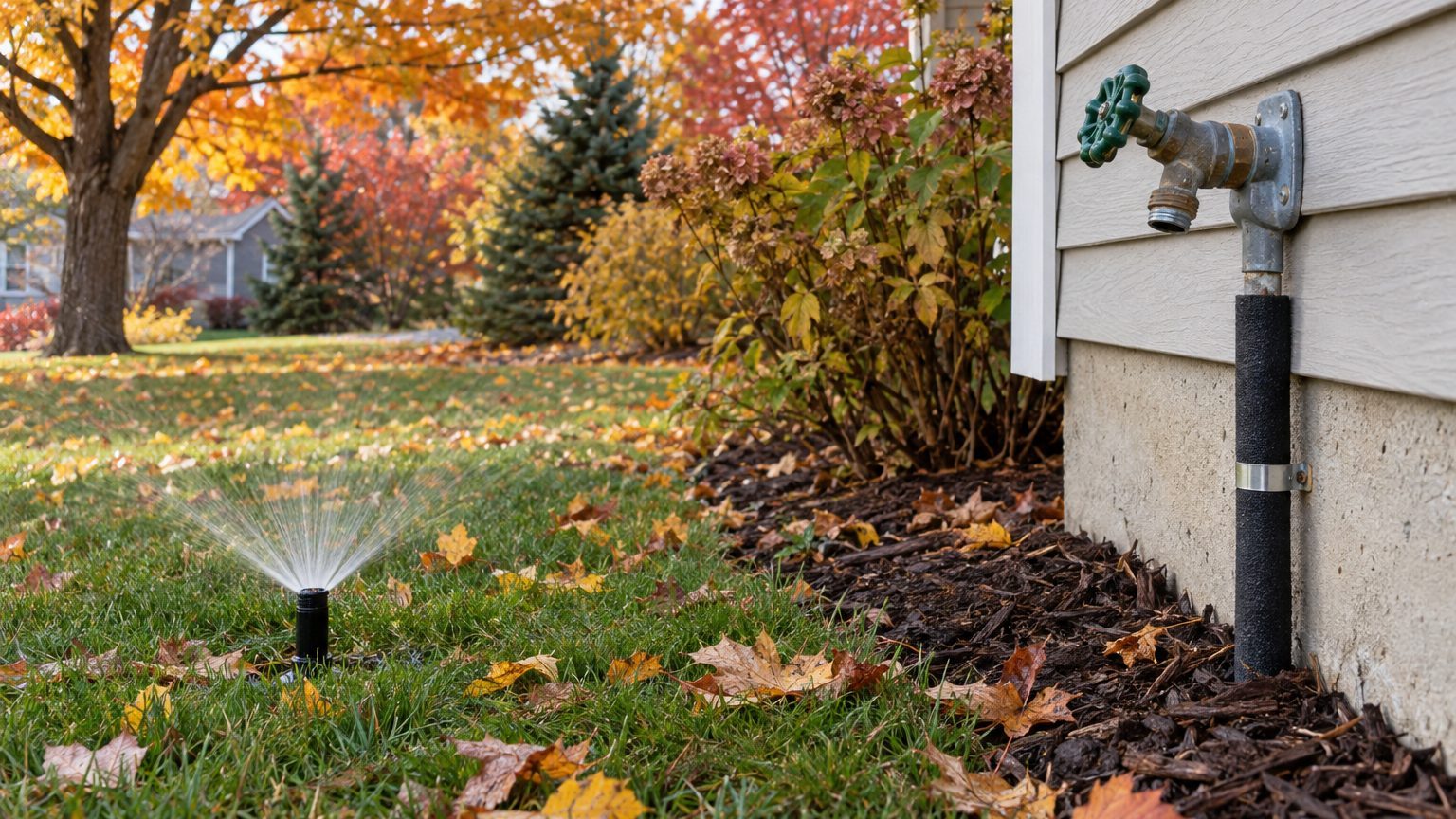

Saskatchewan gives you a short fall and a long, hard winter, and sprinkler lines and outdoor faucets have to be empty before the two meet. Drain them in September, ahead of the first hard freeze. Skip the job and ice does the plumbing for you: split fittings, cracked valves, and a leak that shows up the day you turn the water back on in spring. The timing, the method for each part of the system and the usual ways it goes wrong are below.
When to do it in Saskatchewan
Plan to have everything drained between early September and the third week of September, before the first hard freeze, not after the first light one. That window is built around Environment and Climate Change Canada’s 1981-2010 Canadian Climate Normals for the Saskatoon SRC station, which put the average first fall frost on September 18.
Average is the operative word. It is a midpoint, not a safe date. In roughly half of years the first frost arrives later than September 18, and in the other half it arrives earlier. Treat that date as the middle of your window, not the deadline. A job finished before it leaves room for the years when fall turns early.
Light frost versus hard freeze
A light frost is a clear, still night that dips just under freezing. It blackens tomato vines and squash leaves, and by midmorning it is gone. Water in buried pipe sits in soil that is still holding summer heat, so it barely notices. A hard freeze is different. The cold settles in, stays through the day, and repeats night after night until it reaches the parts of the system that sit above ground or near the surface: hose bibs, the backflow device, exposed fittings, and any hose with water still in it.
That is why the first light frost works as a warning rather than a trigger. If you are still waiting for the garden to die back before you call anyone about the sprinklers, you are already late. Book the work early, and let the frost forecast confirm your timing instead of setting it.
Why there is no “skip it” option here
In a climate where winter lows stay above freezing, a full blowout is often unnecessary, and a faucet cover and a closed valve can be enough. Saskatchewan is not that climate. ECCC’s 1981-2010 normals for Saskatoon give a mean daily minimum of -20.7 °C (-5.3 °F) in the coldest month. Those are typical nights, not record lows. Natural Resources Canada places Saskatoon in Canadian plant hardiness zone 3a (a Canadian system, built on several climate variables, that does not convert to a USDA zone). Frozen ground and frozen pipes are the normal course of events, so every line and every outdoor faucet gets emptied.
One caution on the station. Saskatoon is one point on a large province. Northern and upland districts get their first fall frost earlier, which means the whole draining routine moves earlier there too. Fall lawn care runs on a similar calendar; the steps are covered in Winterizing a Lawn.
Sprinkler lines: drain or blow out
Why water left behind does the damage
Water expands as it turns to ice, and a closed pipe has nowhere to give. The pipe, fitting or valve body splits at its weakest point. The ice also acts as a plug, so the damage can sit hidden until spring thaw, when water returns and sprays from a crack you could not see in October. Valves are the most vulnerable parts because their internal chambers hold water in pockets that gravity will not clear. Sprinkler heads, risers and the backflow preventer near the house are exposed to the coldest air.
A sprinkler repair in spring is usually dug-up lawn, a flooded valve box and a wait for parts. Prevention is a few hours in September.
Three ways to empty a system
| Method | How it works | Weak point | Fit for Saskatchewan |
|---|---|---|---|
| Manual drain | Open drain valves at the low points of the lines and let gravity empty them | Only works if every line slopes to a drain; pockets stay full | Unreliable on level prairie lots |
| Automatic drain | Valves open on their own when water pressure drops and let lines drain | Valves can stick or clog, and they only empty what sits above them | A helpful backup, not a plan |
| Compressed-air blowout | Air forced through each zone pushes the remaining water out of pipes and heads | Wrong air volume or pressure can damage heads and fittings | The standard answer for this climate |
Manual and automatic drains rely on gravity and good grading, and on flat ground gravity does not always finish the job. Water sits in low spots, in the bends around valves and in the heads themselves. Automatic drains help, but a stuck valve fails silently, and you will not know until the line has frozen.
Which one to choose, and when to call a professional
With winters this cold, the sound approach is a compressed-air blowout finished between early September and the third week of September, with drain valves opened first so the air has somewhere to push the water. The blowout works one zone at a time. The controller is switched off (not unplugged, so the schedule survives), and the supply is shut at the interior valve.
This is the job most homeowners should hand to a professional. The compressor has to deliver enough air at a controlled pressure, because too much of either can burst a head or crack a fitting, and a blast of air and debris from an open line is a safety hazard to eyes and faces. A professional will also know how to treat the backflow device, which should not be opened or disassembled unless you know exactly what you are doing. If you own a compressor and want to do it yourself, follow the manufacturer’s instructions for the system, wear eye protection, and go zone by zone, never past what the components are rated for.
Outdoor faucets and hoses
Outdoor faucets are the simplest part of the job and the most often forgotten. The work is only turning valves and unscrewing hoses. Anything beyond that, such as cutting, soldering, swapping a faucet or reworking a fitting, is a plumber’s job. The step-by-step version is in Winterizing Outdoor Faucets Before the First Freeze. In short:
- Disconnect every hose, drain it, and store it indoors or in a shed.
- Remove splitters, spray nozzles, timers and any other attachment from the spigot.
- Close the interior shutoff valve that feeds the outdoor line.
- Open the outdoor faucet fully and leave it open so water can drain out.
- If the interior valve has a small bleed cap, open it over a bucket to release the last water, then close it.
Do all of it with the hoses off by early to mid-September, in step with the sprinkler work. Hoses are cheap to forget about and expensive to ignore, because a hose left attached is the main way outdoor plumbing fails over winter.
Why a frost-free faucet can still fail
A frost-free faucet has a long stem that puts the shutoff seat inside the heated part of the wall. When the faucet is closed, the water behind the seat is supposed to run out the spout, leaving the exposed barrel empty. Attach a hose and that drainage stops. The hose holds the water in, and the barrel stays full right where the wall is coldest. The ice that forms there can split the barrel inside the wall, and the damage does not show until spring, when the water is turned on and the leak runs behind the drywall. A frost-free design depends on gravity and on an open end, so it only works when you remove the hose. More on how these fixtures work is in Frost-Free Outdoor Taps.
Call a plumber if the interior shutoff is missing, if the faucet drips with the valve closed, or if it leaked last spring. Those are signs of a repair, not a routine task.
What goes wrong here
The early cold snap
Saskatoon’s average first frost of September 18 hides a wide spread, and some years it comes noticeably earlier. A sharp drop before anyone has drained anything catches homeowners who were planning to do it “next weekend.” What it looks like in spring: a split riser, a cracked valve body, a backflow preventer that leaks the moment it is pressurized. What prevents it is doing the job early, and if a cold night is already in the forecast, pulling the hoses and opening the outdoor faucets right away, even if the blowout has to wait a few days.
The forgotten hose
One hose left on a spigot is enough. In spring the faucet drips or sprays, or a wet patch appears on an interior wall below it, or the basement ceiling shows a stain. The prevention is dull but dependable: walk the whole property, including the back corner and the side of the garage, and check each faucet for an attachment. Pipe breaks get their own treatment in Frozen Pipes, including what to do when one thaws.
The flooded valve box
Valves sit in a buried box, and the box can fill with water from snowmelt, a high water table or a lid that does not seal. Valves inside a flooded box freeze, and in spring they leak or stick. A lawn that stays soggy around the box is a sign. The fix is to blow the valves out as part of the same service, check that the box is not holding standing water, and make sure the lid is on. Check the box in the same early-to-mid-September window, before there is any ice in it to inspect.
Common questions
Is September 18 a safe deadline?
No. It is the average first fall frost for the Saskatoon SRC station in the 1981-2010 normals from Environment and Climate Change Canada. In roughly half of years the frost comes later, and in the rest it comes earlier. Aim to be finished before that date, and treat it as the middle of the window.
Can I wait until after the first frost?
After a light frost you may still have time, since buried pipes are in warm soil. But a light frost can be followed quickly by a hard freeze, and exposed parts such as the backflow device and hose bibs are the first to suffer. The safer rule is to finish before the first hard freeze, not after the first light one.
Do frost-free faucets need winterizing?
Yes, to the extent that you must disconnect the hose and keep it off. The faucet protects itself only when it can drain through the open spout. With a hose attached, water stays trapped in the barrel and can freeze and split it.
Does northern Saskatchewan follow the same schedule?
The logic is the same, but the calendar shifts earlier. Colder districts farther north and at higher elevation get their first fall frost sooner than Saskatoon, so draining should be finished sooner too. For more local planning, see the other Saskatchewan guides. The Saskatoon figures in this article come from one weather station, and conditions at your address can differ.