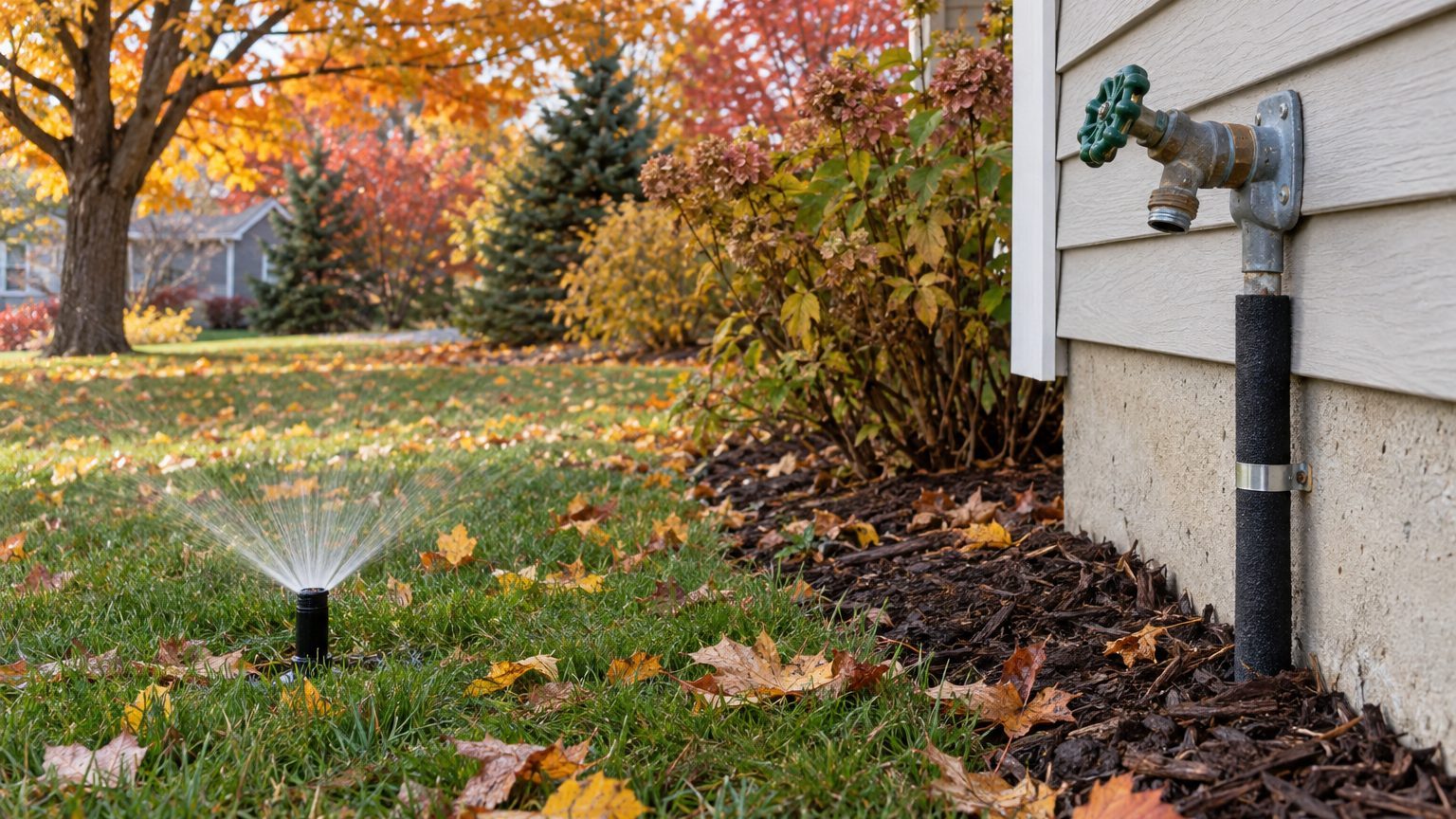

In Manitoba, winterizing belongs in the second half of September, with early October as the outer edge, and it has to be finished before the first hard freeze. The average first fall frost in Winnipeg lands on September 22, so that date is a midpoint, not a deadline. Sprinkler lines, outdoor taps and hoses all need attention in that stretch, in order of urgency: hoses off first, then the outside taps, then a full air blowout of the irrigation system.
When to do it in Manitoba
Winterize sprinklers and outdoor faucets in Manitoba during the second half of September, with early October as the outer edge, and always before the first hard freeze, not after the first light one. Environment and Climate Change Canada’s 1981-2010 climate normals put the average first fall frost at Winnipeg Richardson International Airport on September 22, which is a midpoint and not a safe date: in one year out of two the frost arrives later than that, and in the other it arrives earlier.
Light frost versus hard freeze
A light frost is a warning shot. It blackens tomato leaves and whitens the grass, then the afternoon warms up and the soil, still holding summer heat, keeps buried lines out of trouble. A hard freeze is a different animal. The air stays well below freezing for hours, and everything that sits above the soil starts losing the fight: exposed pipe, the backflow preventer, hose bibs, and any hose still full of water. Fall weather on the Prairies can swing from the first to the second in a matter of days, so treating the first light frost as a “let’s see what happens” signal is a gamble.
A better habit is to use that light frost as the alarm bell, not the starting gun. Start watching the extended forecast in early September. When overnight lows begin creeping toward freezing, pull the hoses and close the outside taps that same evening, then get the sprinkler blowout on the calendar. Lawns still need water into fall, especially new sod and young trees, so shut the system down when those needs are met. The rest of the yard’s fall routine has its own timing, laid out in Winterizing a Lawn.
No shortcut in this climate
In a mild region where winter nights barely touch freezing, a full blowout is often unnecessary, and a quick drain of exposed parts does the job. Manitoba is not that place. Winnipeg’s mean daily minimum in the coldest month is -21.4 °C, according to Environment and Climate Change Canada’s 1981-2010 normals for the city. Freezing is not a risk here, it is a certainty, and it lasts. For reference, Natural Resources Canada places Winnipeg in zone 3b of the Canadian plant hardiness system (1991-2020 normals), which is its own scale and does not convert to a USDA zone. Either way, the answer is the same: nobody in this climate gets to skip the job, and the only open question is timing.
Location shifts that timing. The Winnipeg station is one point on a large map. Northern and upland districts get their first fall frost earlier, so their window opens earlier too. If you live north or up in the hills, start the work sooner than the Winnipeg dates suggest, not later. Also keep in mind that Canadian normals cover 1981-2010, so any given autumn can land on either side of them.
Sprinkler lines: drain or blow out
Water left in a sprinkler system does not stay politely liquid. When it freezes it expands, and pipe, fittings, valve bodies and sprinkler heads have nowhere to give. The split usually happens at a fitting or inside a valve, and it stays invisible all winter because the system is depressurized. Then spring arrives, the water comes back on, and the damage announces itself as a geyser, a soggy patch of lawn, or a zone that never builds pressure. The backflow preventer is especially exposed, since it sits above ground on the supply side.
Three ways to clear a system
Manual draining relies on valves at the low points of the system. You open them by hand, the water runs out by gravity, and you close them again. Automatic draining uses spring-loaded valves that open on their own when line pressure drops, letting water escape at the low points. A compressed-air blowout is a different approach altogether: the water supply is shut off, a compressor is connected to the system, and each zone is run in turn until air, not water, comes out of the heads.
| Method | How it works | Where it falls short in Manitoba |
|---|---|---|
| Manual drain | Low-point valves opened by hand; gravity does the work | Only works if the system was built with drain valves and proper slope; pockets of water can stay behind |
| Automatic drain | Spring-loaded valves open when pressure drops | Can stick or leak; does not clear valves, the backflow preventer or flat runs |
| Compressed-air blowout | Air pushes water out of every zone, one at a time | Needs a suitably sized compressor and careful technique; misused air can damage parts |
Which one this climate calls for
With a coldest-month mean overnight low of -21.4 °C (Environment and Climate Change Canada, 1981-2010, Winnipeg), gravity alone is a thin margin. A little water trapped in a low spot or a flat run is all it takes to crack something. The method to plan around is a compressed-air blowout of every zone, done before the first hard freeze. Drain valves, manual or automatic, are a useful first step, but treat them as help rather than the whole answer.
Air is not harmless, though. Wear eye protection, keep clear of the heads and the backflow preventer while the system is under air, work through the zones one at a time, and never push more pressure than the system is rated for. Do not leave air running on a single zone once the water is out, because dry heads can overheat.
A professional is the sensible choice in several situations: you do not own or cannot borrow a properly sized compressor, you do not know where the main shutoff and low points are, the system has no drain valves, or you simply feel uneasy pushing air through it. The window is short and shared by every system in town, so make that call in early September, not during the week of the cold snap.
Outdoor faucets and hoses
Outdoor taps are the easy half of the job, and the half that most often gets skipped. All it takes is turning valves in the right order, and anything beyond that is a plumber’s job.
The sequence
- Disconnect every hose, splitter, timer and spray attachment, and drain them before storing.
- Find the interior shutoff valve for each outside tap, usually near where the pipe passes through the wall, and close it.
- Go outside and open the tap fully so any water left in the pipe can run out.
- Leave the outside tap open for the winter.
The decision to write down: disconnect every hose and close the interior valve before the first hard freeze, which in practice means the second half of September for most of southern Manitoba. If the interior valve is missing, will not close fully, or the tap keeps dripping after you shut it off, stop there and call a plumber. Cutting, soldering or replacing anything is not a weekend fix. For the full walk-through, see Winterizing Outdoor Faucets Before the First Freeze.
Why a frost-free faucet still fails with a hose on
A frost-free faucet has a long stem that puts the shutoff seat well inside the heated part of the wall. When you close it, the water in the barrel is supposed to drain out through the spout. That only works if the spout is open to the air. Leave a hose attached and the water cannot leave the barrel, so it freezes in the section of pipe that runs through the cold part of the wall. Nothing looks wrong in October or January. The crack shows up in spring, when you open the tap and water sprays or drips inside the wall.
The name says “frost-free,” and the design deserves credit, but it protects you only when it can drain. Even a properly installed one needs hoses off before hard freezes arrive. The differences between styles are covered in Frost-Free Outdoor Taps.
What goes wrong here
Most winter plumbing failures in Manitoba come down to timing and small oversights, not bad equipment. Three show up again and again.
Early cold snap, forgotten hose
Because September 22 is only the average date of the first frost, in roughly half of years the first frost comes sooner, and a hard freeze can follow before anyone has touched a valve. In spring the result looks like a cracked sprinkler head, a valve that leaks, or a lawn zone that stays soggy. The fix is to treat the forecast as the schedule: start watching in early September, do the hoses and taps first, and line up the blowout before the weather forces the decision. If a line does freeze, Frozen Pipes explains what to do and what to leave to a plumber.
The forgotten hose is a quieter version of the same failure. It is usually the one behind the shed, on the reel by the garden, or attached to the rain barrel. A walk around the whole property with a specific list is better than trusting memory. Spring evidence is a tap that drips inside the wall, or a wet patch on the interior side of the basement wall where the pipe enters.
The valve box that floods
Sprinkler valves usually live in an in-ground box, and that box collects meltwater and groundwater. If the valves inside were not drained, a freeze cracks them, and the spring symptom is a zone that will not shut off, will not turn on, or leaves a boggy patch nearby. Make sure the blowout includes the valves, that the lid sits properly, and that the surrounding soil slopes away. When you turn the system back on in spring, do it slowly, and watch each zone. Decide now to check the valve box lid before the ground freezes, not after.
Common questions
Is September 22 a safe date to winterize?
No. It is the average first fall frost at the Winnipeg Richardson station in the 1981-2010 normals, so about half of years see frost later and half see it earlier. Treat it as the middle of your window and start earlier if the forecast turns cold.
Does the timing change outside Winnipeg?
Yes. Northern and upland parts of Manitoba get their first frost earlier, so they need to winterize earlier. For other seasonal tasks in the province, see the Manitoba guides.
Are automatic drain valves enough on their own?
Not in this climate. They can stick or leak, and they do not clear the valves, the backflow preventer or flat runs. A compressed-air blowout of every zone is the safer plan.
Can I do the blowout myself?
You can if you have a properly sized compressor, know your system’s shutoff and zones, and follow the safety steps. If any of that is missing, hiring a professional is the better call. Whoever does it, schedule it for before the first hard freeze, not after.