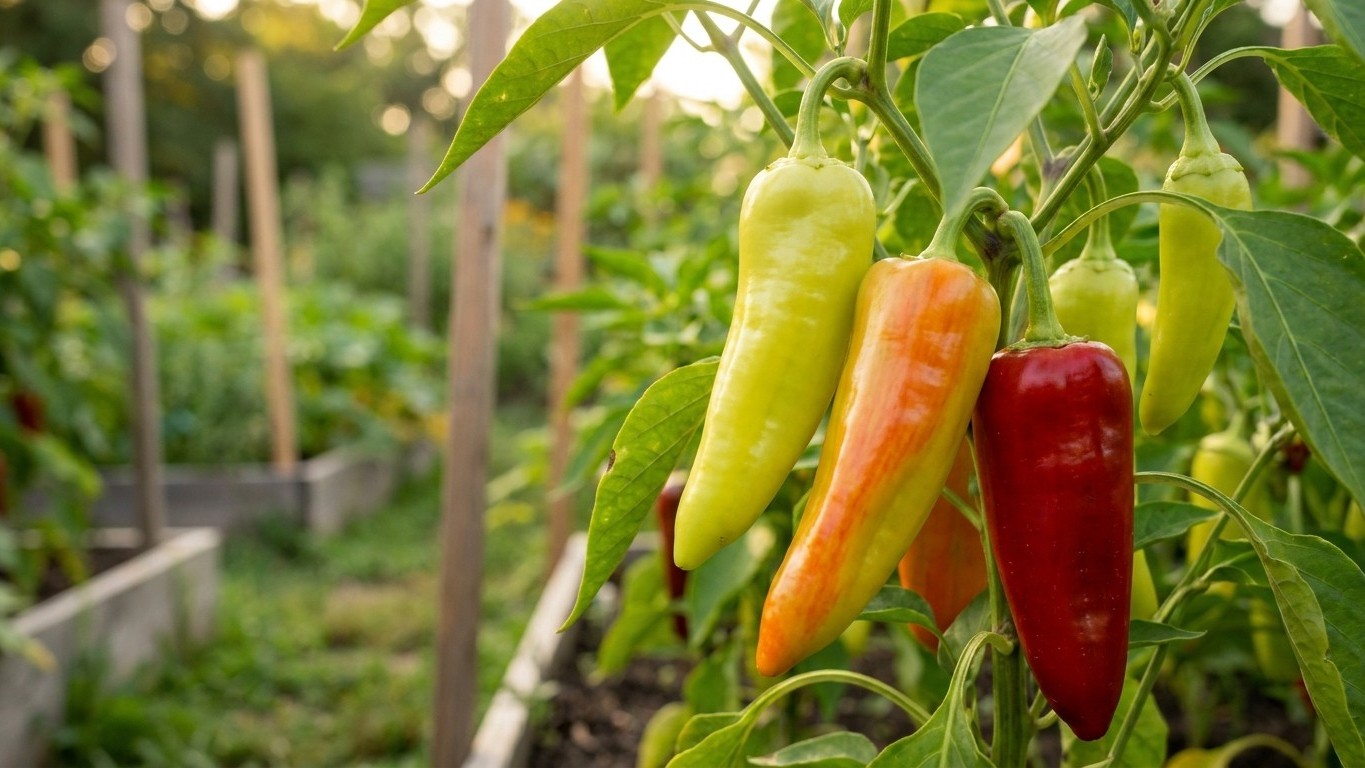

Pick Michigan peppers when the fruit has reached full size and feels firm. For a plant set out in mid to late May, that usually means late July into August. Then keep them out of the refrigerator. Clemson Extension puts the best storage at 45 to 50 °F, and a home fridge runs colder than that. Below about 45 °F, peppers develop chilling injury: pitted, softened skin that no amount of rescue will fix.
The short answer
Detroit, the reference station for Michigan here, averages 10.3 days a year at 90 °F or higher, according to NOAA NCEI Climate Normals. That is roughly one day in 35. For peppers, it is a light heat load, but not a zero one. Utah State University Extension is blunt that fruit set fails at both ends: days above 90 °F or nights below 55 °F. Blossoms that open during a hot spell tend to drop instead of turning into fruit. An average also hides the hot years, so a July stretch can cost you a flush of blossoms. The plant sets again once the weather breaks, but the harvest slides back with it.
The cool end is the one Michigan gardeners get caught by, and this site cannot tell you your number. It carries days at or above 90 °F, but it does not carry summer night minima. Do not guess them from your latitude or from how cold your winters get, because neither says anything reliable about a June night. Put a min/max thermometer at pepper height and read it each morning. A low spot in the yard can run colder than a station miles away. When a run of nights dips under 55 °F, expect blossoms to drop. The full story is in Why Peppers Fail to Set Fruit in Michigan.
Reading the calendar for picking
Clemson Extension says peppers should be ready for harvest in about 70 to 85 days after transplanting. The count starts at the transplant date, not at seed. Transplanting itself waits for the last spring frost, which MSU Extension places around April 30 in the Detroit area and in early to mid May across most of the Lower Peninsula, and for soil that has reached 60 °F. A pepper is edible green once it is full size and firm. Leaving it on the plant lets it color up, but that takes longer and keeps the plant busy with ripening fruit. This site does not carry a first fall frost date, so check your local forecast in September and pick everything that is sized up before a frost night arrives.
Why the fridge is the wrong place
Here is the quote that matters. Clemson Extension writes, “The optimal conditions for storage are temperatures of 45 to 50 °F and 80- to 90-percent relative humidity for two to three weeks.” That temperature is warmer than a domestic refrigerator. Most people put peppers in the crisper because that is where vegetables go, and it is the mistake nearly everyone makes. Below about 45 °F the skin pits and softens. The damage often shows only after the peppers come back to room temperature. Note also that “two to three weeks” is a ceiling under ideal conditions, not a promise. A cool, humid spot you have checked with a thermometer works better than the fridge. Cut peppers are a different matter, and those do belong in the cold. For the full growing picture, see Growing Peppers in Michigan.
When to start seed here
Working backward from the transplant date is the only method that holds up in every county. The sources give the pieces: transplant after frost and once soil reaches 60 °F, and give transplants 8 to 10 weeks indoors. Here is the arithmetic in words, using a sample date you should replace with your own.
- Find your last spring frost. MSU Extension gives around April 30 for the Detroit area and early to mid May across most of the Lower Peninsula. For the Upper Peninsula, that date is not published here, so ask your county Extension office.
- Wait for the soil. Peppers go out when the soil reaches 60 °F, and that comes after the last frost, not on it. Use a soil thermometer. For this example, say the soil hits 60 °F on May 20. That date is an illustration, not a published figure.
- Count back 8 weeks from May 20, which lands on March 25. Count back 10 weeks, and you land on March 11. Your indoor sowing window runs from March 11 to March 25.
- Count forward to check the harvest. Clemson’s 70 to 85 days after transplanting, added to May 20, gives roughly July 29 to August 13 for the first picking. If that window runs into a stretch of 90 °F days or cold nights in your yard, you will see it in your own records.
- Redo it for your county. Swap in your own soil date, subtract the same 8 to 10 weeks, and add the same 70 to 85 days. If the soil warms a week late, every date moves a week later. Starting seed earlier does not help, since a transplant held indoors past 10 weeks gains nothing from the extra time.
Keep a note of the date you actually transplanted. The harvest estimate is only as good as that starting point, and next spring you will have a real Michigan data point instead of a guess.
What goes wrong here
Most pepper trouble in Michigan comes from weather swings and uneven watering rather than from the plant itself. Three failures show up most often, and each has a practical fix.
- Blossom drop. Flowers fall off without setting fruit after a hot spell above 90 °F or after nights below 55 °F. Detroit averages 10.3 days at or above 90 °F, so the heat version is occasional, and the cold version depends on your own yard. Check your thermometer. On hot afternoons, light shade cloth takes the edge off. On cold nights, a row cover laid over the plants in the evening holds a little warmth. Once the weather settles, the plant sets fruit again, so do not pull it out.
- Sunscald. Pale, papery patches appear on the side of a pepper facing the sun, and the spots can turn sunken and gray. It happens where leaves have thinned and the fruit is exposed. Keep the canopy intact, do not strip leaves for any reason, and stake plants so they do not flop open. If a strong-sun stretch is forecast, shade cloth protects the fruit.
- Blossom-end rot. A dark, leathery, sunken patch forms at the bottom of the fruit. The cause is usually uneven watering that keeps the plant from moving calcium to the fruit, not a shortage in the soil. Water on a steady schedule, mulch to hold moisture, and watch sandy beds, which dry out fast between rains. Take a soil test before adding any calcium. Pick off affected fruit so the plant does not spend energy on it.
If the damage looks like holes, chewed leaves or scarred skin instead of pits and patches, you are dealing with something else. What Eats Pepper in Michigan, and When covers that.
Common questions
Can I keep peppers in the crisper drawer?
You can, but it is the wrong place for whole peppers. Clemson Extension recommends 45 to 50 °F and 80 to 90 percent relative humidity for storage, and a domestic refrigerator is colder than that. Below about 45 °F peppers pit and soften from chilling injury. A cool spot you have measured is better. Once a pepper is cut, though, the fridge is where it belongs.
When is it safe to plant peppers outside in Michigan?
After the last frost and once the soil reaches 60 °F. MSU Extension lists the last frost as around April 30 in the Detroit area and early to mid May across most of the Lower Peninsula. Because the soil warms later than the air, the actual planting date often falls after those dates. This site does not carry Upper Peninsula frost dates, so check with your county Extension office.
How long from transplant to harvest?
Clemson Extension says peppers should be ready in about 70 to 85 days after transplanting. The clock starts when the transplant goes into the garden, not when you sowed the seed. Add those days to your own transplant date for an estimate, and treat the result as a window rather than a deadline.
What if my nights are under 55 °F in early summer?
Utah State University Extension lists nights below 55 °F as one of the two ends where pepper fruit set fails. This site does not carry summer night minima, so the reading has to come from your own thermometer. When a cold run is forecast, cover the plants in the evening and uncover them in the morning. Blossoms that drop during the cold stretch will not come back, but the plant keeps flowering once nights warm up.