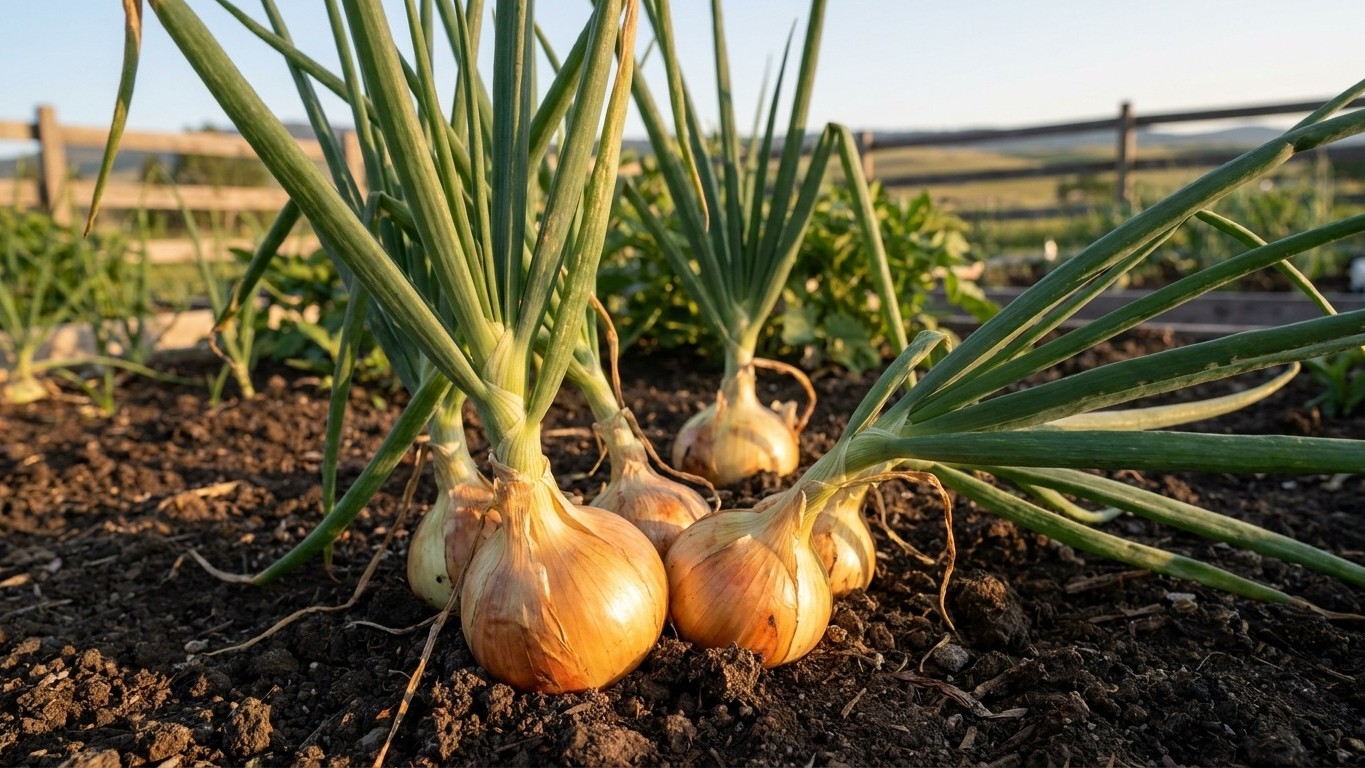

Lift onions in Mississippi once the tops have flopped over and begun to yellow, which for fall-planted short-day types lands as spring turns to summer. Pull them on a dry day, leave the tops on, and cure them in an airy, rain-free spot until the necks are tight and the skins feel papery. Only then do they go into storage. Skipping the cure is how a good crop turns to mush in the pantry.
The short answer for Mississippi
Jackson sits at 32.32 degrees north, and on the longest day of the year it gets 14 h 07 of daylight. That number, not the thermometer, sets your harvest. An onion stops making leaves and starts swelling a bulb when the day reaches a certain length. Short-day varieties start at about 12 hours, according to Clemson Cooperative Extension’s Home & Garden Information Center. Jackson passes 12 hours around the March equinox, so a short-day onion begins bulbing in early spring and finishes before the worst summer heat. (The 14 h 07 is a geometric figure. Atmospheric refraction adds roughly seven minutes of real daylight.)
Reading the tops
Once the bulb is made, the neck goes soft and the green tops fall over on their own. Wait until most of the row is leaning. Don’t step on the tops or bend them early to hurry things along. Onions knocked down before the plant is ready keep thick, wet necks, and a thick neck is where rot gets in.
Pick a dry day. Loosen the soil with a digging fork, lift each bulb gently and handle it like an egg, because a bruise today becomes a soft spot in a month. Leave the tops attached.
Curing before storage
Spread the bulbs in a single layer on screens, wire racks or slatted crates, in shade with air moving around them and no rain. Mississippi springs are humid, so a covered porch with a box fan, a carport or an open-sided shed works better than a closed garage. Keep them off bare concrete if you can.
Judge the cure by touch, not by the calendar. The neck should be tight and dry, with no give when you squeeze it. The outer skins should be papery and rustle in your hand. A muggy week takes longer than a dry one. Then trim the tops to a short stub, brush off the loose soil, and skip the washing.
What will not work here
Long-day onions are the trap. They wait for 14 to 16 hours of daylight before they bulb, and Jackson’s longest day tops out at 14 h 07. That clears the bottom of the range by a few minutes for a few days around the solstice, and never comes close to 16. A long-day plant set out here keeps making leaves all season, forms no usable bulb, and then rots in the wet heat of summer. Nothing in the soil or the fertilizer program changes that, because the signal is daylight. For the varieties that do work, see The Best Onion Varieties for Mississippi.
Catalogs list day-length groups, and these long-day names are the ones to leave on the shelf:
- Yellow Sweet Spanish: a long-day type that wants far more daylight than Mississippi supplies, so it stays leafy and never swells.
- Copra: a long-day storage onion built for northern summers, which makes leaves here and rots before it makes a bulb.
- Ailsa Craig: a long-day exhibition type that needs the long northern evenings and sulks through a southern season.
- Walla Walla: usually sold as long-day, so it bulbs late and small in our short days, if it bulbs at all.
- Stuttgarter: a long-day set onion that bolts or rots in heat before it finishes.
Planting late does not push the harvest back. It shrinks it. Whatever size the plant has reached on the day the daylight triggers bulbing is the size of the bulb you get. An onion set out late in spring is still a seedling when Jackson passes 12 hours, so it bulbs at the size of a golf ball, or smaller. The calendar runs on daylight whether or not your transplants are ready.
Harvest has its own failures. Bulbs shoved into a basement straight from the ground carry wet necks with them and rot from the top down. Washing them adds moisture right where it does the most harm. Chewed or bruised bulbs go first in storage, so pull them out and eat them. What Eats Onion in Mississippi, and When explains which damage to expect and when.
What changes across Mississippi
The 32.32 degrees north belongs to Jackson, and Mississippi stretches from the Gulf Coast to the Tennessee line. A gardener in Pascagoula and one in Corinth do not share a latitude. Day length shifts with it, and so does the weather the onion lives through.
| Location | Latitude | Longest day | What it changes |
|---|---|---|---|
| Gulf Coast | South of Jackson (look up yours) | A little under 14 h 07 | Short-day onions bulb a touch earlier and the heat arrives sooner, so the harvest runs a little ahead of Jackson |
| Jackson (reference) | 32.32 degrees north | 14 h 07 | Short-day onions bulb in early spring, as the day passes 12 hours |
| North Mississippi | North of Jackson (look up yours) | A little over 14 h 07 | Short-day onions still work, but the colder winter and later spring slide planting and lifting later |
The gap in daylight between the coast and the Tennessee line is a matter of minutes, not hours. It does not move the state out of short-day territory. The bigger effect is on the calendar. A cold snap that stalls young plants in the north matters more than a few extra minutes of light. Because the final bulb size depends on the plant’s size at bulbing, a gardener in the far north who lets winter hold transplants back is paying the same penalty as a late planter further south.
Readers near the northern edge should also know that neighboring states farther north fall into different day-length groups. If you garden within sight of the Tennessee line, ask your extension office whether an intermediate-day variety makes sense for you. Everyone else can stick with short-day types. For the full picture of the crop here, start at Onions in Mississippi.
Sweet now, or onions that last
Southern gardens lean sweet and short-keeping. Northern gardens lean sharp and long-keeping. The cause is chemistry. The bite of an onion comes from volatile sulfur compounds, and those same compounds protect the bulb in storage. A sweet onion carries fewer of them. It is better raw and worse in the pantry. The University of Missouri Extension puts it plainly in its onion guide (G6355): “As a rule, ‘sweet’ onions do not store as well as the more pungent types.”
Day length lines up with this. Short-day types, the only ones that suit Mississippi, run sweeter. Long-day types, which suit the north, hold their flavor and their firmness longer. A Mississippi garden therefore produces onions to eat soon. A northern one produces onions that feed a family into March.
Here is what your pantry looks like in March. The sweet bulbs are soft, sprouting, or already in the compost. If you grew a pungent short-day type and cured it well, a few are still firm, but not many. Never count on a sweet onion to keep, however carefully you cure it. Eat the sweet ones first, in the weeks after the cure, and save the sharpest, driest bulbs for later.
Storage conditions matter just as much. Clemson Extension’s factsheet says: “Ideal conditions are between 45 °F and 55 °F, and 50 to 60 percent humidity.” Onions want it dry, not damp, which is the opposite of carrots and other root crops. One cellar cannot hold both well. Few Mississippi sheds or kitchens sit in that range through summer, so look for the coolest, driest, best-ventilated spot you have, and keep the onions in mesh bags or slatted crates.
Checking this against your own garden
Everything above is built on one city. The figures are right for Jackson. They are a starting point, not a guarantee, for your yard. Your county extension office (Mississippi State University Extension runs one in every county) can fill in what a state-wide table cannot. A few checks you can do this week:
- Look up the latitude of your own address. If it differs from 32.32 degrees north by a degree or more, expect a different longest day than 14 h 07.
- Ask the extension office for your local frost dates. The figures here do not include any, so don’t borrow Jackson’s.
- Read the day-length group on your seed or plant label and confirm it says short-day, or intermediate if you are in the far north.
- Put a thermometer and a humidity gauge in your intended storage spot and read them for a few days. You are looking for 45 °F to 55 °F and 50 to 60 percent humidity.
- Pick a spot for curing that has shade, airflow and a roof, and check it against a rainy forecast.
Common questions
How do I know it is time to lift onions in Mississippi?
Watch the tops. When most of them have fallen over and started to yellow, the bulbs are done. Short-day onions planted in fall typically reach that point as spring turns to summer, but the plants decide, not the date. Pull on a dry day.
Should I cut the tops off before curing?
No. Leave them on while the bulbs dry. The neck seals as the tops wither, which is what keeps rot out. Trim the dry tops to a short stub only after the neck is tight and the skins are papery.
Can I store onions with carrots, beets or potatoes?
Not well. Onions need 50 to 60 percent humidity, and root crops want it damp. A single cellar cannot give both what they need. Keep onions in their own dry, ventilated spot.
Why are my onions so small?
Most likely they were planted too late. The size a plant has reached when daylight triggers bulbing is the size of the bulb, and the trigger comes whether or not the plant is ready. Setting out transplants earlier is the only fix. A long-day variety that never bulbed at all is the other common cause, and no care routine rescues that one.