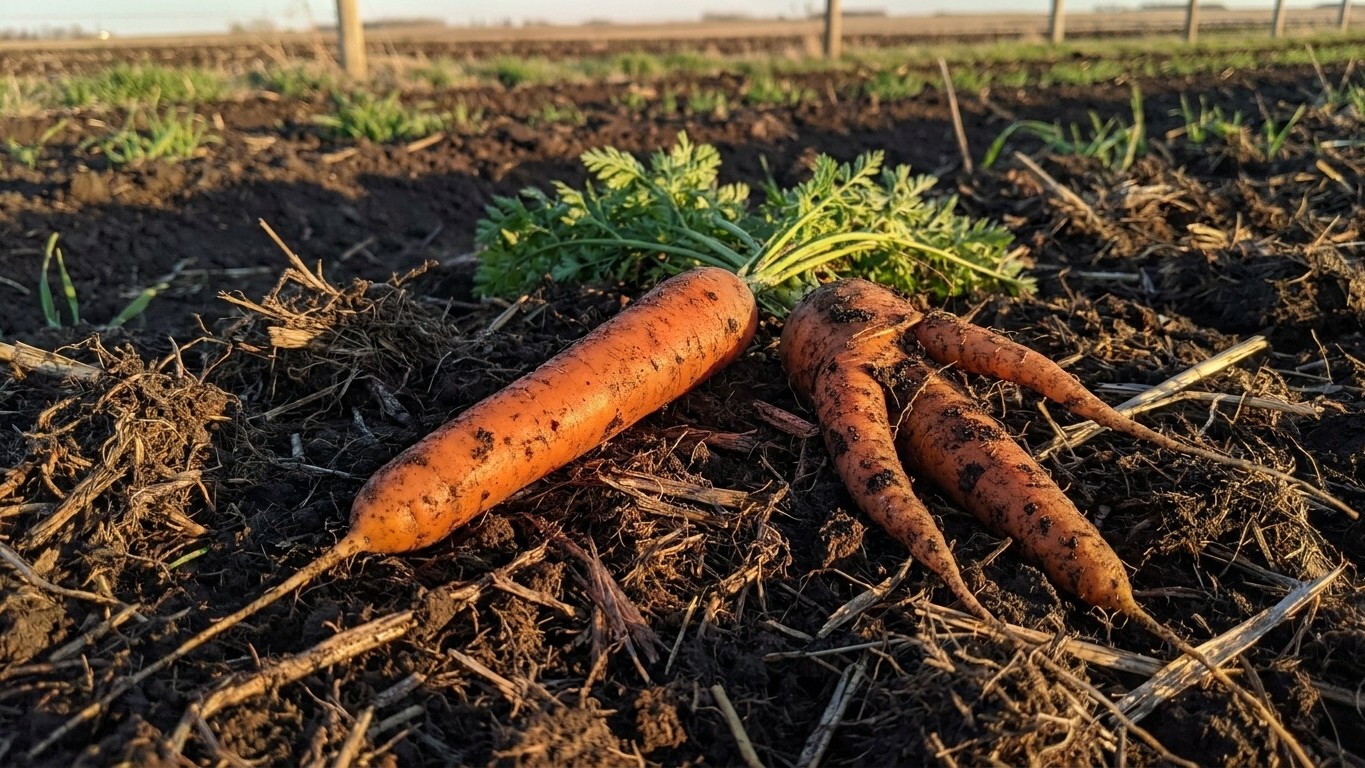

Pull carrots about 65 to 75 days after planting, per Clemson Cooperative Extension. Some plantings need longer, up to 100 days, and the count always runs from the day you seed, since carrots are sown where they grow. Once they’re out of the ground, cut the tops off right away and store the roots at 33 °F with high humidity. Prince Edward Island’s sandy ground suits the crop well, with a few catches. For the full growing picture, see Growing Carrots in Prince Edward Island.
The short answer
What the island’s dominant soil looks like
Canada has no official provincial soil the way each US state does, so there is no single emblematic series to name here. What the survey offers is a dominant profile. Agriculture and Agri-Food Canada’s Canadian Soil Information Service mapped 542 soil components across Prince Edward Island, and the surface horizons tell a consistent story. The commonest order is Podzol, the acid, leached soil that forms under conifers, where rain has washed the bases out of the topsoil. It covers 33 percent of the mapped surface, with Gleysolic soils next.
The median surface layer is sandy: 66 percent sand, 7 percent clay and 27 percent silt. Organic matter sits at about 2.2 percent, and the drainage class is imperfectly drained. The median surface pH is about 4.8, which is strongly acid. That is a median of mapped soils, never your pH. The survey also covers the island’s agricultural land only, so it says nothing about a lot a builder has scraped or filled, or about ground along a river bottom.
Treat all of this as a starting point, not a diagnosis. A province spans hundreds of soils, and the bed behind your house may look nothing like the median.
Will a carrot fork in it?
At the median, probably not. Utah State University Extension says carrots want deep, sandy, well-drained soil rich in organic matter, and that heavy or rocky soil makes the root fork. With only 7 percent clay, the typical island surface has little sticky material to grip a growing root and bend it sideways. Texture is the island’s advantage here.
Two things in the numbers keep it from being a clean pass. Organic matter at 2.2 percent is modest next to the “rich” ground the crop prefers, and imperfect drainage means water lingers longer than a carrot likes. Gleysolic soils, the second most common order, lean wetter still. A bed on one of those, or in a low corner of a yard, can behave very differently from the sandy median.
The fixes follow the same Extension guidance. Where the ground is heavy, work in plenty of compost and double dig, loosening the lower layer as well as the top. Where water stands, build a raised bed. Neither problem is solved by shopping for a different seed packet, because the source names no variety that gets around heavy ground. For more on how texture shapes root shape, see Will Carrots Fork in Prince Edward Island Soil?
The test that settles it in your own garden
The province’s median tells you what island ground tends to do. Your bed tells you what it actually does, and finding out takes an afternoon, a spade and a hose. Do it before sowing, when fixing things is still cheap.
- Dig a hole in the bed itself. Go deeper than the spade blade by loosening the bottom with a fork. A carrot root wants that much open room, so you are checking whether it exists.
- Read the wall of the hole. Note where the dark topsoil ends and the paler subsoil begins. Look for stones, a hard layer that resists the spade, or a sudden change in color or texture. Stones and hard layers are what split a root in two.
- Feel the texture. Take a handful from the middle of the hole, dampen it and squeeze. Sandy soil feels gritty and crumbles when you open your hand. Soil that holds a smooth, sticky ribbon between thumb and finger is heavy with clay, and it is the kind Extension says needs compost and double digging.
- Watch the water. Fill the hole, let it drain, then fill it again, because the first fill only wets the surrounding soil. If the second fill is still standing the next day, the bed is poorly drained and a raised bed is the safer choice. Water that vanishes quickly points to sandy ground, which is fine for carrots but will need steadier watering.
- Send a sample for a lab soil test. Digging cannot tell you your pH or organic matter. A lab can, and then you have your own numbers to set beside the province’s median of about 4.8 instead of guessing.
- Pull one carrot early as a check. Starting around 65 days from seeding, ease a single root out of the row and look at its shape and size. Clemson Extension gives 65 to 75 days as the harvest window, so one test root tells you whether the rest are close and whether the soil is shaping them cleanly.
No one result is a verdict on its own. A bed that is sandy but stony wants stone-picking more than compost, and a bed that is loose but soggy wants a raised frame more than digging. The four checks together show which problem you actually have.
What goes wrong here
Island soil and weather make a handful of problems more likely than others. Some start in the ground, and one waits until the carrots are already harvested.
- Forked or stubby roots in heavy or stony patches. Even on a sandy island, a clay pocket or a buried stone can split a root. Pick out stones, dig in plenty of compost and double dig the heavy spots. If the spade test showed standing water, build a raised bed rather than fight the ground.
- Poor germination in a hot spell. Carrot seed is slow to come up, and sandy soil dries at the surface fast. A crust or a dry week can leave gaps in the row. Keep the seedbed evenly damp until seedlings show, with light, frequent watering rather than a single soaking. A board or a layer of row cover over the row helps hold moisture. This source gives no temperature cutoff, so judge by the seedbed: if it dries out in a day, water more often.
- Splitting from uneven water. A dry stretch followed by a heavy rain or a long soak can make roots swell too quickly and crack. Sandy ground makes the swings sharper because it drains fast. Water on a steady schedule, and add compost, which helps the soil hold moisture longer between waterings.
- Soft or rotting roots in wet ground. Imperfect drainage, and the wetter Gleysolic soils behind the second-place ranking, mean low spots stay saturated after rain. A raised bed lifts the roots out of it. Fixing a stubbornly wet bed with a different variety does not work.
- Pest damage that gets blamed on soil. Tunnels and chewed roots often have nothing to do with texture. What Eats Carrot in Prince Edward Island, and When covers what to look for and the timing.
- Wilting, sprouting and softening in storage. The most avoidable loss comes after the harvest. Clemson Extension’s advice reads: “Harvest carrots about 65 to 75 days after planting… Store them at 33 °F and high humidity to prevent wilting. Bunched carrots (plants with tops on) can be stored for about 10 to 14 days.” That 33 °F is just above freezing, not a cellar temperature. Roots kept near 50 °F sprout and soften in a fraction of the time. The tops are the catch: the leaves keep drawing moisture out of the root, which is why bunched carrots last 10 to 14 days and trimmed ones keep for months. Cut the tops right after pulling, before the roots go into storage.
Common questions
How many days until I can pull carrots?
Clemson Cooperative Extension says about 65 to 75 days after planting. Carrots generally run from 70 to 100 days from seeding, and the clock starts the day the seed goes in the ground, since carrots are sown in place. The source names no particular variety, so check your seed packet for its own timing and use an early test root to confirm.
Will carrots fork in Prince Edward Island soil?
The median surface is sandy, with 66 percent sand and only 7 percent clay, which is the texture carrots prefer. Forking comes from heavy or rocky ground, and your bed may have either even if the province’s median does not. Run the dig-and-drain test, then add compost and double dig, or use a raised bed.
What temperature should I store carrots at?
Clemson Extension gives 33 °F with high humidity to prevent wilting. That is barely above freezing, so an ordinary cool room or an unheated closet will not match it, and carrots held near 50 °F sprout and soften much faster.
Should I cut the tops off before storing?
Yes, right after pulling. The leaves keep drawing moisture from the root, so carrots stored bunched last only about 10 to 14 days, while trimmed roots keep for months under the right cold, humid conditions.