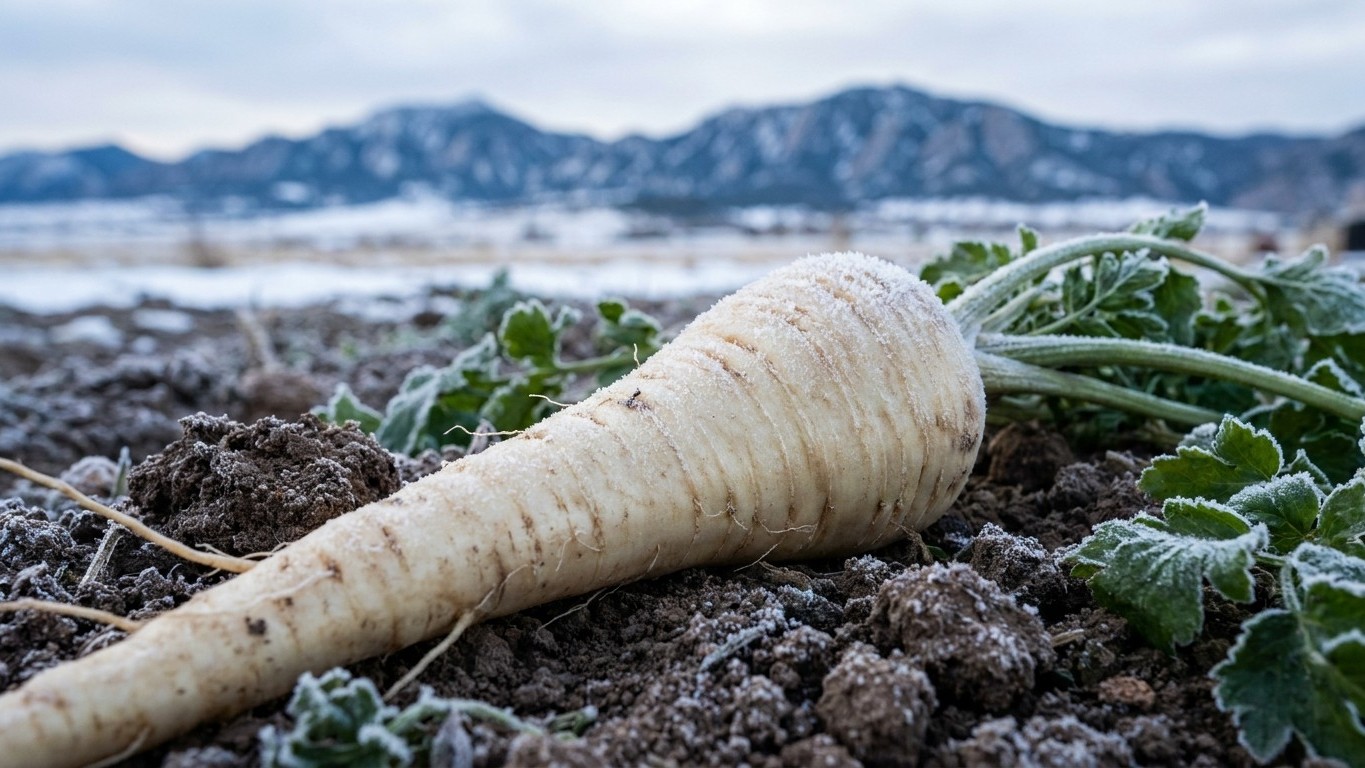

Lift parsnips in Maine only after the roots have sat through several frosty weeks. On the coast, where the first fall frost lands between October 9 and October 21, that puts the first digging well into November. Inland, the clock starts earlier. Once out of the ground, parsnips can keep four to six months, but only in near-freezing, very humid storage and well away from apples. Here is why each of those details matters.
The short answer
The question that decides everything is whether a place delivers several frosty weeks, and Maine does. In Portland, the mildest corner of the state, the mean daily minimum of the coldest month is 15.6°F, according to NOAA NCEI’s most recent 30-year climate normals. That is the average overnight low, not a record, and it sits far below freezing. Inland and northern Maine run colder still. A parsnip grown here will sweeten, not merely grow.
The mechanism is simple. Cool, frosty weather prompts the root to convert stored starch into sugar, and that is the whole reason a fall-dug parsnip tastes so different from a summer-pulled one. Utah State University Extension puts it as several weeks of cool, frosty weather. Note the wording: exposure to frost does the work, not a number on a hardiness map. A comfortable zone and a run of frosty weeks are different things, and I’d rather you judged your own bed by the nights it actually freezes. For the full story on how that sugar shift plays out, see Will Parsnips Sweeten in Maine?
So when do you dig? The first frost starts the clock; it doesn’t finish the job. On the Portland coast, with a first fall frost between October 9 and October 21, a parsnip has barely begun to sweeten by the end of that window. Give the roots several weeks beyond it. That means mid-to-late November for the coast, and a bit sooner for anyone inland, where fall frost arrives earlier. Digging a few roots as a taste test beats guessing. If they taste starchy, leave the rest.
Storage is where most home gardeners lose the harvest they worked all season for. The USDA Agricultural Handbook 66 says parsnip roots can be stored four to six months at 32 to 34°F with 98 percent relative humidity (USDA Handbook 66). That is a long keeper by any standard. It also assumes cold and humidity held steady, which almost no house manages. A refrigerator crisper is cold enough but dry, and a basement drifts with the seasons.
Cold is not the danger. Parsnips are not chilling sensitive, so a root at 32°F is fine. The danger is ethylene, the ripening gas that apples and other fruit give off. Parsnips produce almost none themselves, but exposure to even low levels in cold storage makes them bitter, likely from a compound called xanthotoxin building up. Keep them in a separate drawer, a separate bin, a separate room from the fruit. One more rule from the same handbook: top them after harvest, but do not trim into the crown.
For a broader look at the crop in this state, start with Growing Parsnips in Maine.
Does the season fit?
It fits, and comfortably. Parsnips are sown in place and the 100 to 120 days run from seeding, not from transplanting. Utah State University Extension recommends sowing two to three weeks before the last frost. Here is the arithmetic in words, using coastal Portland as the benchmark (the mild end of Maine):
- The last spring frost falls between April 22 and May 1. Counting back two to three weeks gives a sowing window of roughly April 1 to April 17. Treat that as a target, not a promise. Sow when the soil is workable, not just when the calendar says so.
- Germination takes 14 to 21 days, so nothing shows for two to three weeks. Plenty of gardeners dig up bare soil at day ten and re-sow over seedlings that were about to emerge. Mark the row and wait.
- Add 100 to 120 days to that sowing window. A seed in the ground on April 1 reaches maturity between July 10 and July 30. A seed sown April 17 gets there between July 26 and August 15. The roots are full size by midsummer at the latest.
- Set that against the first fall frost, October 9 to October 21. Even the slowest case, a mid-April sowing taking the full 120 days, finishes about eight weeks before the earliest frost in that band. The roots then sit and grow through autumn, which is where the sweetness comes from.
- Count backward from frost to find the outer edge. A sowing on June 11 still has 120 days before October 9, and one on July 1 has 100. That is the limit, not a plan, because a late sowing leaves the roots small and rushed when the cold arrives.
The verdict for coastal Maine is a comfortable fit, with roughly two months of slack at the front end. Inland and northern Maine are a different calculation. Spring frost comes substantially later there and fall frost earlier, so the same 100 to 120 days sit in a shorter window. The state of the margin depends on your town’s actual frost dates. Look up your own station’s frost probabilities before you commit to a sowing date. Anyone who has watched a pest chew through a late row will also want to read What Eats Parsnip in Maine, and When, since a long season gives more time for trouble.
What goes wrong here
Season length is rarely the problem in Maine. Ground and handling are. Five failures account for most disappointing harvests:
- Forked roots from heavy or stony ground. A root that hits a stone or a layer of clay splits around it. Utah State University Extension calls for deep sandy soil, and says heavy soil must be double dug. Maine’s glacial ground is stony in many places, so remove what you find and loosen the bed deeper than the length of the root you want. The statewide soil label is only a starting point. Dig a test hole in your own bed and see what is actually down there.
- Forked roots from overwatering. This is a separate cause and needs a separate fix. Soil kept constantly soggy can fork a root even in good ground, so water evenly and let the surface dry between waterings rather than keeping the bed wet.
- A season that runs out. Sowing late, or inland where the frost-free window is shorter, leaves roots stunted when the freeze comes. Sow at the front of the window and count your days from seeding, remembering the two to three weeks of germination in the middle.
- Starchy roots from digging too early. A winter too mild to sweeten is not the issue in Maine, where the coldest month averages a low of 15.6°F in Portland. The real risk is impatience. Pull a root the week after the first frost and it will taste like carrot’s blander cousin. Wait for several frosty weeks.
- Bitter roots in storage. Parsnips tolerate cold fine, but low levels of ethylene from apples or other ripening fruit turn them bitter even at the right temperature. Store them alone, topped but with the crown left intact, at 32 to 34°F and high humidity if you can manage it.
Common questions
Is the first frost enough to sweeten parsnips?
No. The conversion of starch to sugar needs several weeks of cool, frosty weather, not a single cold night. On the Portland coast the first frost arrives between October 9 and October 21, so the better flavor comes weeks later. Taste a root before you commit to digging the whole row.
Can I store parsnips next to apples?
Don’t. A parsnip produces very little ethylene, but exposure to low levels in cold storage makes it bitter. Apples and other ripening fruit give off that gas, so the damage happens even at the correct temperature. Give the roots their own bin or drawer.
How long do parsnips really keep at home?
USDA Handbook 66 gives four to six months, but that figure assumes 32 to 34°F and 98 percent humidity held steady. Most kitchens and basements cannot do that, so expect less. The handbook does not give a figure for ordinary household conditions, and I won’t invent one. A cold, humid spot away from fruit gets you closest to the long end.
How long until the seeds come up?
Germination takes 14 to 21 days. That is why a row can look empty for two to three weeks after sowing. Resist the urge to dig or re-sow, and mark the row so you remember what is there.