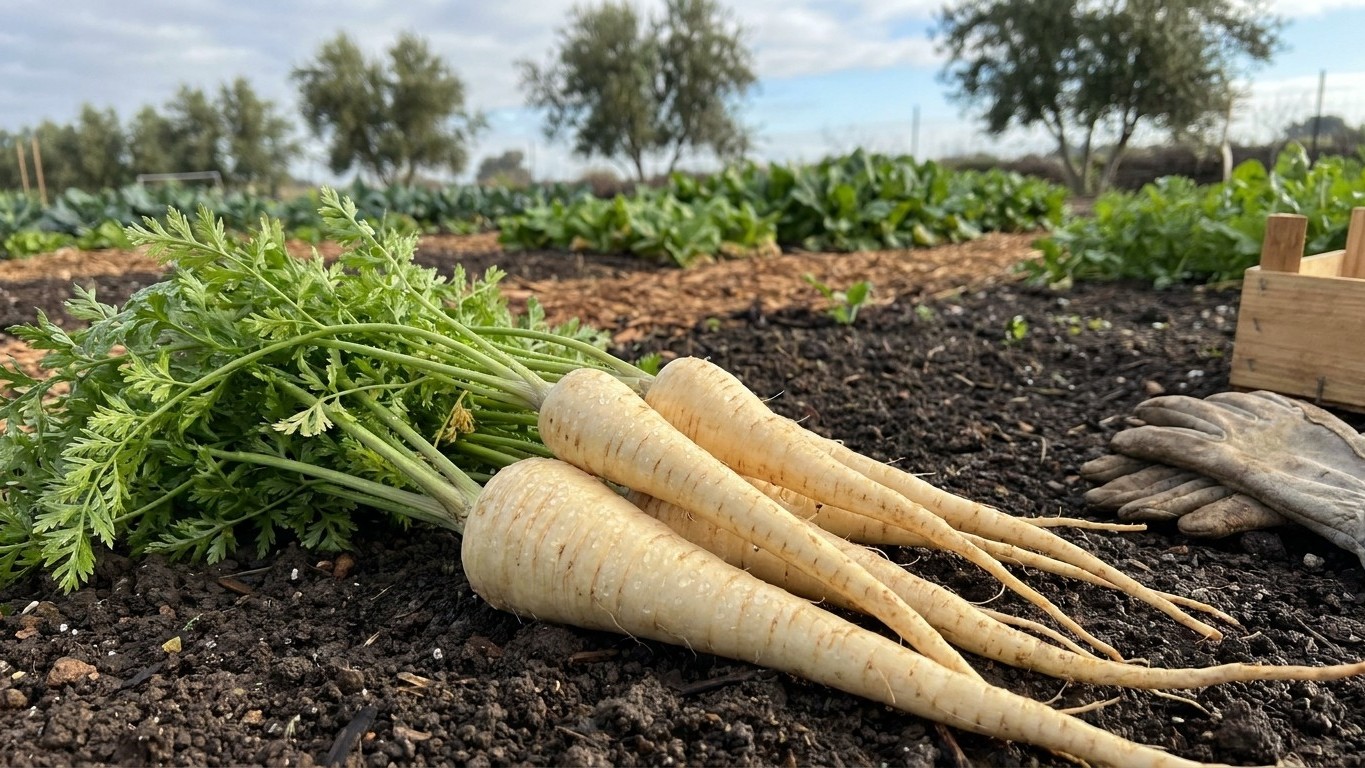

Lift Ohio parsnips after several weeks of frost, not before. At the Columbus reference station, the coldest month averages a daily low of 22.0°F, and the first fall frost lands between October 5 and October 15. That is enough cold for the roots to turn sweet in the ground. Once dug and held properly, they keep four to six months. Held next to a fruit bowl, they turn bitter.
The short answer
The question that decides everything here is whether Ohio delivers several frosty weeks. It does. The mean daily minimum of the coldest month, drawn from NOAA NCEI Climate Normals for the Columbus station, is 22.0°F. That is ten degrees below freezing on the average night, and it is the average of the daily lows, not the record low and not the monthly average of highs and lows blended together. A parsnip grown in Ohio will sweeten, not merely grow.
The mechanism is simple. According to Utah State University Extension, parsnips taste best after several weeks of cool, frosty weather, which converts stored starch to sugar. A parsnip pulled in a warm September is a perfectly good root vegetable, just a starchy one. The sweetness is a response to cold exposure, and Ohio supplies plenty of it. For the full story on that conversion, see Will Parsnips Sweeten in Ohio?
One caution about reading the map. The sweetening comes from frost exposure, not from the hardiness zone. A comfortable zone number tells you a plant survives winter, which a parsnip does easily, but it says nothing about how many cold nights the roots actually sit through. The date sources here carry a zone 6a label, and the Columbus figure is a single station. A lakeshore bed and a southern-border bed may behave differently.
That sets the timing. With the first fall frost expected October 5 to October 15, the clock starts there, and “several weeks” pushes the first worthwhile digging into November. After that, lift as you need them. A thick layer of straw or leaves over the row makes digging easier when the top of the bed stiffens in a cold snap.
Storage is where most advice goes quiet, and it is where the roots are most often ruined. According to USDA Agricultural Handbook 66, parsnip roots can be stored 4 to 6 months at 32 to 34°F with 98% relative humidity. Parsnips are not chilling sensitive, so cold itself is not the danger. Ethylene is. A parsnip produces very little of it, under 0.1 µL per kilogram per hour at 68°F. But exposure to low levels of ethylene in cold storage causes bitterness. Stored near apples or any ripening fruit, even at the right temperature, a parsnip turns bitter. Keep them in their own crisper drawer or their own container, away from the fruit.
The same handbook says parsnips are topped after harvest but should not be trimmed into the crown. Cut the leaves off, leave a stub, and do not slice into the shoulder of the root. The handbook itself is free to read. One honest note: four to six months assumes 32 to 34°F at 98% humidity held steady, and almost no house does that. A home refrigerator is colder and drier than the figure suggests, or warmer and fluctuating, so treat the number as a ceiling, not a promise.
Does the season fit?
Parsnips need 100 to 120 days from seeding, and the seed goes in 2 to 3 weeks before the last spring frost. Ohio’s last spring frost runs May 5 to May 15 (per Ohio State University Extension’s gardening calendar). Run the arithmetic in order:
- Find the sowing window. Three weeks before May 5 is April 14. Two weeks before May 15 is May 1. Seed goes directly into the bed, since parsnips are sown in place, between roughly April 14 and May 1.
- Allow for germination. Seed takes 14 to 21 days to come up. An April 14 sowing may show nothing until April 28, and a May 1 sowing may stay bare until May 22. That bare soil is normal. Do not dig it up and re-sow. The 100 to 120 days run from seeding, so these weeks are already counted.
- Count to maturity. A hundred days from April 14 is July 23. A hundred and twenty days from May 1 is August 29. Roots reach full size somewhere between late July and the end of August, depending on when the seed went in.
- Compare with the first fall frost. That frost arrives October 5 to October 15. Even the slowest case, finishing August 29, leaves 37 days before the earliest frost date. The fastest case leaves more than two months.
- Add the sweetening time. The roots then need several weeks of frosty weather, which they get by staying in the bed from that first frost into November and beyond.
The fit is comfortable, with room to spare. Sown on schedule, an Ohio parsnip finishes growing weeks before the cold begins and then sits through the frost that sweetens it. The margin does shrink if the sowing slips. Seed that goes in on June 1 reaches 120 days on September 29, a week before the frost window opens and with no spare time at all. That is the one version of the calendar where the season gets tight, and it is a gardener’s delay, not the climate’s fault. For the broader picture of the crop, see Growing Parsnips in Ohio.
What goes wrong here
Ohio’s climate suits the crop. The failures that do show up come from the bed, the calendar, and the cellar.
- Forked roots from heavy or stony ground. A root that hits clay or a stone splits around it. Utah State University Extension recommends deep sandy soil and says heavy soil must be double dug. A state soil map is only a starting point, so check your own bed: if it stays sticky and wet after rain, it is heavy ground. Dig deep, remove stones, and loosen the full depth of the root before sowing.
- Forked roots from overwatering. This is a separate cause, and it can happen in good soil. Constant wet encourages branching roots instead of one straight taproot. The remedy is to water the row steadily and only when the soil needs it, not on a fixed schedule through a rainy stretch.
- A season that runs out. Sowing in late May or June squeezes the 100 to 120 days against the first fall frost, as the arithmetic above shows. Keep to the April 14 to May 1 window, and if a late sowing is unavoidable, expect smaller roots with less time in the cold.
- A fall or winter too mild to sweeten. A mean minimum of 22.0°F makes this unlikely across a whole winter, but a warm stretch can still delay the cold. Digging a few days after the first frost gives you a root that has grown without sweetening. Let the bed sit through several frosty weeks, then lift.
- Bare soil mistaken for failed seed. Germination takes 14 to 21 days, and the seedlings are slow and thin. Mark the row and wait the full three weeks before concluding anything.
- Bitter roots from the fruit bowl. Ethylene from apples or ripening fruit turns stored parsnips bitter even at the right temperature. Store them alone, topped but with the crown uncut.
Damage from animals and insects is a separate list, covered in What Eats Parsnip in Ohio, and When.
Common questions
When can I start digging parsnips in Ohio?
The roots reach size 100 to 120 days after seeding, which is late July to the end of August for a spring sowing. Sweetness comes later. With the first fall frost between October 5 and October 15 and several frosty weeks needed after that, November is the earliest sensible time for a real harvest.
Is it a problem to dig them before frost?
Not a safety problem, a flavor one. According to Utah State University Extension, the starch converts to sugar during cool, frosty weather. A root dug before that happens is edible but starchy.
How long do parsnips keep after harvest?
USDA Agricultural Handbook 66 gives four to six months at 32 to 34°F and 98% humidity. Few homes hold those conditions steadily, so the figure is a best case.
Does being in zone 6a mean my parsnips will sweeten?
No. Sweetening depends on exposure to frost, not on the hardiness zone. The Ohio evidence is the coldest month’s mean minimum of 22.0°F at Columbus and a first frost in the first half of October. Even then, that is one station, so a bed far from Columbus is worth watching for its own first frost.