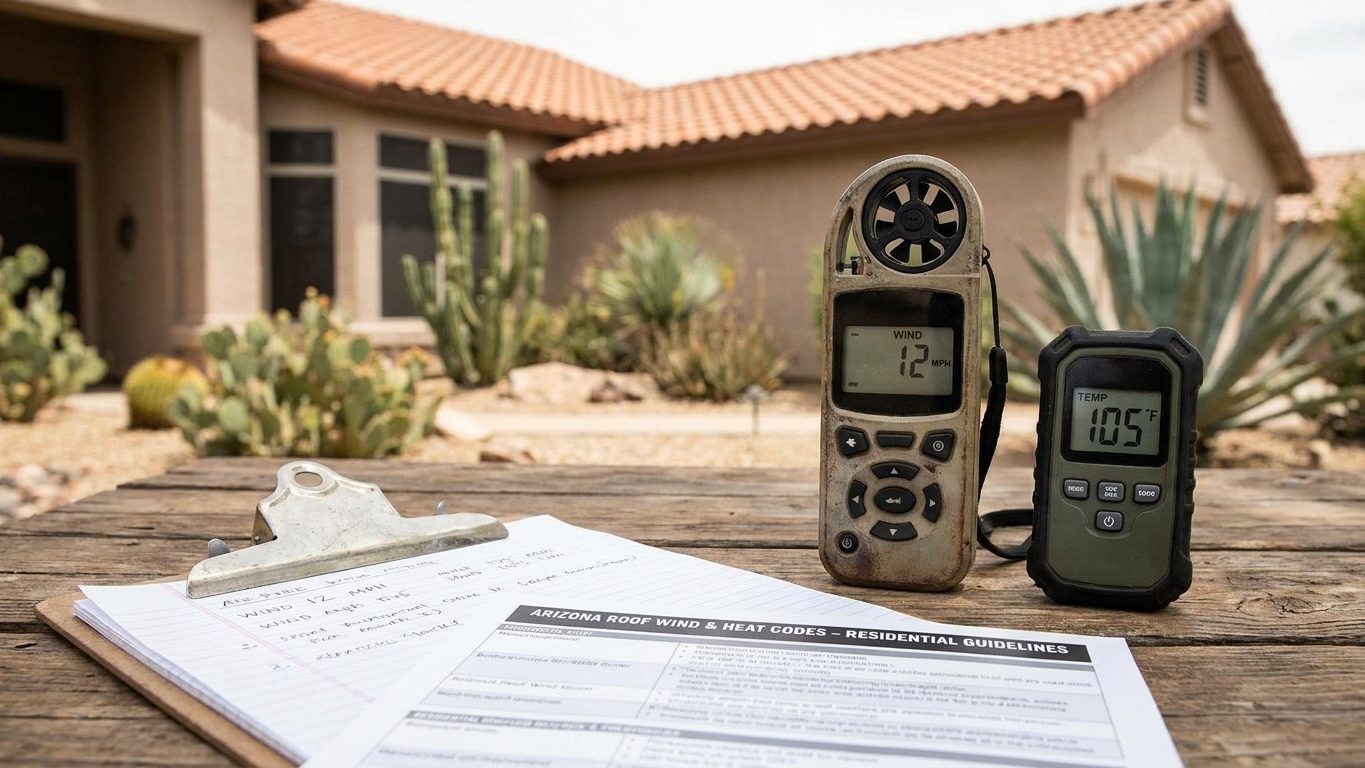

A 3-second gust of 136 mph at Houston is what decides how a Texas roof gets built, because that is the design wind speed ASCE 7-16 assigns Risk Category II houses at this reference city. It is not a sustained wind and not what a hurricane forecast reports, it is the peak gust the code assumes hits open, flat terrain 33 feet up. Check with your city building department for the design wind speed and code edition that actually apply to your address, since Texas leaves that decision to each municipality rather than setting one figure statewide.
What wind speed must a roof withstand in Texas?

Before any material choice, roofing in Texas starts from a single number. At Houston, the reference city ASCE uses for this part of the Gulf Coast, the basic design wind speed is 136 mph under ASCE 7-16, the edition behind the load tables IRC/IBC 2021 makes applicable in most states. That figure is a 3-second gust, measured at 33 feet in open, Exposure C terrain, for Risk Category II, the ordinary single-family house. It is not a sustained wind and not the number a hurricane advisory reports. A named storm’s “130 mph winds” describes a sustained speed averaged over a minute or more offshore. The design gust is a shorter, sharper spike, and the code is built around that spike because it is what actually tears a shingle or a piece of flashing loose.
The newer ASCE 7-22 maps the same point at 133 mph, a small drop from 7-16’s figure. That is the coming edition, not the one your permit is drawn against today, and the change reflects a revised statistical model, not a lower hurricane risk on the Gulf Coast.
This number is what the whole roof assembly is designed around. It sets the required wind rating on the shingle package, the nailing pattern, how many fasteners per shingle and where, the fastening schedule for the roof sheathing, and the uplift connections, straps or clips, that tie the roof structure down to the wall framing. Edges, rakes and ridges fail first in a high wind event because airflow separates there and uplift pressure concentrates at those lines, which is why fastener spacing tightens right at the perimeter and hips even when the field of the roof uses a wider pattern.
Houston sits inside a hurricane-prone region as ASCE 7 defines it, a designation with real code consequences discussed below. Coastal counties southeast of Houston, and the immediate Gulf shoreline, sit on wind contours higher than the inland reference point this page uses, so a project there is governed by a different design speed entirely. Neighboring stretches of the Gulf Coast carry their own figures too, and it is worth checking how Louisiana’s roof wind speed and heat rules compares before assuming one number travels across a state line. Confirm the design wind speed and code edition for your specific address with your city or county building department before assuming Houston’s figure applies to yours.
Does Texas require impact-rated roofing or shutters?
Not at Houston, and not by the wind map alone. Houston’s mapped basic design wind speed of 136 mph under ASCE 7-16 sits inside a hurricane-prone region but stays under the wind-borne debris threshold the code sets for that tier, so the map does not, on its own, trigger a requirement for impact-rated glazing or approved storm shutters at this reference point. That does not mean Houston carries no hurricane risk, it means this particular map value does not cross into the debris-impact requirement. Locations further along the Gulf Coast, and states with wider stretches of high wind contour such as the ones described in Florida’s roof wind speed and heat rules, cross that threshold across much larger areas, and impact protection there becomes a routine line item.
Texas has no single statewide residential building code to check this against. State law adopts the 2012 International Residential Code as a model for municipal residential codes, but leaves cities free to add, modify or remove requirements after a public hearing, so the edition and the local amendments in force depend on the city, not the state. Unincorporated areas answer to a still older edition, and counties have almost no power to enforce it. Ask your city’s building department which edition and which local amendments apply at your address, because the figure above tells you what the map says, not what your permit will require.
Where an impact requirement does apply somewhere along this coast, understand what it is actually protecting. A window, door or skylight that fails under wind pressure or flying debris lets outside air rush into the house. That sudden internal pressure pushes upward and outward on the roof structure from underneath, on top of the suction already pulling at it from above, which is why an opening failure and a roof failure are one problem, not two separate ones.
A roof contributes its own resistance regardless of whether a glazing rule applies. A sealed roof deck, taped or sealed at the sheathing seams, keeps wind-driven rain out even if the shingles themselves are damaged. Ring-shank nails hold sheathing to rafters far better than smooth-shank fasteners under repeated uplift cycling. A secondary water barrier under the shingles buys protection if the primary roof covering is compromised. And the connections between roof framing and wall framing, whatever hardware the local code calls for, carry uplift load down through the walls to the foundation rather than letting the roof structure lift as a unit.
Does snow ever matter for a roof in Texas?
Barely, and the code reflects that plainly. The design ground snow load at Houston is 0 psf under ASCE 7-16, the edition behind IRC/IBC 2021’s load tables. Wind, not snow, governs roof design at this reference point.
Ground snow load is also not the same thing as the load that actually reaches a rafter. The mapped figure describes snow sitting on open ground. The code applies exposure, thermal and roof-slope factors before that number becomes a design load on an actual roof, and at zero, none of that arithmetic changes the outcome here.
ASCE 7-22 maps the same Houston point at 7 psf, but on a different, strength-level basis than 7-16’s nominal figure, so the two are not comparable the way an inch-for-inch measurement would be, and the newer figure still does not rise high enough to control the design.
A rare snow event in a place that never designs for it still causes trouble, just not through weight. Ponding on flat and low-slope roofs, a blocked scupper or drain, and the ice that follows on a roof with no slope to shed water, are the real exposure. That is a drainage and maintenance question, not a structural one, and it is worth checking gutters and roof drains before a winter storm rather than after.
How much does heat shorten a roof in Texas?

Houston averages 102.4 days a year at or above 90°F, according to NOAA’s 1991-2020 climate normals for the reference station there, and that single number says more about what a roof endures in this state than any wind figure does. A roof covering here spends more than a hundred days a year absorbing direct summer sun on top of ambient heat that is already high, and it does that every year, not just in an unusual season.
What the heat actually does to the material
Asphalt shingles rely on oils within the asphalt mat to stay flexible. Ultraviolet light and sustained heat drive those oils out over time. As they go, the mat stiffens, and a shingle that used to flex with the deck under thermal movement starts to crack instead. The surface granules, embedded in that same softened asphalt, lose their grip and shed, which is usually the first visible sign of an aging roof, granules collecting in gutters and at downspouts.
None of that runs on a clock set by the calendar. It runs on cumulative heat exposure, which is exactly why a roof in a climate with 102 days a year above 90°F ages differently than the same product in a cooler state.
Why attic ventilation is a roof question, not just a comfort one
A dark asphalt roof deck in full Texas sun can run far above the surrounding air temperature, and that heat radiates directly into the attic below it. A poorly ventilated attic traps that heat, which raises the temperature of the underside of the deck and the shingles above it even further, accelerating the same oil-loss and brittleness described above. Ridge and soffit vents that move air through the attic space carry that heat back out before it builds, which is why ventilation belongs on a roof-lifespan checklist and not only on a summer-comfort one.
Houston falls within IECC climate zone 2A, one of six zones that appear somewhere across the state’s 254 counties, alongside 3B, 3A, 4B, 2B and 1A. That spread means the heat load driving roof wear in the Rio Grande Valley or along the Gulf Coast is not the same load a roof carries in the Panhandle, and a reader should check the county-level table rather than assume one zone covers the state.
Reflectance, color and an underlayment rated for the temperatures it will actually see are the levers available against this kind of wear. None of them are a substitute for the fastening and structural questions covered above. They address a different failure mode entirely.
What roofing material suits Texas best?
Given a design wind speed of 136 mph at Houston under ASCE 7-16, and well over a hundred days a year above 90°F, the honest starting point is not the roof covering at all. It is the deck and the fastening underneath it. A shingle rated for high wind performs to whatever standard it was actually nailed to, not to the rating printed on its wrapper, so a correctly specified nailing pattern and a sealed deck matter more than which category of material sits on top of them.
With that established, the categories do differ in what they are good at under these particular loads.
| Material | Wind performance | Heat and sun performance | Weight and fastening notes |
|---|---|---|---|
| Architectural asphalt shingles | Carries a manufacturer wind rating, but that rating assumes the specified nailing pattern was followed exactly | Asphalt mat loses oils and stiffens under sustained UV and heat, the mechanism above | Lightest common option, straightforward re-roof over an existing deck |
| Standing-seam metal | Concealed clips distribute uplift load along the panel rather than concentrating it at exposed fasteners | Reflects more solar radiation than dark asphalt, running cooler at the surface | Light to moderate weight, clip spacing is the detail that carries the wind rating |
| Concrete and clay tile | Individual tiles and their fasteners are the vulnerable point in high wind, even though the material itself is durable | Long service life under direct sun, minimal oil-loss failure mode | Heavy, requires a structure designed for the added dead load |
Architectural asphalt shingles carry a published wind rating from the manufacturer, but that figure is only as good as the installation underneath it, the nailing pattern, the number of fasteners per shingle and their placement relative to the tab. Standing-seam metal roofing distributes uplift through concealed clips along the length of each panel rather than through exposed nails punched through the field of the material, which is part of why it performs differently under the same gust. Concrete and clay tile last a long time under direct sun with none of the oil-loss failure mode that ages asphalt, but the tiles themselves and their individual fasteners are the weak point in high wind, and the added weight changes the structural design of the roof framing beneath them.
Where the heat load matters on its own terms, a roof surface with higher solar reflectance runs cooler at the surface than a dark one under the same sun, which reduces the temperature the material and the attic below it actually experience, independent of wind performance entirely. That is a separate lever from wind resistance, and a roof assembly has to satisfy both loads at once, not choose between them.