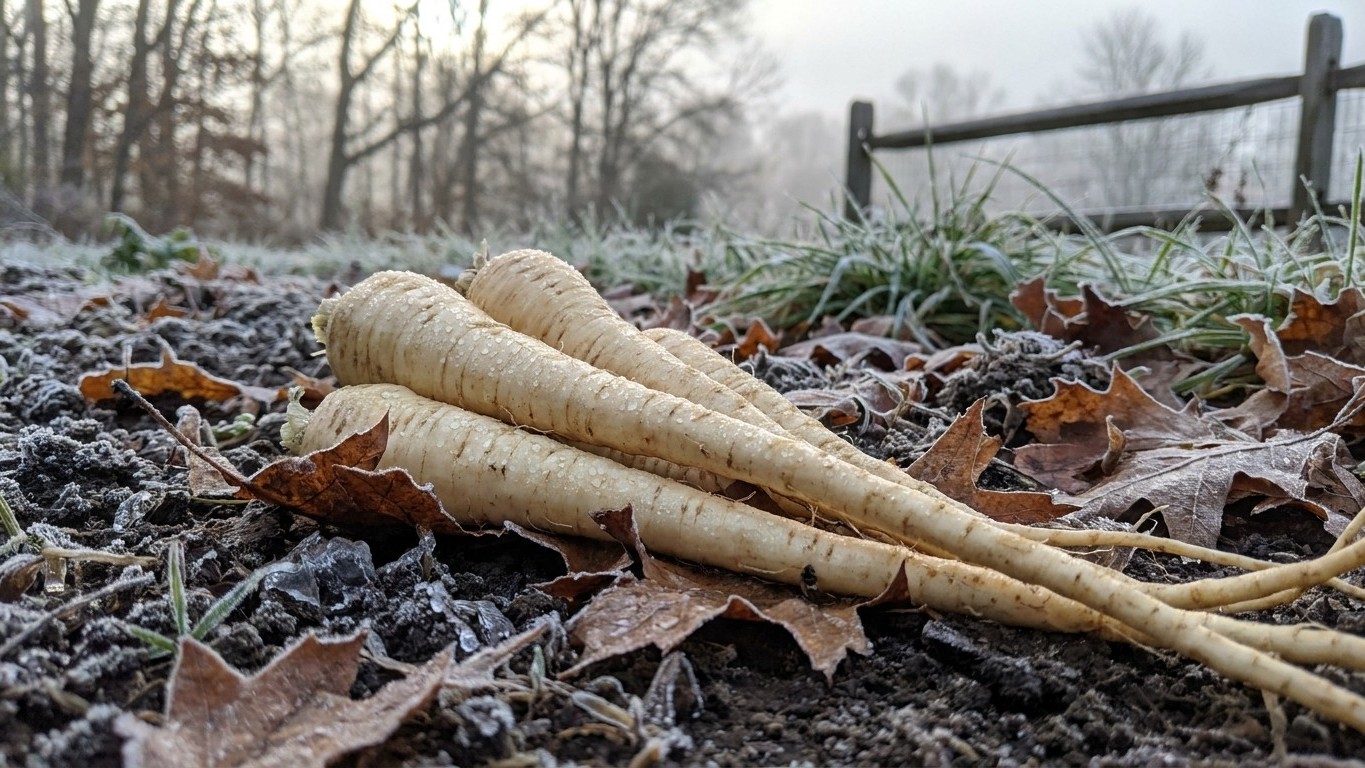

Lift parsnips 100 to 120 days after seeding. In the Houston area, roots sown at the usual time finish between late April and mid June, months before any frost. That is the Gulf end of Texas, where the coldest month averages a nighttime low of 43.7 F. A parsnip grown there will size up fine, but it won’t reliably sweeten the way the textbooks promise. Once lifted, it can keep four to six months, provided you hold it away from the fruit bowl.
The short answer
Does this part of Texas deliver several frosty weeks? Along the Gulf, not dependably. The Houston reference station in the NOAA NCEI Climate Normals puts the mean daily minimum of the coldest month at 43.7 F. The average night in the dead of winter sits 11.7 degrees above freezing. Frost arrives as a handful of cold snaps, not as a season.
That matters because of how the crop works. Utah State University Extension notes that parsnips taste best after several weeks of cool, frosty weather, which converts stored starch to sugar. The trigger is frost exposure, not the hardiness zone. A comfortable zone number tells you the plant will survive winter. It says nothing about how many nights actually drop to 32 F. So a Houston-area parsnip will grow, and in a cold winter it may pick up some sweetness, but plan on a mild, starchy root. The mechanism, and what changes in colder parts of the state, is laid out in Will Parsnips Sweeten in Texas?
When to lift
Parsnips are sown in place, so the clock starts at seeding, not at transplanting. Lift once 100 to 120 days have passed. In this climate the date comes off the calendar, not off the first frost, which is how a northern gardener decides. The arithmetic in the next section lands the harvest in late April through mid June for a winter sowing.
One warning about geography. Every date on this page comes from Houston, the mild Gulf end of a state that spans four USDA zones. The Panhandle freezes months earlier in fall and months later in spring, and the Hill Country and North Texas each differ again. Even inside Houston, Hobby airport runs about two weeks milder than IAH, the station used here. Treat these numbers as one corner’s calendar, not a Texas planting chart. For the wider picture, start with Growing Parsnips in Texas.
How long they keep, and the ethylene problem
USDA Agricultural Handbook 66 says parsnip roots can be stored 4 to 6 months at 32 to 34 F with 98 percent relative humidity. That is a long keeper by any standard. It also assumes those conditions are held steady, and almost no house manages that. Read four to six months as the ceiling, not the promise.
The surprise is what spoils them. The handbook states that parsnips are not chilling sensitive, so cold itself does no harm. Ethylene does. A parsnip makes very little of it (under 0.1 microliters per kilogram per hour at 68 F), but exposure to low levels in cold storage causes bitterness, likely from a buildup of xanthotoxin. Apples and other ripening fruit give off ethylene, so a parsnip stored beside them turns bitter even at the right temperature. Give the roots their own bin or drawer. And when you trim them, top the greens but do not cut into the crown.
Does the season fit?
On paper, comfortably. The real question is when the roots finish compared with when frost shows up. Here is the arithmetic in words, using the Houston station’s 30 to 70 percent probability band for a 32 F freeze.
- Start with the last spring frost: February 4 to March 1. That is the window in which the odds of another freeze fall from 70 percent to 30 percent.
- Sow in place 2 to 3 weeks before it. Three weeks before February 4 is about January 14, and two weeks before March 1 is about February 15. So the sowing window runs from roughly mid-January to mid-February.
- Expect bare soil first. Germination takes 14 to 21 days, so a seed row can look empty for up to three weeks. That is normal, not a failure, and re-sowing on day ten wastes seed. Those weeks count inside the 100 to 120 days, which run from seeding.
- Add the growing time. A January 14 sowing reaches 100 days on about April 24 and 120 days on about May 14. A February 15 sowing reaches 100 days on about May 26 and 120 days on about June 15. Lifting time is late April through mid June.
- Check the other end. The first fall frost falls between December 1 and December 19. From the latest finish, June 15, to December 1 is about 24 weeks of slack.
- Run the fall version backward, as arithmetic only. To finish by December 1 on a 120-day crop, you would sow around August 3. To finish by December 19 on a 100-day crop, around September 10. The source says nothing about germinating seed in August soil, so this is a calculation, not a tested calendar.
The verdict is that the season fits with room to spare, perhaps too much room. A winter sowing is done long before frost arrives, which is exactly why the sweetness question matters more than the calendar one.
What goes wrong here
Most failures trace to soil, water, or a winter that never gets cold enough. Utah State University Extension recommends deep sandy soil, and says heavy soil must be double dug. What sits under your yard is only a starting point, and it can change from one bed to the next.
- Forked roots from heavy or stony ground. A root that meets clay or a stone splits or twists around it. Much of the Gulf plain is heavy clay, so double dig the bed deeply before sowing, pull out stones, and break up clods. Don’t count on amendments sprinkled on the surface.
- Forked roots from overwatering. This is a separate cause, and loosened soil won’t fix it. Constantly soggy ground can fork a root in a bed that was dug perfectly. Water evenly, let the bed drain between waterings, and don’t use a rainy spell as a reason to keep irrigating.
- A winter too mild to sweeten. With a coldest-month average low of 43.7 F, many seasons offer only a few frosty nights. Don’t blame the planting. Set expectations, lift on the 100 to 120 day schedule, and treat any sweetness as a bonus. A parsnip that never sweetens is still a good root vegetable, just a plainer one.
- A season that runs out. It rarely does in spring, given the slack above. It does with a late fall sowing. Seed that goes in after about September 10 cannot reach 100 days before even the latest first-frost date of December 19, so the roots would still be small when the cold arrives.
- Bitter roots from storage. A sweet, well-grown parsnip can still turn bitter in the kitchen if it sits next to apples or ripening fruit. Store them apart, and top the greens without cutting into the crown.
Insects and animals are a separate failure with their own calendar, covered in What Eats Parsnip in Texas, and When.
Common questions
When do I lift parsnips in the Houston area?
Count 100 to 120 days from seeding. A sowing made between roughly mid-January and mid-February finishes between late April and mid June. The date depends on when you sowed, not on frost.
Will they get sweet in Texas?
Sweetness needs several weeks of cool, frosty weather to turn starch into sugar. At the Gulf end, the coldest month’s average low is 43.7 F, so frost comes in short snaps. Expect a fine but mild root. Colder parts of Texas change the answer.
How long will lifted parsnips keep, and what ruins them?
Four to six months is the figure from USDA Handbook 66, at 32 to 34 F with 98 percent humidity held steady. Cold doesn’t hurt them, but ethylene from apples or ripening fruit makes them bitter. Top the greens and leave the crown uncut.
Do these dates apply to the rest of Texas?
No. They come from the Houston reference station, the mild Gulf end of four USDA zones. The Panhandle, Hill Country and North Texas each freeze on different dates. Even within Houston, Hobby airport runs about two weeks milder than IAH, so check the nearest station before copying these dates.