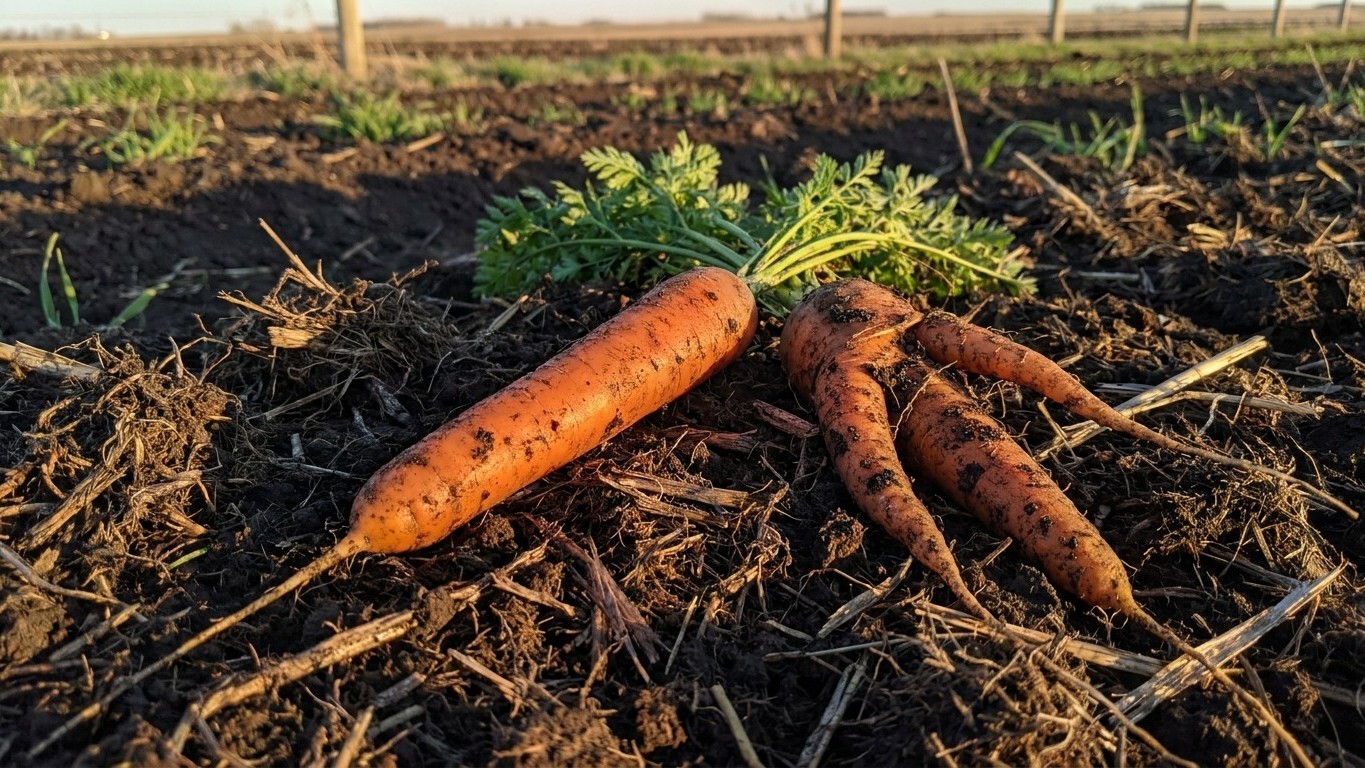

Pull carrots when the roots reach the width on the seed packet. Clemson Cooperative Extension puts that at about 65 to 75 days after planting, and packets for slower types run 70 to 100 days. Count from seeding, because carrots are sown in place and never transplanted. After the harvest, the job is cold and moisture. Cut the tops off, chill the roots at 33 °F in high humidity, and they will outlast any bunch left with its leaves on.
Keeping them, and for how long
Clemson Cooperative Extension’s Home & Garden Information Center gives the storage recipe in one line: store carrots at 33 °F and high humidity to prevent wilting. That is one degree above the freezing point of water. It is not a root-cellar temperature, and the difference matters. A carrot held at 50 °F will sprout and go soft in a fraction of the time it would last in true cold.
The same source says bunched carrots, meaning plants with the tops still on, keep for about 10 to 14 days. Treat that as a ceiling. It describes the best case, with steady cold and humid air, and a fridge that runs warm or dry will cut it short. Roots that are nicked, split or chewed will go first, so eat those right away. If you are seeing tunnels or gouges, What Eats Carrot in Michigan, and When explains what is likely doing it.
Why do carrots keep longer without their tops?
The leaves keep working after the root is out of the ground. They pull moisture out of the carrot and let it evaporate, so a root with its tops on goes limp while the greens still look fine. Trimmed carrots, with the tops cut off, keep for months under the same cold, humid conditions. The gap between 10 to 14 days and months comes almost entirely from that one cut.
So cut the tops first, soon after pulling, before the roots go into any cold space. Cut at the crown and brush off loose soil. A thick bunch of greens in a fridge drawer also takes up a lot of room, which is a good reason to trim even if you plan to eat the carrots within a week. The tops can go in the compost pile or the stockpot.
How do you know carrots are ready to pull?
Use the calendar as a guide and the roots as the final word. Mark the sowing date, then start checking at the early end of the range. Brush the soil back from the crown of one carrot. If the shoulder is about as wide as the packet describes, the rest are likely close behind. Pull one and look at it. Carrots that are left too long in warm ground can turn woody, so lifting a few early costs you very little.
Soil sets how easy that lifting is. Utah State University Extension says carrots want deep, sandy, well-drained soil rich in organic matter, and that heavy or rocky ground makes the root fork. Michigan’s state soil, the Kalkaska series, leans that way. It is a sandy, strongly leached, somewhat excessively drained soil, and the mapped surface layer is about 86 percent sand, 5 percent clay and 9 percent silt. Ground like that lets roots slide out whole.
Your own bed may be nothing like it. A state has hundreds of soil series, and river bottoms, clay country and any lot a builder scraped will behave differently. A quick jar test shows what you have. Fill a straight-sided jar about one-third full of soil from the bed, add water, shake hard, and let it settle. A thick band of clay means forked roots are likely, and Will Carrots Fork in Michigan Soil? covers the fixes. For the full picture of the crop, start with Growing Carrots in Michigan.
Where in the house that actually is
The refrigerator is the closest match to 33 °F for most households. Carrots do not mind near-freezing air. The crisper drawer is the usual spot, and a lidded container or a loosely closed bag holds in the humidity that keeps roots firm. Leave a gap or poke a few holes so the bag does not sweat. The risk in a fridge is the back wall, where a cold-running unit can freeze whatever touches it. Frozen and thawed carrots turn mushy.
A heated room is the wrong answer. Kitchen counters, pantries and closets inside the living space sit at room temperature, which is far above 33 °F. Carrots left there wilt within days, and the ones with tops go limp fastest. A bowl on the counter is fine for a day of cooking, but it is not storage.
A garage is a gamble because it follows the weather. In a Michigan winter it can sit below freezing for weeks and then swing well above it on a sunny afternoon. An attached garage is a little steadier than a detached one, but still not reliable. Carrots can freeze one night and rot the next week.
An unheated basement or cellar comes closest for big harvests, but only if it is cold enough. Many basements stay too warm for the Clemson figure. A cold corner against an outside wall, or a room cooled by a window cracked open, can get close to freezing in the depths of winter. Do not assume it. Measure it.
How do you check a storage spot with a thermometer?
Put a simple thermometer in the exact spot where the carrots will sit, and leave it for a couple of days, reading it morning and evening. Skip that check and you are guessing at a number that decides whether the harvest lasts months or rots in weeks. If the reading hovers close to 33 °F, the spot works. If it drifts warmer than that, use the fridge for what you can and eat the rest first.
A thermometer also catches the opposite problem. Set one on the back shelf of the fridge and another in the crisper drawer. The two spots often read differently, and if the back wall dips to freezing, move the carrots to the front. A second refrigerator in the garage or basement works well if you grow a lot, because it can be filled with trimmed carrots and left alone. Check the humidity by touch. The roots should feel firm and cool, not slimy, and the container should show a little moisture but no standing water.
Common questions
Can I leave carrots in the ground instead of pulling them?
For a while, yes. The ground holds them in cold, humid conditions of its own, and you can lift a few at a time. Pull them before the soil freezes solid. Your county extension office can tell you when that usually happens where you live.
Will carrots keep in a 50 °F basement?
Not for long. Clemson Cooperative Extension recommends 33 °F, and carrots held at 50 °F lose out to sprouting and softening in a fraction of the time. Use the basement only if a thermometer shows it is much colder than that in the spot where you plan to store them.
How long do carrots keep with the tops on?
About 10 to 14 days, according to Clemson, and that is the best case. Cut the tops off at the crown and the same carrots keep for months, because the leaves can no longer pull moisture out of the root.
Do I need a soil test before I plant carrots?
It helps. Michigan’s state soil is sandy, acid and fast-draining, but that is only a starting point for your own bed. A jar test shows how much sand, silt and clay you have. A lab test through your county extension office gives the pH and the nutrient numbers that a jar cannot.