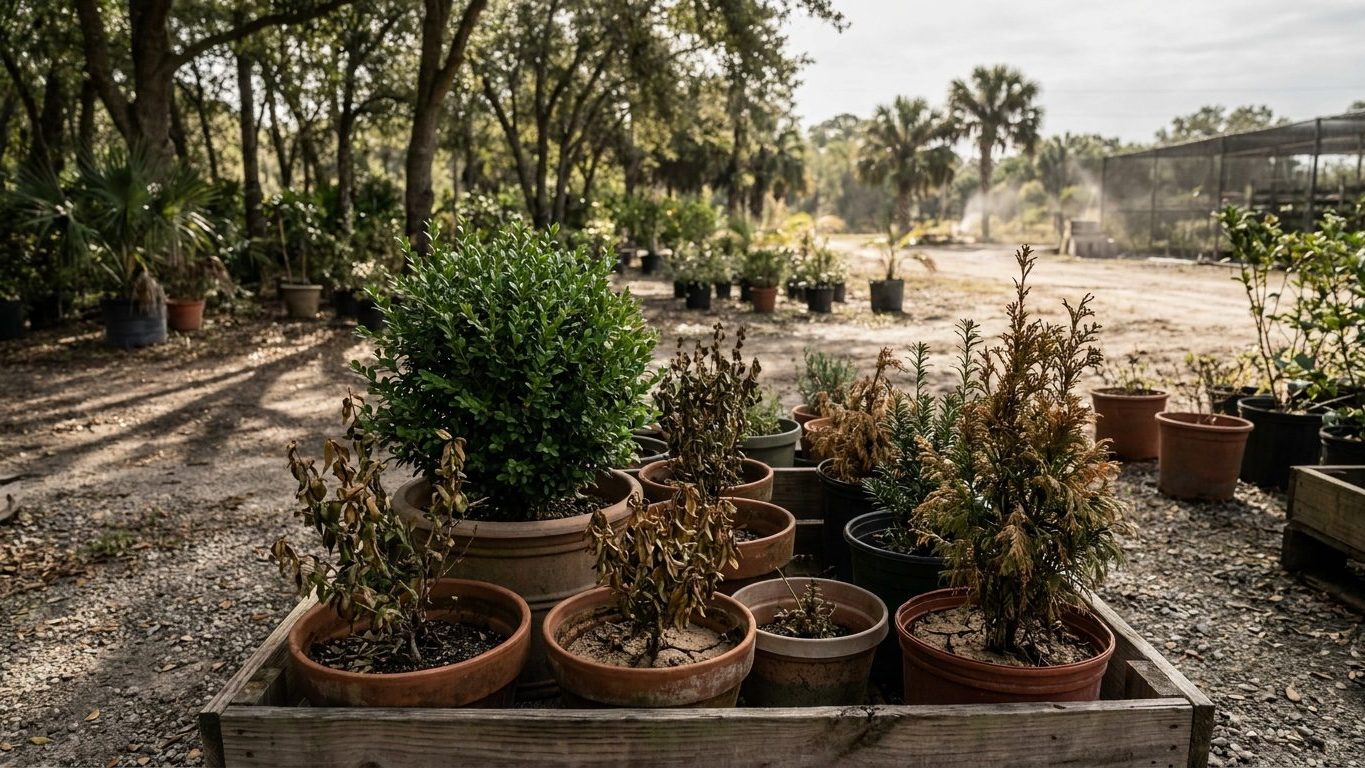

Of twelve common hedge species, five hold across all of South Carolina and seven only in part of it. The state runs from USDA zone 7a to 9a, so a shrub that does fine in the Upstate can fail near the coast, usually from heat. No species on the list fails everywhere. Three of the evergreens people buy most, though, can never be cut back to size once they outgrow the spot. Here is what to plant where, and what to leave on the nursery shelf.
What actually holds in South Carolina
The USDA Plant Hardiness Zone Map (2023 edition, built on 1991-2020 normals) rates South Carolina from 7a to 9a. It rests on a single number, the average annual extreme minimum temperature. The cold end sits in the Upstate and the warm end along the coast. A reference station near Charleston has its last spring frost between February 28 and March 17 and its first fall frost between November 20 and December 5 (NOAA NCEI 1991-2020 normals). Peninsular Charleston runs milder than that station, and the Upstate runs several weeks tighter at both ends. Use these dates as a starting point for your own county.
Which hedge plants fail in the warmer half of the state?
Seven species hold in only part of the state. Four of them stop at zone 7b: privet, yew, arborvitae and eastern hemlock. Three go as far as 8b: boxwood, cherry laurel and arrowwood viburnum. None of the seven is listed for zone 9a. The upper edge of these ranges is a heat limit. A plant can sail through a January low and still struggle through a humid August, and a hedge that sulks every summer never fills in.
| Plant | Zones where it holds | Height as a hedge |
|---|---|---|
| Privet (Ligustrum vulgare) | 7a, 7b | 4 to 12 feet |
| Yew (Taxus x media) | 7a, 7b | 3 to 8 feet |
| Arborvitae (Thuja occidentalis) | 7a, 7b | 4 to 15 feet |
| Eastern hemlock (Tsuga canadensis) | 7a, 7b | 10 to 20 feet |
| Boxwood (Buxus sempervirens) | 7a to 8b | 2 to 6 feet |
| Cherry laurel (Prunus laurocerasus) | 7a to 8b | 6 to 15 feet |
| Arrowwood viburnum (Viburnum dentatum) | 7a to 8b | 6 to 10 feet |
Which hedge plants hold from the mountains to the coast?
Five survive in every zone from 7a to 9a: American hornbeam, Leyland cypress, inkberry holly, winterberry holly and eastern red cedar. Inkberry keeps its leaves all winter. Winterberry drops them. “Holds” here means the plant survives the winter low and the summer heat. It does not promise a thriving hedge in every yard, so soil and drainage still matter (more on that below).
Gardeners near the North Carolina line can compare notes with the guide to Hedge Plants for North Carolina: What Holds, and What Only Looks Hardy, where the colder zones change the sorting.
The hedges you can never cut back down
Most hedge shrubs forgive a bad haircut. Cut boxwood, privet, cherry laurel, yew, hemlock, arrowwood viburnum, hornbeam or either holly hard, and they sprout again from old wood. Three do not. Arborvitae, Leyland cypress and eastern red cedar do not regrow from old wood. Cut into the bare interior and the branch stays bare, with a brown gap that never fills.
That matters most with Leyland cypress. It grows 3 to 4 feet a year and reaches 15 to 25 feet as a screen. A hedge that is 6 feet tall this fall can be well past 12 feet two summers later. The only fix at that point is removal, since a topped Leyland leaves a flat brown stump of foliage. Eastern red cedar grows 12 to 24 inches a year toward 8 to 20 feet and takes only light cuts in late winter. Arborvitae adds 6 to 9 inches a year and reaches 4 to 15 feet, and it holds only in zones 7a and 7b.
Eastern hemlock is a half exception. It regrows from old wood, but it only takes light cuts in late spring, so an overgrown one still needs patience. For the plants that can never be cut back, the only way to control height is to pick a species whose mature size fits the space before you plant. A Leyland is the wrong choice for a 10-foot slot, because no later pruning will make it fit.
Timing matters on top of that. Arborvitae takes its trim in late winter before growth starts or in midsummer. Leyland takes it from late spring to midsummer. Never cut into the brown interior on either date. A hedge you can trim a little every year stays manageable, and one trimmed every five years does not. Early fall is a poor time for any of it, because cutting now pushes tender new growth just ahead of the first fall frost, which reaches the Charleston reference station between November 20 and December 5.
Matching the plant to the job
Start with the job, then check the zone. A privacy screen, a low formal edge and a wildlife hedge call for different plants, and the growth rates differ a lot.
Which hedge plants make a fast privacy screen?
Leyland cypress is the quickest, at 3 to 4 feet a year, but it cannot be cut back later. Privet grows 2 to 3 feet a year to 4 to 12 feet and holds only in zones 7a and 7b. Eastern hemlock adds 12 to 24 inches a year toward 10 to 20 feet, also in 7a and 7b only. Cherry laurel is slower at 1 to 2 feet a year, but it reaches 6 to 15 feet and holds through zone 8b. Prune it in late spring after flowering. For a deciduous screen across the whole state, American hornbeam grows about 12 inches a year to 6 to 15 feet, with its trim in midsummer after the first flush.
Which hedge plants suit a low, formal edge?
Boxwood is the classic choice, at 3 to 6 inches a year and 2 to 6 feet tall as a hedge. It holds from zone 7a through 8b. That slow growth means it takes years to fill a long run, but it stays tight. Yew grows 6 to 12 inches a year to 3 to 8 feet, and only in zones 7a and 7b. For a trimmed evergreen edge that holds in all three zones, inkberry holly grows 6 to 12 inches a year to 5 to 15 feet and takes its pruning in late winter while dormant. Winterberry holly has the same size and growth rate, but it loses its leaves in winter.
For a looser, flowering hedge, arrowwood viburnum grows 12 to 24 inches a year to 6 to 10 feet. It holds in zones 7a to 8b and gets its trim right after flowering. Gardeners comparing how the same species sort in dry or cold country can read the guides for Hedge Plants for Arizona: What Holds, and What Only Looks Hardy and Hedge Plants for Iowa: What Holds, and What Only Looks Hardy. The wider Hedges section covers spacing and care across all of them.
Whatever the job, plant for the mature size. A shrub that wants to be 15 feet tall will fight you every season in a 6-foot space.
The ground you are planting into
The soil USDA lists as representative of South Carolina is the Bohicket series, an Entisol. That means a very young soil with almost no profile development. The surface horizon averages about 17 percent sand, 35 percent clay and 48 percent silt, which is heavy clay. Its surface pH is about 7.3, near neutral, and its organic matter is about 15.0 percent. It is very poorly drained. Those are the values USDA records for the mapped surface layer. They do not describe a worked garden bed.
That soil represents the state, but it is not necessarily the ground in your yard. South Carolina has hundreds of soil series. River bottoms, hill country and any lot a builder has scraped or filled can differ completely from this one. What the Bohicket series does show is what the state’s heavy ground tends to do, which is hold water. Boxwood and yew resent standing water around their roots. Inkberry and winterberry hollies both grow naturally in damp ground, so they are the safer picks for a low spot that stays wet after rain.
To learn what you actually have, get a soil test through Clemson Extension and your county office. The result gives you a real pH and nutrient readout for your own bed, and the office can tell you what is normal for your county. Do it before planting, since a hedge row is hard to amend once it is in.
For drainage, dig a hole about a foot deep where the hedge will go, fill it with water and let it drain. If water is still standing the next day, pick wet-tolerant species or set the root ball slightly high on a low mound. With the first fall frost not due at the Charleston reference station until November 20 to December 5, October is still a good month to plant, since roots keep growing in warm soil for several weeks.
Common questions
What is the best evergreen hedge for South Carolina?
Inkberry holly is the evergreen that holds in all of zones 7a to 9a, and it reaches 5 to 15 feet as a hedge. Cherry laurel and boxwood stay evergreen too, but they hold only through zone 8b. Leyland cypress and eastern red cedar also hold statewide, though neither can be cut back once overgrown.
Can I plant arborvitae near the coast?
Arborvitae holds only in zones 7a and 7b, so the warmer parts of the state are outside its range, mostly because of heat. It also cannot regrow from old wood, which makes a failing plant a poor candidate for a rescue cut. Eastern red cedar is a screen that holds across all of South Carolina.
When should I prune a hedge?
It depends on the plant. Hollies take their trim in late winter while dormant. Arrowwood viburnum and cherry laurel take theirs right after flowering. Boxwood is pruned in late spring after the last frost, and Leyland cypress from late spring to midsummer. The reference station near Charleston sees its last frost between February 28 and March 17, and the Upstate runs later.
How do I find my hardiness zone?
Look up your ZIP code on the USDA Plant Hardiness Zone Map. South Carolina falls between 7a and 9a, so neighboring counties can land in different zones. Your county Clemson Extension office can confirm the zone and tell you which of the seven part-hardy species are safe in your yard.