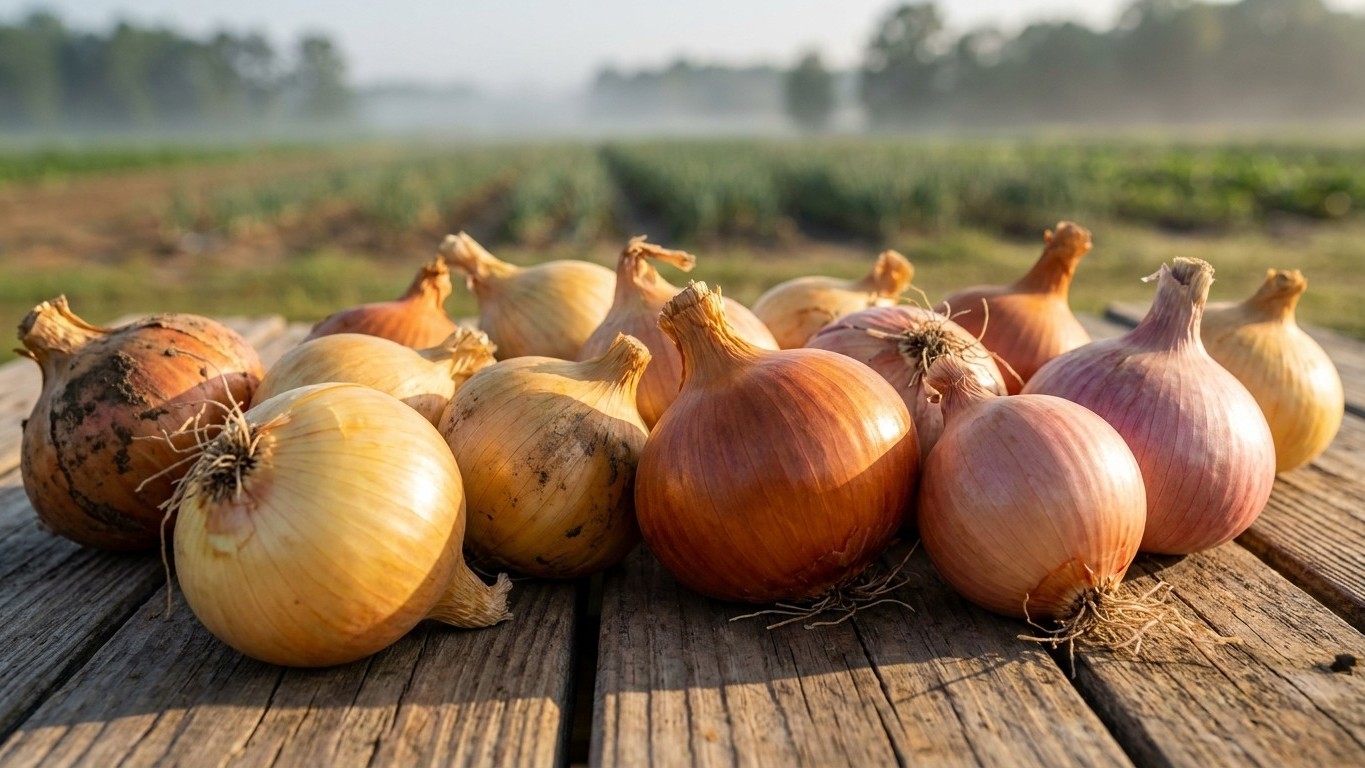

In British Columbia, lift onions once the tops have fallen over and started to yellow, usually from late summer into early fall. Cure them in a warm, dry, airy spot until the necks are tight and the skins papery. Only then do they go into storage, somewhere cool and dry. Wet coastal autumns make curing the step most gardeners rush. A bulb stored half-cured is the first one to rot, and it can take its neighbors with it.
When are onions ready to lift?
Onions decide when to finish long before you do. Day length triggers bulbing, and warmth has little say in it. The reference city here is Vancouver, where the Environment and Climate Change Canada station (Vancouver Int’l A) sits at 49.20 degrees north. At that latitude the longest day of the year brings 16 h 01 of daylight, calculated for the June solstice. That clears the 14 to 16 hours a long-day onion waits for, so those varieties bulb in the Lower Mainland. A short-day variety starts bulbing at about 12 hours, according to Clemson Cooperative Extension, which means it bulbs early and stays small this far north. The The Best Onion Varieties for British Columbia page sorts the choices by day length.
Vancouver is only one point on a very long province. A garden in the northern Interior sits well north of 49.20 degrees and gets a longer summer day. One on southern Vancouver Island sits a little south. If you garden near either edge, look up your own latitude before you decide what to plant, and expect your lifting window to shift with it.
For the lifting itself, the plants give the signal. Stop watering when the tops begin to yellow, so the necks have a chance to dry. Then wait for most of the tops to fall over, which means the bulb has stopped growing and is sealing itself off. A few more signs confirm it:
- The leaves are yellow and flopped, with only a few green ones left standing.
- The neck has gone soft and thin where the leaves meet the bulb.
- The outer skin is dry and rustles when you rub it.
- The bulbs sit high, with their shoulders showing above the soil.
Pick a dry day. Loosen the soil with a fork and pull the bulbs gently, because bruises are where rot starts. Set aside anything with a soft spot, a thick green neck or maggot damage and eat it first. What Eats Onion in British Columbia, and When explains which damage you are looking at.
How do you cure onions after lifting?
Curing dries the neck and the outer skins so they seal the bulb like a wrapper. Spread the onions in a single layer, or hang them in bundles, in a warm, dry place with good air movement and out of direct sun. Hot sun can scald the bulbs. On the coast, October rain often arrives before the job is done, so a covered porch, a greenhouse with the vents open or a garage with a small fan running all work better than a lawn or a driveway.
How long it takes depends on the weather and on how thick the necks are. Count on a couple of weeks, and longer in a damp spell. Judge it by the onion. The neck should be tight and dry, with no give when you squeeze it, and the outer skins should be papery. Then trim the tops down to a short stub and brush off loose soil and dry roots. Do not wash them.
Curing comes first, always. Bulbs go into storage only once the necks are tight and the skins are papery, never straight from the ground. Skip it and the moisture left in the neck becomes a way in for rot.
Keeping them, and for how long
Once the onions are cured, the target is cool and dry. Clemson Cooperative Extension’s Home & Garden Information Center puts the ideal conditions at between 45 °F and 55 °F, and 50 to 60 percent humidity. You can read the Clemson fact sheet for the full guidance on onions, leeks, shallots and garlic.
The humidity number surprises people who store carrots and beets. Roots like it damp, and onions want the opposite. A single cellar cannot hold both well. Put onions in a cellar that suits carrots and they sprout and soften. Put carrots in a spot that suits onions and they shrivel. If you grow both, give them separate places.
How long they last is a ceiling. Any length of storage you read about assumes the best conditions, a well-cured bulb and a sound variety. Pungent, thick-skinned onions generally keep longest. Sweet, mild types hold the least time, so use those first. A bulb with a thick neck or a bruise will fail ahead of the rest no matter how good the room is.
Pack them in a way that lets air move. Mesh bags, slatted crates, open baskets and old nylon stockings with a knot between bulbs all work. Sealed plastic bags and closed boxes trap moisture and invite mold. Keep them in the dark, too, since light and warmth push bulbs to sprout.
Then check them. Go through the stored onions every couple of weeks and take out anything that is soft, damp at the neck or sprouting. One rotting onion releases moisture and spores into everything touching it. Catching it early costs you a single bulb. Missing it can cost the whole bag.
If you are still choosing what to plant for next season, the main Onions in British Columbia guide covers the full growing calendar, from sets and transplants through harvest.
Where in the house that actually is
Few rooms hit 45 °F to 55 °F and 50 to 60 percent humidity. A domestic fridge runs colder than the 45 °F floor, and its crisper drawer adds moisture, which suits lettuce and carrots but not onions. A heated living space runs warmer than the 55 °F ceiling, and a kitchen counter adds heat and steam from cooking. A garage swings with the weather, so it can sit in range one week and drop toward freezing or climb past it the next.
| Spot | What happens to onions |
|---|---|
| Domestic fridge | Colder than the 45 °F floor, and humid in the drawers |
| Heated room or kitchen | Warmer than the 55 °F ceiling, so bulbs soften or sprout |
| Garage | Swings with the weather, so it passes in and out of range |
| Cool basement or unheated spare room | Closest match, if the air is dry enough |
| Damp root cellar | Right temperature, but too humid for onions |
For most BC houses, the closest match is a cool basement room, a closet on an outside wall or an unheated spare room, somewhere in the cool half of the house with some airflow. On the wet coast, basements can run damp from fall through spring, so humidity is the usual problem. In the drier Interior, the problem is more often temperature, with cold snaps that reach an uninsulated garage.
Before you commit the harvest, leave a thermometer with a humidity reading in the spot for a few days. Check it in the morning and again in the evening, and look again after a cold night or a rainy spell. If the temperature stays between 45 °F and 55 °F and humidity holds from 50 to 60 percent, you have your storeroom. If the room runs damp, a small fan, a slatted shelf and a bag of desiccant can pull the humidity down. If it runs too warm, move the onions to a cooler corner. Skipping this check is how a full season’s crop ends up in the compost.
Common questions
Can I leave onions in the ground until I need them?
Not for long. Once the tops fall over, the bulb has stopped growing, and wet autumn weather invites rot, sprouting and pest damage. Lift on a dry day and cure them.
What if it keeps raining while the onions are curing?
Move them under cover. A porch, a greenhouse with the vents open or a garage with a fan will do. Keep air moving over the bulbs and keep them out of direct sun.
Can I store onions in the fridge?
It is a poor choice. A domestic fridge runs colder than the 45 °F floor for ideal onion storage, and the humidity is too high. Keep cured bulbs in a cool, dry, dark spot instead.
How do I know if a stored onion has gone bad?
Soft spots, a damp or slimy neck, mold or a sour smell mean it is finished. Remove it at once and check the ones around it. A green sprout through the top means the bulb is on its way out, so use it soon.