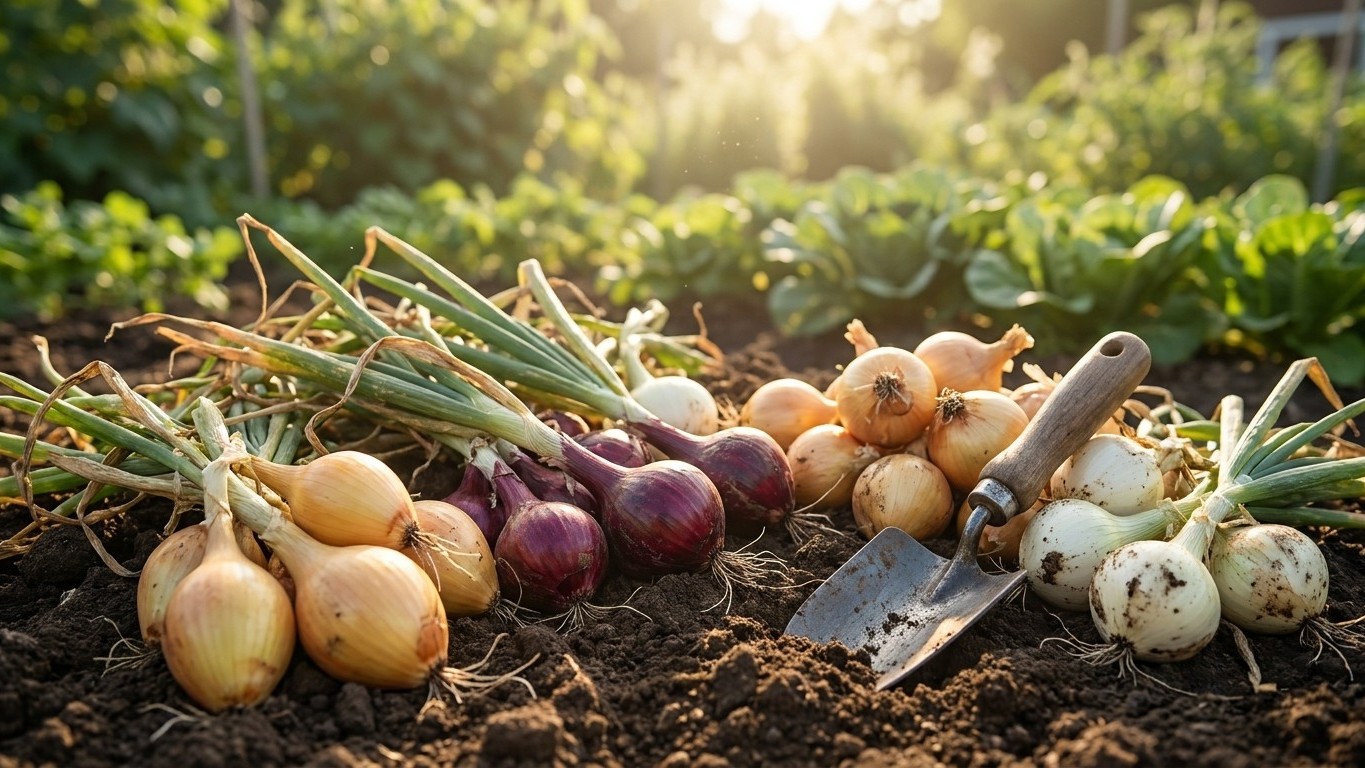

Lift onions in Colorado when most of the tops have flopped over and started to yellow, which usually happens in late summer. Then cure them in a dry, shaded, airy spot until the necks are tight and the skins feel papery. Cured pungent onions can last well into winter in a cool, dry room. Sweet types are kitchen onions to eat soon after harvest. Skip the curing and stored bulbs tend to rot from the neck, however good the storage room is.
When do you lift onions in Colorado, and how do you cure them?
Day length sets the clock before the calendar does. The latitude of the Denver station in NOAA NCEI records is 39.83 degrees north, and the longest day there brings 14 h 50 of daylight. That is measured to the geometric horizon, so real daylight runs about seven minutes longer. Clemson Cooperative Extension puts the bulbing trigger for short-day onions at about 12 hours, so those varieties start swelling early and stay small this far north. Long-day varieties wait for 14 to 16 hours, and a Denver summer clears that bar. Daylight grows with distance north, so a gardener near the Wyoming line or the New Mexico line should look up the latitude of their own town and compare it before choosing varieties. The The Best Onion Varieties for Colorado page covers that choice.
Once bulbs have formed, the plant signals when it is finished. The necks soften, the green tops lose their stiffness, and they bend over at the base. Exact dates shift with planting date, variety and the year’s weather, so read the plants and ignore the calendar. Lift when most of the tops have fallen over and the leaves are yellowing. Choose a dry day, loosen the soil with a garden fork, and lift the bulbs rather than yanking them by the tops. A bruised or nicked bulb breaks down in storage, so set those aside for the kitchen, along with any soft or pest-scarred ones. Common damage is described in What Eats Onion in Colorado, and When, and the season as a whole is laid out in Onions in Colorado.
How do you cure onions after lifting?
Curing dries the neck and the outer skins so they seal the bulb. Spread the onions in a single layer on screens or slatted racks, or tie the tops in loose bunches and hang them. Pick a spot with moving air, shade and shelter from rain. A covered porch, an open shed or a breezy garage all work. Direct afternoon sun can scald the bulbs, so keep them out of it. Colorado’s dry air helps, but a wet spell or a cold snap means you should bring the bulbs under cover. Curing takes as long as the necks need, so check them every few days instead of setting a date.
Bulbs are ready for storage when they show these signs:
- The neck is tight, thin and dry, with no green or moisture left.
- The outer skins are papery and rustle when rubbed.
- The roots are dry and wiry.
- Loose soil brushes off by hand, so there is no need to wash the bulbs.
Trim the tops to a short stub and clip the roots. Onions go into storage only after this step, never straight from the ground.
Keeping them, and for how long
Clemson Cooperative Extension’s Home & Garden Information Center gives the target for stored onions: “Ideal conditions are between 45 °F and 55 °F, and 50 to 60 percent humidity.” Both numbers matter. Onions want a cool room, and they want it dry. Carrots, beets and other root crops want the opposite, with damp air that keeps them crisp. A single cellar cannot hold both well, so if you grow both, give the onions their own corner or a separate room.
Duration is a ceiling under good conditions, and it depends on the onion. A pungent, long-day onion that was cured properly and stored in that range can feed a northern household into March at best. A warm spell, a damp spot or one rotting bulb in the crate shortens that. Check the stored onions every couple of weeks and use any that go soft or sprout.
The variety decides much of the outcome. University of Missouri Extension (Planting, growing and harvesting onions, G6355) says it plainly: “As a rule, ‘sweet’ onions do not store as well as the more pungent types.” The reason is chemical. The bite of an onion comes from volatile sulfur compounds, and those compounds also protect the bulb while it sits in storage. A sweet variety carries fewer of them, so it tastes better raw but will not last the winter. Day length lines up with this: short-day types run sweeter and long-day types keep longer. A southern garden produces onions to eat soon, and a northern one produces onions to eat in late winter.
| Onion type | Day length to bulb | Flavor | Storage |
|---|---|---|---|
| Short-day | About 12 hours | Sweeter, fewer sulfur compounds | Eat soon after harvest |
| Long-day | 14 to 16 hours | Pungent, more sulfur compounds | Keeps longest, months under good conditions |
With 14 h 50 of daylight on the longest day, a Denver garden suits long-day types. Never count on a sweet onion to last the winter.
Where in the house that actually is
The numbers on paper are easy to hit in a lab and harder to hit in a real house. A domestic fridge runs colder than onions like, and its crisper drawer is humid, which is the wrong direction on both counts. A heated living space is too warm. Colorado winters are dry, which helps, but a kitchen cabinet next to the stove or a closet over a furnace duct will sit above the range and push the bulbs to sprout. A garage swings with the weather: freezing nights in January, warm afternoons in October. Frozen and thawed onions turn to mush.
The room that usually comes closest is an unheated interior space. Think of a spare room that stays cool, a basement corner away from the furnace and water heater, or a pantry or closet on an interior wall. Basement rooms often come close to the range, but they can run damp, particularly near a sump pump or laundry, so test them. Choose the coolest dry room you have, then confirm it with instruments instead of a guess.
Put a min/max thermometer and a cheap hygrometer where the onions will sit for a week before you move them in. Skipping that check can cost you the whole crop, because a spot that feels cool in the afternoon may swing past 55 °F overnight or sit well above 60 percent humidity. Read the lows and highs, and compare them with the Clemson range. If the room runs too warm, move the crate lower or against an outside wall. If it runs damp, add air circulation.
Store the bulbs in mesh bags, slatted crates or open baskets, with air moving around them, and keep them out of sealed plastic. Onions give off moisture, so a single layer or shallow stack works better than a deep pile. Keep them apart from damp root crops.
Common questions
Can I keep cured onions in the refrigerator?
A whole cured onion does best outside the fridge. A domestic fridge runs colder than the 45 °F to 55 °F range, and the humidity is higher than the 50 to 60 percent onions prefer. Use the fridge only for cut onions, wrapped or in a sealed container.
Do I wash onions before storing them?
No. Brush off the dry soil after curing and leave the skins on. Water on the neck or skins invites rot, and wet bulbs go to the kitchen first.
Will sweet onions store through winter?
No. Sweet onions have fewer of the volatile sulfur compounds that protect pungent onions in storage, so they do not last as long. Eat them first and save the pungent, long-day types for late winter.
Can I store onions with potatoes or carrots?
Not in the same space. Onions want dry air at 50 to 60 percent humidity, while root crops like carrots want damp conditions. Give onions their own spot and keep the root crops somewhere more humid.