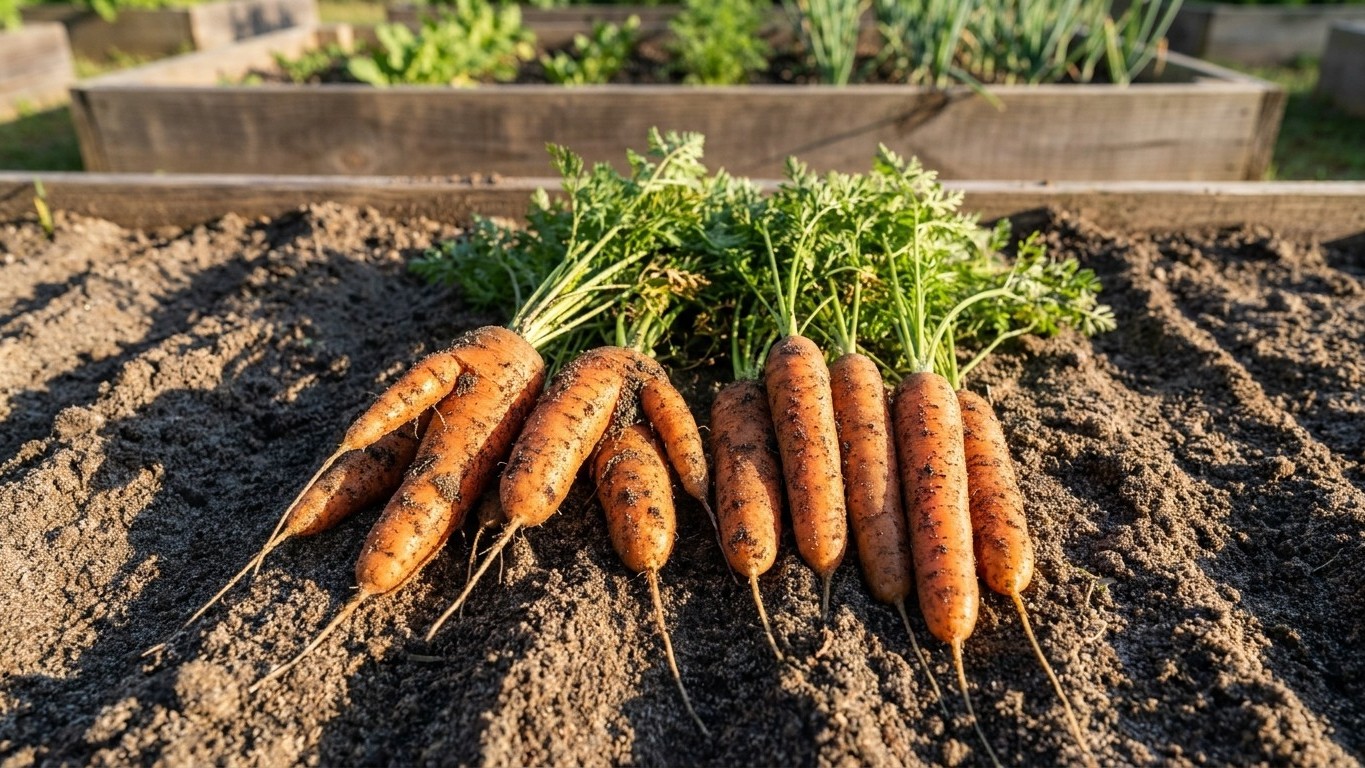

Start checking carrots about 65 to 75 days after sowing, the window Clemson Cooperative Extension gives. Pull them when the shoulders at the soil line look as wide as the seed packet promises, and before the ground freezes hard. Carrots are sown in place, so every day count runs from seeding. Once they are out of the ground, cut the tops off and hold the roots just above freezing in humid air. Left with their tops on, they last only 10 to 14 days.
Keeping them, and for how long
Why do carrots wilt so fast after harvest?
A carrot is mostly water, and its leaves keep working after the root leaves the soil. Through those leaves, water evaporates, and the root is the only supply left to pay for it. Within a day or two a bunched carrot goes limp and rubbery, because the tops have been quietly emptying it. Dry air pulls moisture out through the skin in the same way.
That is why trimming matters more than any other step. Twist or cut the greens off the day you pull, leaving a short stub at the crown. Brush off the loose soil, and sort the roots before they go anywhere. Cracked, split or nicked roots rot first, so those go to the kitchen. If something has been chewing on the crop, What Eats Carrot in South Dakota, and When explains what the damage means and when it tends to show up.
What temperature and humidity keep carrots longest?
Clemson Cooperative Extension puts it plainly: store carrots at 33 °F and high humidity to prevent wilting. That is one degree above the freezing point of water. It is a cold-storage number, and it is much colder than a cellar, a pantry or a mudroom. Humidity matters as much as temperature. Roots in dry, cold air still shrivel, only more slowly. A perforated plastic bag, or a closed container with the lid left slightly open, holds moisture around the roots without sealing them in a puddle.
Temperature drives how quickly the roots deteriorate. A carrot held at 50 °F, which feels cool to a person, starts to sprout and go soft in a fraction of the time it would last at 33 °F. The crown wakes up, sends out small shoots and spends the root’s sugars doing it. The texture goes from snappy to spongy, and the flavor goes flat.
How long do carrots keep once they are pulled?
Clemson says bunched carrots, meaning plants with the tops still on, keep for about 10 to 14 days. Treat that as the best case. It assumes the cold and the humidity are right from the first day, and a warm kitchen counter will shorten it. Trimmed carrots kept in those same conditions last much longer, up to months at best, which is the whole reason to cut the greens off first. Even then, a bag of carrots is not a set-and-forget pantry item. Check the bag every couple of weeks. Pull out any root that has gone soft or slimy, since one bad carrot can spoil the ones touching it.
The harvest date feeds into this too. A carrot lifted near the 65 to 75 day mark, at the size the packet describes, is sound and ready to store. One left until it is oversized and cracked from uneven watering will not hold as well, so it is worth lifting a few test roots at the early end of that window rather than waiting for the whole row to bulk up.
Where in the house that actually is
The refrigerator is the closest match, and it is also a little off. The main shelves usually run somewhat warmer than 33 °F, while spots near the back wall or the cold air vent can dip below it. The crisper drawer is the best location, since it is built to hold humidity, and a bag with a few air holes inside it does the rest. A few trimmed carrots fit easily. A whole garden harvest does not, and fridge space is what limits most households.
For larger amounts, people usually look at three places, and each one has a flaw.
- A heated room, such as a pantry off the kitchen or a closet on an inside wall, is far too warm. The carrots sprout and soften within weeks.
- An attached or detached garage swings with the weather. On the northern Plains it can sit near the right temperature on a mild fall night and drop well below freezing in January, which damages the roots. A spell of warm afternoons in early fall pushes it the other way.
- An unheated basement or a cold room against a north foundation wall comes closest to a root cellar. It can work in the cold months, but it is usually too warm in early fall, right when the harvest comes in.
The only way to know which spot holds up is to measure it. Put a thermometer in the spot you have in mind and read it over two days before you commit a harvest there. A min/max thermometer is better still, because it catches the overnight low and the afternoon high, which are the numbers that actually ruin stored roots. Skip this and the usual result is a crate of soft, sprouting carrots by midwinter, with nobody sure why. If the spot reads well above 33 °F, use it for a few weeks only. If it dips to freezing, move the roots, since frozen and thawed carrots turn mushy.
Humidity needs a check too, though it is harder to measure. A cheap hygrometer works. If you don’t have one, judge by the roots. After a week, press one gently. A carrot that is still firm is in good air, and one that has started to bend is drying out.
Common questions
How do I know a carrot is ready to pull?
Count from the day the seed went in, and start testing at about 65 to 75 days. Brush the soil back from one shoulder. If it is about as wide as the packet describes, pull that carrot, wash it and taste it. Texture and sweetness tell you more than the calendar does. Seed packets count their days from sowing, never from a transplant date, because carrots are never transplanted.
Can carrots stay in the ground into late fall?
For a while, yes. The soil itself protects the roots, and many gardeners leave a row in place and pull it as needed. The limit is hard freezing. Once the ground is frozen solid, you cannot dig the roots without breaking them, and repeated freezing and thawing damages them. A thick layer of straw or shredded leaves over the row delays that. In regions with long, cold winters, pull what you want to store before the soil locks up, and check with your county extension office for local timing.
Will my soil make carrots fork?
Utah State University Extension describes the ideal as deep, sandy, well-drained soil rich in organic matter, and says heavy or rocky ground makes the root fork. South Dakota’s state soil, the Houdek series, is a loam to silt: about 38 percent sand, 22 percent clay and 40 percent silt, with roughly 3.0 percent organic matter, and it drains well. That is a decent starting point for carrots, but it describes the soil that represents the state, not every yard in it. River bottoms, hill country and any lot a builder has scraped or filled can be quite different. To test your own bed, fill a quart jar a third full of soil, add water, shake it and let it settle. Sand drops in about a minute, silt over a few hours and clay over a day or two, so the layers show you the proportions. Will Carrots Fork in South Dakota Soil? covers raised beds and double digging for heavy ground, and Growing Carrots in South Dakota covers the rest of the season.
Why did my stored carrots go soft and sprout?
Usually the storage spot is too warm, the tops were left on, or both. Greens pull water out of the root, and warm air wakes the crown. Even at 50 °F, carrots sprout and soften far sooner than they do at 33 °F. Dry air adds to the problem. Trim the tops right after harvest, store the roots in a humid, near-freezing place, and check them every couple of weeks so one bad root does not spoil the rest.