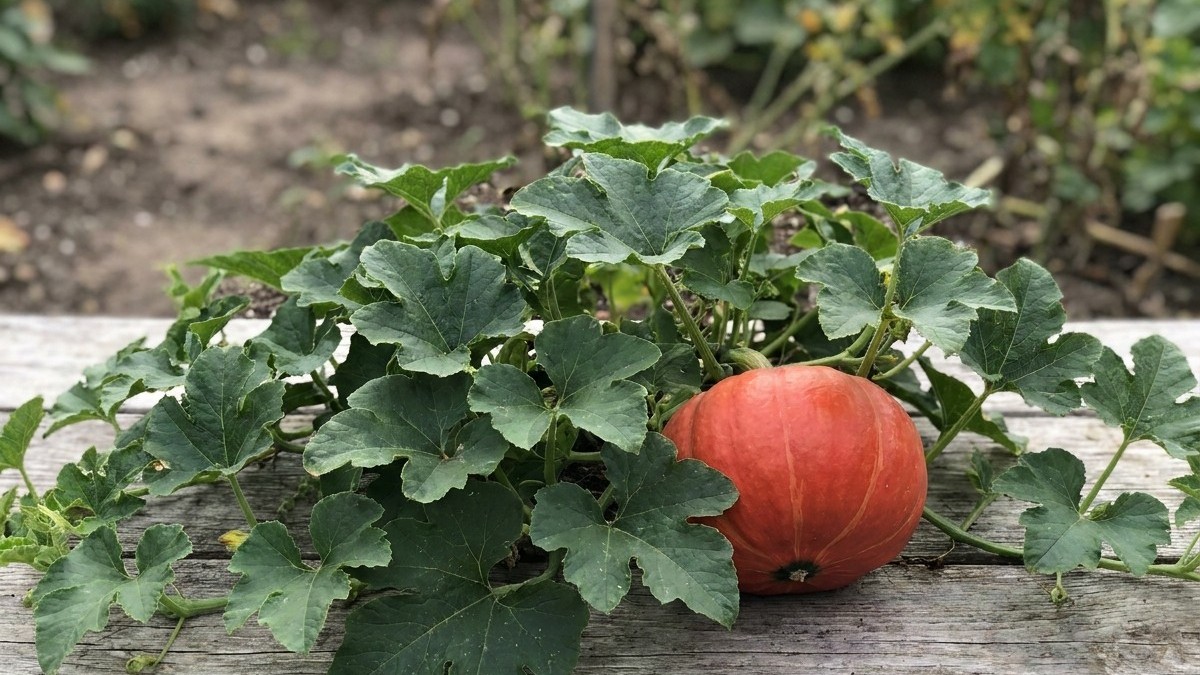

Cut a pumpkin when the rind is hard, the color is deep and even, and the stem has dried, and do it before the first fall frost. Stored whole in a cool, dark spot, a sound pumpkin can last up to three to six months. Both rules come with conditions. The ripening clock starts at flowering, not at planting, and the storage spot matters more than the calendar. The frost dates around Atlanta make a good yardstick for working out both.
When pumpkins are ready in Georgia
A pumpkin is ready when the rind is too hard to dent with a thumbnail, the color has gone deep and even, and the stem has dried and turned woody, usually 45 to 55 days after flowering. In the Atlanta area, that count has to finish before a first fall freeze that NOAA’s climate normals place between November 13 and December 1 (the 30 to 70 percent probability band for 32 F at the airport station).
Treat those dates as a starting point. The Atlanta airport sits in an urban heat island, so it freezes later than the country around it. North Georgia and the mountains freeze several weeks earlier in fall, and the coastal plain runs milder. A gardener in the foothills should plan around the early end of the window or ahead of it. The county extension office can narrow the dates for a specific town.
When does the 45 to 55 day clock start?
At flowering. It does not start at seeding or at transplanting. Packet days to maturity count from sowing, so they run much longer than 45 to 55, because the vines spend weeks growing before the first blossom opens. Mixing up the two counts is the most common way to misjudge a harvest date by a month or more.
Seeds go in the ground once the soil reaches 65 F. That is a soil reading, and soil lags the air by weeks, so it does not arrive on the last spring frost date. The mean last 32 F freeze at the Atlanta station falls between March 11 and March 29. Cold soil can hold seed back well past those dates. A cheap soil thermometer pushed into the planting row settles the question.
What happens when a flower opens too late?
Lay the 45 to 55 days against the frost window and the cutoff shows itself. A flower that opens in mid-September finishes even on the long 55-day count, because the clock runs out around November 9, still ahead of the earliest date in the window. A flower that opens in early October finishes only if the freeze holds off toward the later part of the window and the fruit ripens on the short count. Anything that opens after that gives you a green fruit, and frost will end the season for it.
When frost is closing in and fruit is still green, the call is a hard one, and Will Pumpkins Ripen Before Frost in Georgia? walks through it. Late-season insect damage, including squash bugs and cucumber beetles, is covered in What Eats Pumpkin in Georgia, and When. Planting dates and spacing live in Growing Pumpkins in Georgia.
When the pumpkin passes the thumbnail test, cut it with a sharp knife or pruners and leave the stem attached. Harvest before frost, even if the vines still look green.
Keeping them, and for how long
The University of Illinois Extension says a whole pumpkin keeps for three to six months in a cool, dark location between 45-50 F. Read the six months as a ceiling. It describes a sound pumpkin, cut with its stem on before frost, held under those exact conditions. A bruise, a broken stem or a warm shelf will cut that time short, sometimes by a lot.
Work the ceiling against the calendar. A pumpkin cut in mid-October and held in range could reach mid-January at the low end and mid-April at the top. Plenty of pumpkins will not make it that far. Utah State University Extension gives the minimum rule: keep them where they will not freeze. A pumpkin that freezes loses its flesh when it thaws.
Why can’t pumpkins sit next to apples?
The Illinois Extension also says to store pumpkins away from any ripening fruit or vegetables such as apples, potatoes or tomatoes. The reason is a gas that ripening produce gives off, which ages the pumpkin faster. Most people know to keep pumpkins cool. Few know they should keep them away from the fruit bowl.
This is why the porch next to a crate of apples is the worst place to leave one. The same goes for a pantry shelf holding potatoes, or a counter where tomatoes are finishing. Give pumpkins their own corner, with space around each one so air moves and a soft spot is easy to spot.
Do the 45-50 F range and the three to six months apply to carved pumpkins?
No. That range is for a whole pumpkin with an intact rind. Once a pumpkin is cut open, the flesh is exposed and its life is far shorter, so the storage figures do not carry over. If you want a carved pumpkin on the porch for Halloween, carve it close to the day you plan to display it.
Check stored pumpkins every week or two. A soft spot or a sunken patch spreads, and one bad pumpkin can mold the one beside it. Use the questionable ones first, in pies, soups or roasted cubes, and leave the firm ones to last.
Where in the house that actually is
The 45-50 F range sits between a refrigerator and a living room. A domestic fridge runs colder than that range, and a whole pumpkin takes a full shelf anyway. A heated room is too warm. The kitchen, a pantry beside the oven or a closet with a heat vent all run well above the range, because they sit at whatever the thermostat says. A garage is the wildcard, since it swings with the weather.
Which room in the house comes closest to 45-50 F?
An unheated interior space comes closest. A basement, in homes that have one, is the classic answer, and basements are common across the Piedmont and the north of the state. On a slab foundation, the next best option is a closet on an inside wall of a spare room, with the heat vent shut. An attached garage can work in the cooler months, since the house shields it from the worst swings. A detached garage, a carport or a sunny porch is the least reliable. Autumn days in the Deep South can run warm and nights cool, and north Georgia winters can drop below freezing in an uninsulated space.
Put pumpkins on a shelf or a pallet instead of bare concrete or the floor. Keep them in the dark if you can. Keep the fruit bowl, the potato bin and the tomato flat in another room.
How do you check the spot with a thermometer?
Do not trust your hand, because a room can feel cool in the afternoon and still sit near freezing at dawn. Leave a min/max thermometer in the spot for a few days before moving any pumpkins in, then read both the high and the low. The target is 45-50 F, and the low should never touch freezing.
Skip the test and you may only find out in January, when the stack on the shelf has gone soft. If the spot reads warmer than the range, expect a shorter keeping time. If it swings wide, move the pumpkins to a more stable corner. A basement corner against an outside wall is often a few degrees cooler than the middle of the room.
Common questions
Should I cut pumpkins before the first frost?
Yes. Harvest with the stem attached before frost arrives. Around Atlanta, the first 32 F freeze falls between November 13 and December 1 in NOAA’s climate normals. North Georgia and the mountains freeze several weeks earlier, so gardeners there should watch the forecast from early fall and harvest sooner.
How long will a pumpkin last after I cut it from the vine?
Three to six months is the ceiling under the best conditions, according to the University of Illinois Extension: a whole pumpkin in a cool, dark place between 45-50 F. A pumpkin on a warm porch or in a heated room will not reach it. A carved pumpkin is a separate case with a much shorter life.
Can I keep pumpkins on the porch next to a crate of apples?
Move them. Ripening fruit gives off a gas that ages a pumpkin, so the Illinois Extension recommends storing pumpkins away from apples, potatoes and tomatoes. The porch also swings from warm to cold with the weather, which makes it a poor storage spot even without the apples.
Does 65 F soil mean the last frost has passed?
No. Soil temperature lags the air by weeks, so the two are separate checks. At the Atlanta station, the last spring 32 F freeze falls between March 11 and March 29. Pumpkin seeds go in when the soil reaches 65 F, which can come well after those dates.