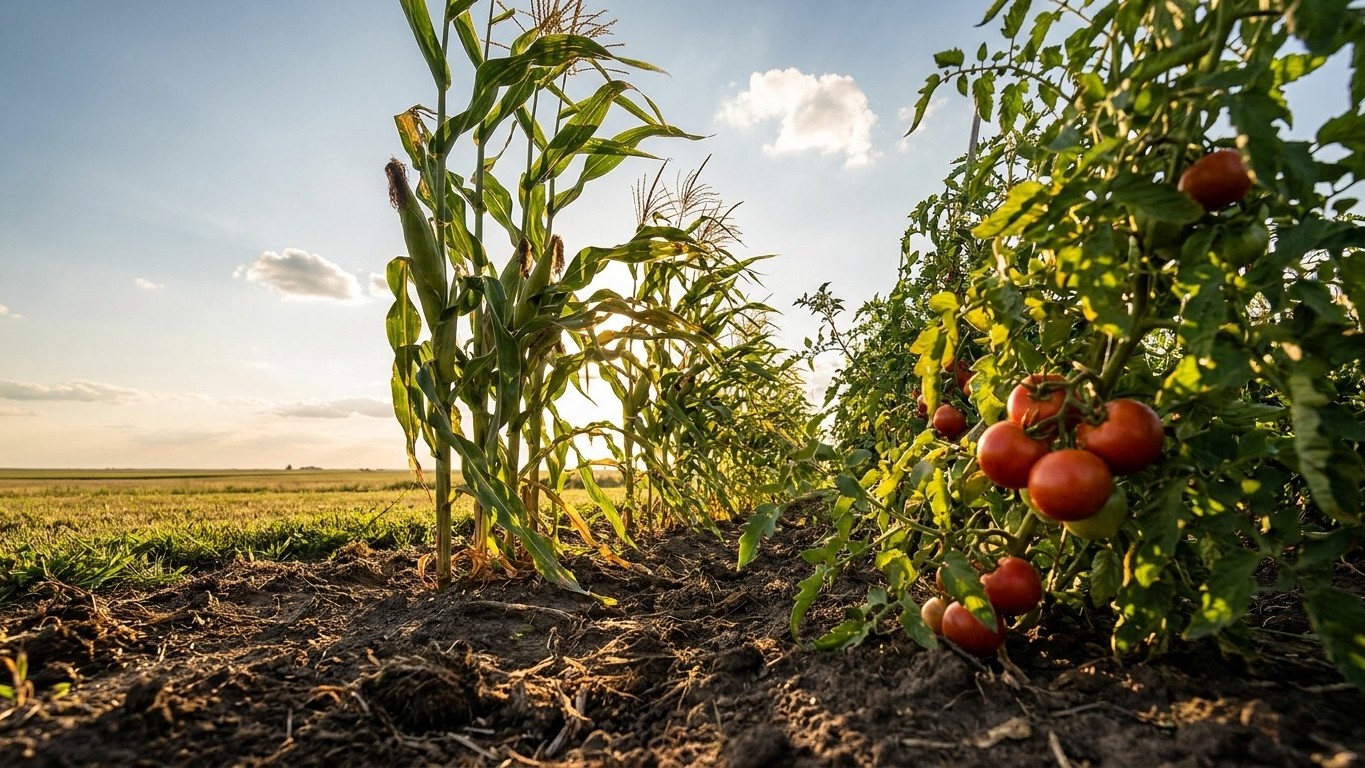

Corn gets eaten at every stage, and the culprit changes with the calendar. Soil insects and birds go after seed and sprouts, leaf and stalk chewers show up during the growing weeks, caterpillars work the ears once silks appear, and wildlife arrives as the kernels fill. In a season that runs between an April last frost and an October first frost, that sequence is packed tight. Knowing the order tells you what to look for, and when.
Which pests attack corn in Rhode Island
Most damage on garden sweet corn comes from five groups of feeders. University of Rhode Island Cooperative Extension is the service that can tell you which species within each group are active in the state, and it is the place to send a sample or a photo.
- Soil insects that eat the seed and young roots
- Cutting caterpillars that clip seedlings at the soil line
- Leaf-chewing and stalk-boring caterpillars
- Caterpillars that feed on silks and kernels in the ear
- Birds and mammals that pull sprouts or strip ears
Some pests you will read about in state garden alerts do not belong on this list. Insects that defoliate shade trees or bore into bark feed on woody plants, and an annual grass crop offers them nothing. They may land in a corn patch near a hedge or a tree line without eating a leaf. The same goes for any insect resting on a tassel. If you cannot find chewed tissue next to it, it is a visitor.
The grouping matters because each group is handled differently. A soil insect is dealt with before and at planting. A caterpillar inside a stalk or ear is already protected from anything you put on the outside of the plant. Birds and mammals ignore everything you would aim at an insect. Naming the group from the damage is the first useful step, and the next section shows how the groups line up with the season.
When each one shows up, and what it does first
Start with the planting rule, because it sets the whole schedule. Clemson Cooperative Extension says: “Do not plant before the soil temperature at the 4-inch depth is at least 50 ºF. Wait to plant extra-sweet varieties until soil temperatures reach 65 °F.” Ordinary sweet corn and extra-sweet types have different thresholds, and neither is a calendar date. At the Providence reference station the last spring frost falls between April 7 and April 17, but soil reaches those temperatures well after that. Suburban and rural gardens often see the last frost one to two weeks later still.
The 60 to 90 days from planting must end before the first fall frost, which at the reference station falls between October 24 and November 3. Gardens outside the city often get that frost one to two weeks sooner, so a long-season variety planted late can run out of room. The timing guide for sowing sweet corn works through that fit.
The first trouble shows up right after sowing. A bare gap in the row with a soft, rotten seed underneath points to cold, wet soil. A hollowed seed points to a soil feeder. Seedlings cut off at the base and lying on the ground are the mark of a cutting caterpillar. Sprouts pulled up with the kernel still attached suggest birds.
During the weeks of leaf growth, ragged holes in the whorl are the first thing you see. Look for dark droppings packed into the leaf folds. Later, a broken tassel or a stalk with sawdust-like debris at a hole signals a borer.
When silks emerge, check the silk channel and the ear tip. Chewed, matted silks with droppings at the tip mean a caterpillar is feeding on the kernels beneath. Ear feeders and wildlife both arrive around the same window, and the ripening clock decides how long that window lasts. Ripeness is a separate question from whether the crop fits the season. The ripening guide covers the fit.
Torn husks, stripped cobs and flattened stalks at that stage mean mammals. Birds usually peck at exposed tips instead.
Telling the damage apart from everything else
A lot of corn trouble looks like an insect and is not. A thin stand, a ragged leaf, a short ear: each has several causes, and the fix depends on which one it is. Providence averages 9.4 days a year at 90 F or more, so summer heat is occasional, and leaf curl in the afternoon is more often a watering problem than a heat one. Dig, look and compare before you spray anything.
| What you see | Possible causes | What settles it |
|---|---|---|
| Gaps in the row, seed never came up | Cold soil, soil feeder, birds | Dig a seed. Soft and rotten suggests cold or wet. Hollow or chewed points to an insect. Sprout on the surface with the kernel attached points to birds. |
| Yellowing starting on lower leaves | Nitrogen shortage, waterlogged roots | A V-shaped yellow band from the leaf tip down the midrib on the oldest leaves suggests a nutrient shortage. No chewing and no droppings. |
| Leaves rolled up in the afternoon | Water stress | Leaves that open again by morning and soil that is dry a few inches down. |
| Ragged leaf holes | Caterpillars, hail or wind tearing | Droppings in the whorl point to caterpillars. Tears with clean, ripped edges on many plants at once point to weather. |
| Missing kernels scattered over the ear | Poor pollination, ear feeders | Scattered gaps with no frass and no tunnel suggest pollination. A tunnel and droppings at the tip suggest a caterpillar. |
| Starchy, less sweet kernels | Types tasseling together, picking late | Ask whether su, se and sh2 types were in the same patch or tasseling at the same time. |
| Plants leaning or flat | Wind, roots damaged, borer in the stalk | Check the base. Torn roots point to wind. A hole in the stalk with debris points to a borer. |
The pollination row catches many gardeners out. Corn is pollinated by wind, so a single short row sheds pollen away from the silks. Utah State University Extension says to plant in blocks of three or more rows. The same source says sweetness is lost when su, se and sh2 types tassel at the same time, which is a timing problem and has nothing to do with insects.
If a symptom does not fit a row, take a photo or a sample to the extension service in the last section rather than guessing from a picture online.
What actually works here, and what is a waste of time
On a short season, timing and barriers do more than any treatment. Sowing into soil that has reached 50 F at the 4-inch depth (65 F for extra-sweet types) gets seed up fast, and fast seedlings are past the most vulnerable stage sooner. Netting or row cover over the seed row keeps birds off sprouts, and cover also keeps early insects away from the leaves. It has to come off before tassels open, because pollination needs open air.
A fence or netting goes up before the ears fill, not after the first raid. Once mammals learn a patch, they come back every night. Planting in blocks of three or more rows helps pollination and makes the patch easier to fence as one unit. Pulling out and disposing of the stalks after harvest removes places where stalk-boring caterpillars can overwinter, and it takes an afternoon.
Several common habits are a waste of time. A scarecrow, a hanging pie plate or flash tape works for a few days and then animals learn to ignore it. A spray applied after you find a tunnel does nothing to a caterpillar already inside the stalk or ear. Spraying on a fixed schedule without looking at the plants wastes effort and can harm bees working the tassels. Planting early into cold soil to get a head start costs you the seed, and then you replant and lose the days you tried to gain.
Any product decision belongs with the extension service. It knows what is registered for home use in Rhode Island and which products suit which group of feeders.
Where to check this for your own county
University of Rhode Island Cooperative Extension is the service to contact. Rhode Island is small enough that gardeners deal with the statewide program rather than a county-by-county office, so one contact covers every corner of the state. It can identify an insect from a photo or a sample and can say whether it is active in your area.
What is documented for the state does not tell you what is in your garden. Coastal plots, inland valleys and the northwestern hills differ in frost timing, soil temperature and wildlife pressure. The Providence frost dates are a reference for the city. A garden away from the water often has a later last frost and an earlier first frost, by one to two weeks.
Before you contact them, write down your planting date, the type of corn, the date you first noticed damage and where on the plant it was. A photo of the damage plus the insect, if you can find one, helps most. The main guide to growing sweet corn in Rhode Island has the surrounding season details.
Common questions
What eats corn seedlings right after planting?
Soil insects, cutting caterpillars and birds. Dig up a seed, look at the base of a cut seedling, and check whether the kernel is still attached to a sprout lying on the ground. Each sign points to a different group.
Can I pick early to beat wildlife?
Picking before the ears are ripe costs you the crop, so watch the plant for the signs of ripeness before you pick. Clemson Cooperative Extension warns that “Sweet corn loses sugar from the kernel rapidly at high temperatures… Sweet corn can be stored under optimal conditions for about five days, but will lose sweetness with each day of storage.” Standard su types lose sugar fastest, se types hold it longer and sh2 types longest.
Why are kernels missing from my ears?
Scattered gaps with no tunnel and no droppings often come from poor pollination, especially in a single short row. A tunnel and droppings at the ear tip suggest a caterpillar. Planting in blocks of three or more rows helps with the first problem.
Is it too late to protect corn once silks appear?
Fencing and netting against wildlife still work, as long as they go up before the ears are raided. A caterpillar already inside an ear cannot be reached from outside. Ask extension about what to do next season.