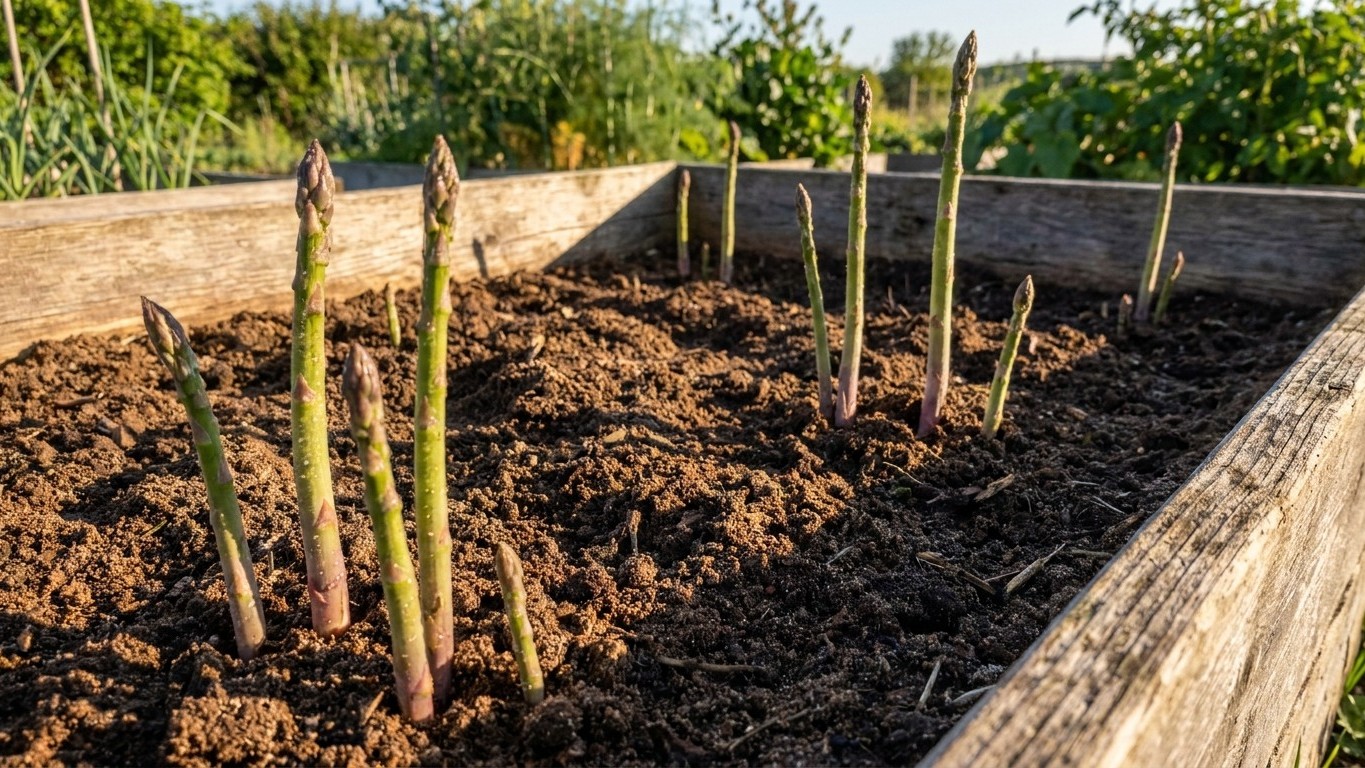

Stop cutting when most of the new spears come up thinner than a pencil. That signal applies in every harvest year, and it counts for more than any calendar date. The spears already in your kitchen then need cold, wet handling to stay tender. If you are still planning the bed, start with Growing Asparagus in Mississippi.
Keeping it, and for how long
What temperature and humidity keep asparagus spears at their best?
The UC Davis Postharvest Technology Center, which studies how produce holds up after picking, puts the optimum for green asparagus at 32°F to 35.6°F (0°C to 2°C). Relative humidity should sit between 95 and 100 percent. UC Davis calls high humidity essential to prevent desiccation, and a cut spear loses water fast, mostly through the base where the knife went through.
That is a narrow window, and both edges do damage. Above 50°F, spear toughening occurs rapidly. The tender tip stays, but the stalk turns stringy and fibrous. Go the other way and the trouble is just as real. At 30.9°F or lower, freezing injury is likely: a water-soaked look first, then extreme softening once the spears thaw. The comfortable zone is about 3.6 degrees wide, and most home refrigerators don’t hit it by design.
How long do fresh asparagus spears last?
Any shelf-life number you see for asparagus is a ceiling. It describes spears chilled quickly, held inside that 32°F to 35.6°F band, and kept in nearly saturated air for the whole stretch. Each degree above the band, and each hour on a warm counter, takes days off that ceiling. A garden spear cut in the morning and stood in cold water by noon will outlast one that rode around in a warm kitchen all afternoon.
Judge by the spear itself instead of a calendar. Fresh ones have tight, closed tips, a firm stalk that snaps cleanly, and a cut end that still looks moist. Tips that spread or turn mushy, a limp stalk, or a dry, pale, shrunken base all say the spears have used up their time. Plan to eat them soon after cutting, since the best eating comes early in the keeping window.
Where in the house that actually is
A domestic refrigerator usually runs warmer than the 35.6°F top of the optimum range. The door runs warmer still, because it swings open all day and sits closest to room air. Leave asparagus in the door shelf and it spends its whole stay in the zone where toughening speeds up. Skip the counter too, since most kitchens sit well above 50°F.
The shelf that comes closest is the lowest one, toward the middle. Cold air settles there, and it stays steadier than the shelves above. Avoid pressing the spears against the back wall, because in many refrigerators that panel runs cold enough to cause freezing injury. A crisper drawer is a decent second choice if it has a humidity slider, set to the high end.
High humidity, in practice, means water. A refrigerator shelf is dry air, and asparagus left bare in it shrivels at the base. The cheapest fix is the one growers’ kitchens have used for generations: stand the spears upright in a jar with an inch or so of cold water covering the cut ends. Skip that step and the butts dry out first, taking the rest of the spear with them. Drape a loose plastic bag over the tips to hold in moisture without sealing them tight. A damp paper towel wrapped around the bases and tucked in a bag does the same job if the jar won’t fit.
Cool the spears quickly after cutting. Cutting in the morning, when the bed is coolest, and getting them into the refrigerator within the hour gives you the best start. Change the water if it clouds, and trim a sliver off the bases if they look dry before cooking.
How do you know when to stop cutting asparagus?
What is the pencil rule?
Early in the season, spears push up thick and fast, fed by energy the crowns stored the summer before. Cut week after week and that reserve drains. The spears thin out, and when most of them come up narrower than a pencil, the crowns are telling you they are spent. An occasional thin spear early on is normal, so look at the whole bed instead of one stalk. Once most are pencil-thin or thinner, stop cutting and let the ferns grow.
The ferns are the crowns’ only way to recharge for next spring, so whatever you leave standing is feeding next year’s harvest. The rule is a thing you can see in the row, so it works whether the season ran short or long. The same rule applies whether you planted Jersey Giant or Jersey Knight (both all-male), or UC 157 F1 or Purple Passion (both male and female plants).
How many weeks can you cut in each year of the bed?
Utah State University Extension describes the schedule plainly. Crowns go into 8-inch furrows in early spring, and the bed is not harvested until year 3. Not a few spears, not a taste. Nothing gets cut until then. A well-sited bed then produces for 10 to 15 years.
The furrow fills in gradually over the first year, so the crowns end up buried at the right depth without being smothered all at once. Hold off on the full eight weeks until the bed has earned them.
What do spring frost and summer rain change?
In the Deep South, spears start showing early. At the reference weather station, the last 32°F freeze falls between March 6 and March 22 in the 30 to 70 percent probability band of the latest NOAA NCEI climate normals. Suburban and rural gardens typically see the last frost one to two weeks later than an airport station, so check your own county. A frost-nipped spear turns dark and limp, and you cut it off and let the next ones come.
After the last cut, the fern season runs straight into summer. The same station averages about 14.1 inches of rain across June, July and August, out of 57.4 inches over the year. June is the driest of the three at 4.43 inches, with July at 5.02 and August at 4.69. That is a lot of water on paper, but heat and thunderstorm runoff mean the ferns can still go thirsty between storms. A rain gauge on your own plot settles it faster than any average.
Drainage matters more than rain, because the bed stays in one place for up to fifteen years. Mississippi’s state soil, the Natchez series, is a young, well-drained silt loam: 82 percent silt, 13 percent clay, 5 percent sand, with about 1.8 percent organic matter. Ground like that tends to shed water, which asparagus likes. But the state covers hundreds of soil series, and river bottoms, hill country and scraped or filled building lots can behave very differently. A soil test tells you what your own bed has, and Will Mississippi Soil Hold an Asparagus Bed for Fifteen Years? walks through what to do if the ground holds water. Ferns left standing through summer also draw hungry visitors, covered in What Eats Asparagus in Mississippi, and When.
Common questions
Can I cut a few spears in the second year?
No. Utah State University Extension says the bed is not harvested until year 3. The crowns spend the first seasons building the root mass that carries the bed for 10 to 15 years, and cutting early takes away what they need most.
Does the variety change when I stop cutting?
Whichever you grow, you stop when most spears are thinner than a pencil.
Can I keep the spears in the coldest part of the refrigerator?
Only if it stays above freezing. At 30.9°F or lower, freezing injury sets in, and the spears go water-soaked and extremely soft once thawed. The lowest shelf, away from the back wall, is the safer spot.
How much soil goes back into the furrow at once?
Filling it all in one go buries the crowns too deep too soon.