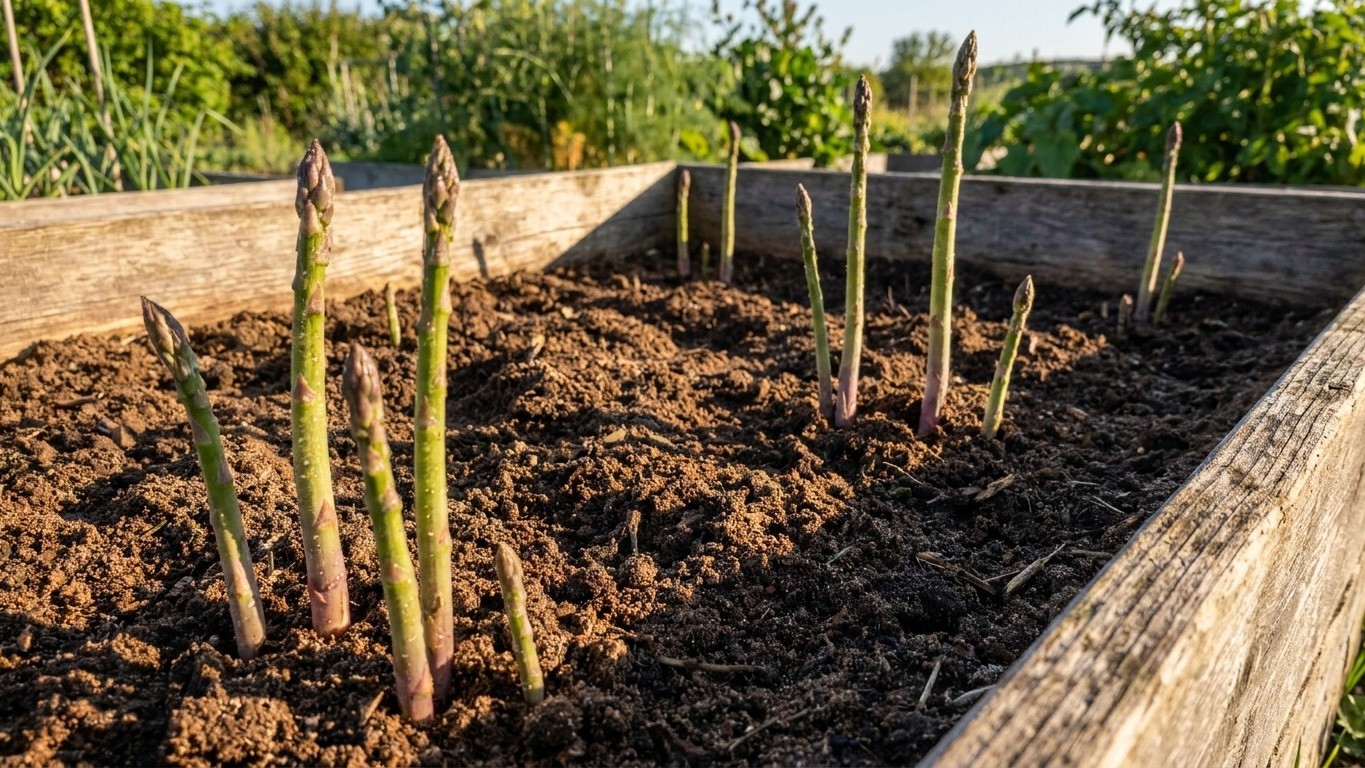

Stop cutting when most of the spears coming up are thinner than a pencil. In the first cutting year that usually matters less than the calendar, because a young bed gets only 4 weeks of harvest, then 6, then 8. After the cut, spears keep best at 0°C to 2°C with the air near saturated, their cut ends in water. Past that window they toughen or freeze.
Keeping it, and for how long
What temperature keeps cut asparagus best?
A spear does not stop living when the knife goes through it. It keeps breathing, and it keeps losing water, mostly through the cut end. Storage is about slowing both. The UC Davis Postharvest Technology Center gives the target in its produce fact sheet on green asparagus: an optimum temperature of 0°C to 2°C (32°F to 35.6°F), with an optimum relative humidity of 95 to 100 percent. The same sheet says high humidity is essential to prevent desiccation. Air that is merely cool and dry will shrivel a spear no matter how cold it is.
The window is narrow, and both edges bite. UC Davis reports that spear toughening occurs rapidly at temperatures above 10°C (50°F). A sunny windowsill, a warm trunk or a kitchen counter in June can pass that mark within hours. At the cold end, freezing injury will likely result at -0.6°C (30.9°F) or lower. The spear takes on a water-soaked look and turns extremely soft once it thaws. A fridge that is set too cold, or a spear pressed against the back wall, can do that damage in a single night.
How long do cut spears last?
Any duration quoted for asparagus is a ceiling that applies only when the spears sit at 0°C to 2°C in near-saturated air from the moment they are cut. Each hour above that range, or each hour in dry air, takes some of the time away. Spears that went into a warm car for a long drive have already used up part of their shelf life before they reach the fridge.
So the practical rule is short. Cool them quickly after cutting, keep them wet at the base, and cook them while they are still crisp. A bed in its prime can throw a lot of spears in a few days, so cut only what you will eat or freeze within that stretch. The fact that spears cut on a Tuesday are tender and sweet on Tuesday, and noticeably tougher by the weekend, is the reason the best asparagus is the kind you picked yourself.
Spears also lose quality faster than most vegetables from the garden. Peas and beans forgive a few days of neglect, but asparagus is less patient, and the 10°C (50°F) toughening threshold is the reason a spear left out on a warm day is worse by evening.
Where in the house that actually is
A domestic fridge usually runs warmer than that 0°C to 2°C optimum, and its door runs warmer still, because it is opened often and sits farthest from the cold source. Skip the door shelves. The closest match is the lowest shelf toward the back, which tends to be the coldest part of the box. Do not press the spears against the back wall, though, since some fridges ice up there and a spear touching the wall can freeze.
The humidity target of 95 to 100 percent is higher than anything the open air of a fridge delivers. In a kitchen, that translates into one of three things: a bag, a damp wrap or water under the cut ends. A loosely closed plastic bag holds in the moisture the spears give off. A damp paper towel wrapped around the butts keeps the cut end from drying. A jar with the spears standing upright, the cut ends in water, gives the best moisture where the spear loses the most. Cover the tops loosely with a bag so they stay humid too.
Skipping the water costs you in a visible way. Spears left dry in the open fridge go limp and wrinkled at the tips, and the cut ends dry and turn woody. Once that happens, trimming the butts and standing them in water will help a little, but it will not bring back a spear that has lost its crispness.
If you are not sure how cold your fridge runs, a cheap fridge thermometer left on the lowest shelf overnight tells you. Check for ice crystals on the spears too. If they appear, move the jar up a shelf or away from the back wall.
How do you know when to stop cutting asparagus?
Why does pencil thickness decide when to stop?
The signal is on the plant itself. Spears come up thick at the start of the season and get thinner as the crown spends the energy it stored the summer before. When most of the spears are thinner than a pencil, stop cutting and let them grow into ferns. The ferns feed the crown for next year, so cutting past that point trades a few thin spears now for a weaker bed later. A single thin spear among thick ones does not matter. It is the majority that counts.
How long can the cutting season run?
Asparagus is planted as crowns in 8-inch furrows in early spring, and Utah State University Extension says it is not harvested until year 3. Then it produces for 10 to 15 years. Do not take “just a few spears” in the first two years. The crowns need every fern they can grow while they establish.
When harvest begins, the schedule builds up: 4 weeks of cutting in the first harvest year, then 6, then 8. Those weeks are a ceiling. If most spears go thinner than a pencil before the time is up, stop early.
The furrow is backfilled gradually through the first year rather than all at once. Filling it in one go can smother the young shoots.
Frost matters at the start of the season. At the Whitehorse A station, Environment and Climate Change Canada puts the average last spring frost at June 5. That is a mean date, so in one year out of two the last frost falls later. Treat it as the middle of a window, and expect northern and upland districts to run weeks behind it.
Will Yukon ground hold the bed for fifteen years?
A bed that lasts 10 to 15 years is a decision you cannot easily undo, and the ground matters. The dominant soil in Yukon’s mapped farmland, according to Agriculture and Agri-Food Canada, is a Brunisol: a young soil whose horizons are only beginning to separate. The median surface is a loam to silt with 47 percent sand, 15 percent clay and 38 percent silt, about 12.0 percent organic matter, and it is imperfectly drained. Utah State University Extension says most soils will do for asparagus provided they are well drained, so imperfect drainage is the thing to check before digging a furrow.
That is a regional tendency, not a reading of your plot. River bottoms, wet ground and any spot a builder has scraped or filled will differ, and the survey does not cover the far north. Dig a hole where the bed will go, fill it with water, and see whether it empties within a day. If water stands, build a raised bed. For a real answer on your own soil, a soil test is the way to settle it. The guide to Will Yukon Soil Hold an Asparagus Bed for Fifteen Years? goes deeper.
Rain adds to the picture. At Whitehorse A, June through August brings about 107 mm (4.2 inches) of rain, out of 262 mm (10.3 inches) over the year. June is the driest summer month at 33 mm (1.28 inches), with 1.5 inches in July and 1.41 in August. Those are climate normals for one station, and a rain gauge on your plot tells you more. The ferns that grow after cutting still need water in a dry spell, and that is the stretch when What Eats Asparagus in Yukon, and When is worth a read. For the full picture of the crop, see Growing Asparagus in Yukon.
Common questions
Can I cut asparagus in its first or second year?
No. Utah State University Extension says the crowns are not harvested until year 3. Spears cut earlier take away the fern growth the crown needs to build up. Wait, then start with 4 weeks.
What if some spears are thin and some are thick?
Keep cutting while most spears are still thicker than a pencil. A few thin ones are normal at any point in the season. Stop when thin spears become the majority, even if a thick one pops up late.
Does the variety change when I stop cutting?
No. The pencil rule works the same for all of them. Utah State University Extension names Jersey Giant and Jersey Knight as all-male, and UC 157 F1 and Purple Passion as male and female. It lists them by sex only, so no variety comes with a taste or yield advantage you can count on.
Can I store asparagus in a plain bag in the crisper?
You can, but it is not the best option. The target is 95 to 100 percent humidity. A bag alone helps, though standing the butts in water in a jar does more where the spear loses moisture fastest. Keep it off the door and away from the back wall, where it may freeze.