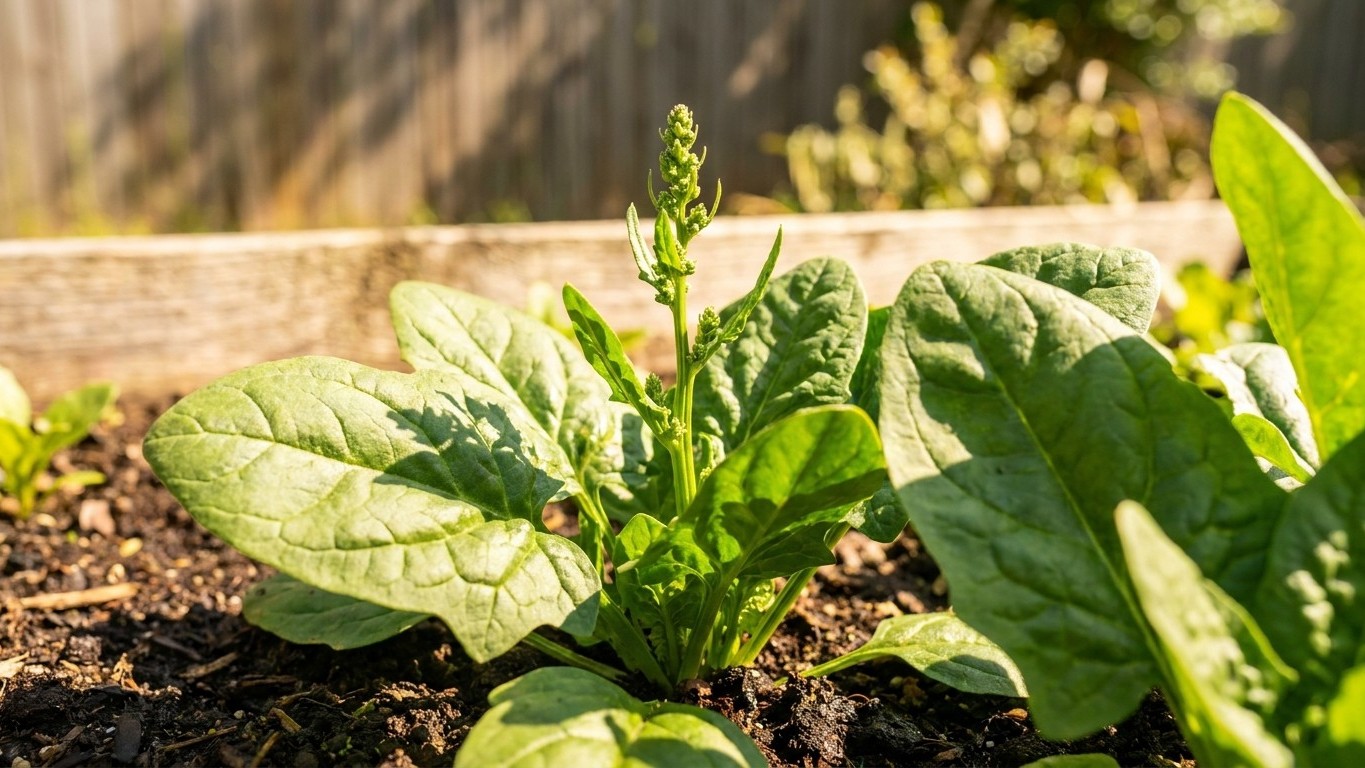

Cut spinach when the outer leaves are big enough to eat and before a flower stalk starts rising from the center. In Michigan that usually means late May through June for a spring sowing, and from late September until hard weather ends it for a fall one. Cut leaves keep two weeks at the very best, and only in near-freezing, humid air. A home fridge gives you less. Here is how to read the plant, and how to store what you cut. For the full growing picture, start with Growing Spinach in Michigan.
When spinach is ready in Michigan
The plant tells you before the calendar does. Spinach is ready when the rosette is full and the outer leaves are the size you would put on a plate. Baby leaves can go earlier, if you like them small. Three things are worth checking each time you walk past the bed:
- The outer leaves are broad, smooth and deep green, with the center still tight and low.
- The center has not started to lengthen or push up a stalk.
- The forecast is not about to turn hot.
The dates come from the frost calendar. Michigan State University Extension puts the last spring frost around April 30 in the Detroit area, and in early to mid May across most of the Lower Peninsula. Spinach goes in ahead of that, as soon as the soil can be worked, so it grows through cool weeks. That is why the spring cutting falls in late May and June, before the weather turns.
Heat and day length both end the crop. Utah State University Extension says spinach bolts during long days and warm temperatures, and that it grows best where temperatures do not exceed 75 F. The same 75 F is where the flavor starts to turn bitter. Day length is the surprising part. On the longest day of the year, the Detroit area gets 15 h 05 of daylight, calculated from the latitude of the NOAA climate station there. Long days alone push spinach toward flowering, so a cool June does not buy extra weeks. The heat adds to it. NOAA’s National Centers for Environmental Information (NCEI) climate normals show Detroit reaching 90 F or more on 10.3 days in an average year. Those days come on top of a long stretch of days already warm enough to hurry the plant along.
The practical rule for spring is to cut steadily. Take the outer leaves and leave the center growing. When the center begins to stretch upward, cut the whole plant and eat it that week. Will Spinach Bolt Early in Michigan? covers what pushes it over the edge.
When do you cut fall spinach?
Your local county extension office can give you a rule for a fall crop. MSU Extension’s Michigan Garden Calendar lists the first fall frost between October 6 and October 21 for zone 6a. If you want a cutting around that time, working backward lands you roughly between late July and mid-August.
The obstacle at that point is warm soil. Seed germination drops when soil runs above 80 F, so a hot August bed can stall a sowing that looks right on paper. The window really opens when the soil cools, not when the air does. Water the bed before sowing, shade it until seedlings are up, and wait a week if the weather is still hot. The seed packet is the place to check timing for whichever variety you choose.
Leaves chewed before you reach them are a separate problem. What Eats Spinach in Michigan, and When explains what to look for and when it shows up.
Keeping it, and for how long
Spinach loses quality faster than most vegetables in the garden. The best data on storage comes from the University of California, Davis, Postharvest Technology Center, which publishes produce fact sheets used across the fresh-produce trade. Its numbers describe the ideal case, and your kitchen will fall short of it.
What temperature and humidity does spinach need?
The UC Davis Postharvest Technology Center gives an optimum temperature of 0°C (32°F) and an optimum relative humidity of 95-98%. Cold slows the leaves’ breathing and water loss. High humidity keeps them from drying out and going limp. You need both. A cold fridge with dry air still wilts spinach, and a humid spot that is too warm rots it. Aim for 32°F with 95-98% relative humidity.
| Storage condition | Temperature | What UC Davis reports |
|---|---|---|
| Optimum | 32°F, 95-98% relative humidity | Will not maintain good quality for more than 2 weeks |
| Common distribution conditions | 41 to 50°F (5 to 10°C) | Wilting, yellowing and decay increase faster |
| Beyond 10-14 days at any temperature | Any | Wilting, yellowing of leaves and decay are likely to increase |
How long does cut spinach really keep?
UC Davis calls spinach highly perishable and says it will not maintain good quality for more than 2 weeks. That is a ceiling for perfect conditions, not a plan. The same fact sheet says wilting, yellowing and decay are likely to increase once storage runs past 10-14 days, and faster at the 41 to 50°F typical of ordinary distribution. A garden-fresh bunch starts ahead of a store bunch, since it has not spent days in a truck and on a shelf. Even so, the clock begins at the cut.
The higher temperatures matter because a home fridge sits in that range more often than people expect. Leaves held at 41 to 50°F can start to yellow within days. If you want the crop to last, plan to eat the first cutting within a few days. Treat the second week as a bonus, available only if your coldest shelf comes close to 32°F and the leaves stay damp but not soaked.
Harvest timing helps too. Cut in the cool of the morning, when the leaves are full of water and carry the least field heat. Move them indoors right away, since a basket left on a sunny porch starts losing quality before it reaches the fridge.
Where in the house that actually is
A household fridge runs warmer than the 32°F optimum, and the door runs warmer still, because it opens often and sits next to the room air. Keep spinach off the door shelves. A lot of people stash greens there because the bag fits, and the leaves pay for it with yellowing and slime.
Which fridge shelf works best for spinach?
The back of the bottom shelf comes closest to the optimum, since cold air settles low and the rear wall is the coldest surface. A crisper drawer can work if it has a humidity slider set to high, but only if it sits low and does not crowd the cooling vents. Otherwise a plain shelf, with the bag you prepare, usually does better than a drawer left on its default setting.
High humidity in a kitchen setting means keeping the leaves damp without wetting them to the point of rot. A loosely closed bag does most of the work. Add a lightly damp paper towel or cloth to the bag, and the air inside reaches that 95-98% range far better than an open fridge shelf ever will. If your spinach comes with the stems attached, stand the cut ends in an inch of water in a jar or tall container and drape a bag over the top. The stems drink while the leaves sit in humid air.
Wrap the unwashed leaves in a damp towel, bag them loosely, and set them on the back of the bottom shelf; skip this and you will likely see yellowing within days. Wash just before eating, since leaves stored soaking wet break down faster than leaves stored merely damp.
Do not expect the fridge to repair what the garden got wrong. Leaves from a plant that was close to bolting, or that sat through a hot spell, start out bitter and tired, and the best shelf cannot change that. Cut when the plant is at its peak, and your kitchen only has to hold the leaves, not rescue them.
Common questions
Can I keep cutting from the same spinach plant?
Yes, for a while. Take the outer leaves and leave the center so the plant keeps producing. Once the center lengthens into a stalk, the plant is bolting and the leaves turn bitter. Cut the whole plant at that point and eat it quickly.
Is it too late to cut spinach once the weather turns hot?
Often it is. Utah State University Extension says spinach grows best where temperatures do not exceed 75 F, and long days and warmth push it to bolt. Harvest what you can early in a warm spell, and sow again for fall once soil temperatures fall below 80 F.
How long does spinach last in the fridge?
UC Davis Postharvest Technology Center says spinach will not maintain good quality for more than 2 weeks, even at the optimum 32°F and 95-98% humidity. In a home fridge, especially on a door shelf at 41 to 50°F, it yellows in days. Eat it early, and use the back of the bottom shelf.
When is the first fall frost in Michigan, and does it matter for spinach?
MSU Extension’s Michigan Garden Calendar lists the first fall frost between October 6 and October 21 for zone 6a. Spinach likes cool weather, so frost is less a deadline than a marker for planning your fall cutting. Work back from the harvest date you want, and check with your county extension office for local conditions.