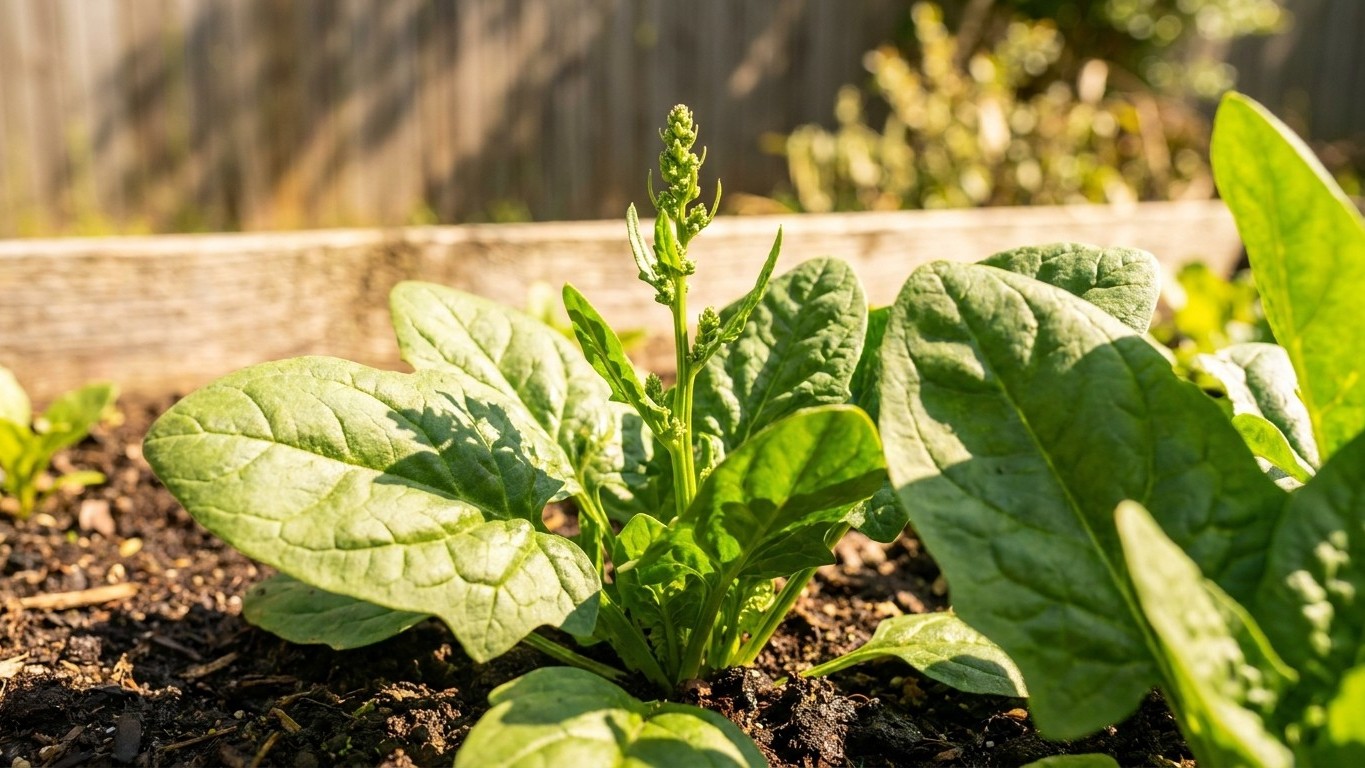

Cut spinach when the outer leaves are about as long as your hand and the center is still a tight cluster of young leaves. Wyoming’s short season gives you two cutting windows, one in late spring and one in early fall. Once cut, spinach keeps two weeks at best, and only in near-freezing, very humid air. Most home fridges fall short of that, so plan on eating it within days. For the wider picture, start with Growing Spinach in Wyoming.
When spinach is ready in Wyoming
Watch the rosette. When several outer leaves are hand-length and the center has not started to stretch upward, the plant is ready to cut. The calendar version, worked from a mean last spring frost between May 7 and May 18, is a spring cut from late May into June for an early sowing. The fall cut falls in the weeks around the first frost, which arrives between September 24 and October 5.
At about 6,000 feet, there are roughly 130 frost-free days between the mean last spring frost and the mean first fall frost. Frost can show up in any month at higher elevations, so a row cover or a low tunnel is part of the plan.
Why does spinach bolt even when summer is cool?
Two things push spinach into flowering: warmth and day length. Utah State University Extension says spinach bolts during long days and warm temperatures, and grows best where temperatures stay at or below 75°F. The longest day at Cheyenne’s latitude brings 14 h 58 of daylight. A cool summer therefore does not buy extra weeks. The days alone are long enough to send a plant up a flower stalk, and the lengthening days of late spring are already working against you.
Heat adds to it. Cheyenne averages 10.4 days a year at 90°F or more, which is modest next to hot regions. But 75°F is the line that matters for spinach, because above it growth slows and the leaves turn bitter. Many afternoons from June through August clear that line. If a plant is already sending up a center stalk, cut the whole plant and use it. The details are in Will Spinach Bolt Early in Wyoming?
When should you sow spinach for a fall cut?
Utah State University Extension advises planting for fall 50 to 75 days before the date you want to harvest. Counting back from the first-fall frost window, sow so the crop matures before frost arrives. Packet days for spinach run from sowing, since the seed goes straight into the ground.
The early end of that range runs into a different problem. Seed germination drops when the soil is above 80°F, and a bed in full afternoon sun can hold that heat well after the air has cooled. Cold is not what blocks a fall sowing here. A bed that gets shade in the afternoon, watered before and after sowing, cools off sooner. Your local county extension office can suggest spinach varieties suited to your area.
Leaf-eaters show up in both seasons, and a young stand is easiest to lose. What Eats Spinach in Wyoming, and When covers who arrives and when to look for them.
Keeping it, and for how long
The best numbers for keeping spinach come from the UC Davis Postharvest Technology Center. Its produce fact sheet lists an optimum temperature of 32°F (0°C) and an optimum relative humidity of 95-98%. Then comes the sentence that sets expectations: “Spinach is highly perishable and will not maintain good quality for more than 2 weeks.” Two weeks is the ceiling under ideal conditions, and nobody should treat it as a plan.
How long does cut spinach last in the fridge?
UC Davis puts the slide at 10 to 14 days. Wilting, yellowing of leaves and decay are likely to increase after storage beyond that, and they come faster at common distribution conditions of 5 to 10°C (41 to 50°F). That second range is the one that matters at home. A fridge door and a crowded upper shelf both sit in the 41 to 50°F zone or close to it, and spinach there yellows in days.
The harvest-to-fridge gap counts too. Wyoming’s dry air pulls moisture out of cut leaves fast, and a basket left on a sunny porch loses crispness in an hour. Cutting in the cool of the morning and getting leaves indoors right away costs nothing and gives the cold chain a better starting point.
Why does humidity matter so much for spinach?
A relative humidity of 95-98% is close to saturated air. Leaves are thin and mostly water, and they lose it quickly into dry air. Fridge air is dry, because the cooling coil pulls moisture out of it. Spinach left loose or in an open bowl wilts in a day or so even if the temperature is right.
The aim is to build a small humid pocket around the leaves without drowning them. Free water pooled in the bottom of a container speeds decay, so humid air is the target, with only light moisture on the leaves themselves. That is why the storage method matters as much as the thermometer. A bag, a damp paper towel and a spot away from the door do most of the work.
Gardeners who cut whole plants sometimes ask whether a bigger harvest keeps better. It does not. A smaller cut that you eat within the week beats a big one that sits for ten days, because quality starts slipping long before the 10-to-14-day mark on the UC Davis sheet.
Where in the house that actually is
A home fridge runs warmer than 32°F, and the door runs warmer still. Each time the door opens, warm kitchen air hits the shelves nearest it first. The door bins, the butter compartment and the top shelves are the least stable spots. The coldest, steadiest area is the back of the bottom shelf, where cold air settles and the door swing barely reaches. That is the closest a domestic fridge gets to what spinach wants, though it will still sit in the range where yellowing speeds up.
Which fridge shelf is best for spinach?
Set the bag on the back of the bottom shelf, away from the door and away from the back wall if you find ice crystals forming there. Frozen leaves turn dark and slimy when they thaw, so a shelf that is slightly too cold does as much damage as one that is too warm. Keep it clear of the cooling vents, and do not stack heavy produce on top of it, since bruised leaves break down first.
If your crisper drawer has a humidity slider, set it to the high-humidity side and put the bag inside. If the drawer has no slider, skip the drawer and use the bottom shelf. Skipping this step costs you days, because spinach left in the door or on a top shelf can yellow in just a few.
How do you keep spinach humid without making it slimy?
Use a loosely closed bag or a lidded container lined with a damp paper towel, wrung out until it is wet but not dripping. The towel holds moisture against the leaves and keeps the air near the saturation the UC Davis sheet calls for. Change it if it turns slick or warm to the touch. Cut leaves that were washed should be spun or patted mostly dry before they go in, since beads of water on the leaf surface invite rot.
Spinach cut with stems, such as a whole bunch, can also stand in a jar with a little water under the cut ends, with a bag loosely over the leaves. This is the closest a kitchen gets to a humid cold room. Expect to eat it in a few days, and treat anything past 10 days as borrowed time.
Common questions
Should I cut spinach as soon as it starts to bolt?
Yes. A center stalk rising from the rosette means flowering has begun, and long days and warmth keep pushing it along. Cut the whole plant at the base, use the leaves quickly, and clear the bed for something else. Waiting makes the leaves tougher and more bitter, especially once afternoons climb past 75°F.
Can spinach really last two weeks in my fridge?
Probably not. UC Davis lists two weeks as the most spinach will hold good quality, and that applies at 32°F with 95-98% relative humidity. At the 41 to 50°F that a home fridge often holds, expect yellowing and wilting well before that. Eat it in the first few days for the best texture.
Is the fridge door okay for a bag of spinach?
No. The door is the warmest part of the fridge and swings with every opening. A bag there sits in the same 41 to 50°F range that speeds up yellowing. Move it to the back of the bottom shelf.
Which spinach varieties are worth trying?
Read the seed packet for each one and ask your county extension office which of them does best in your area and elevation.