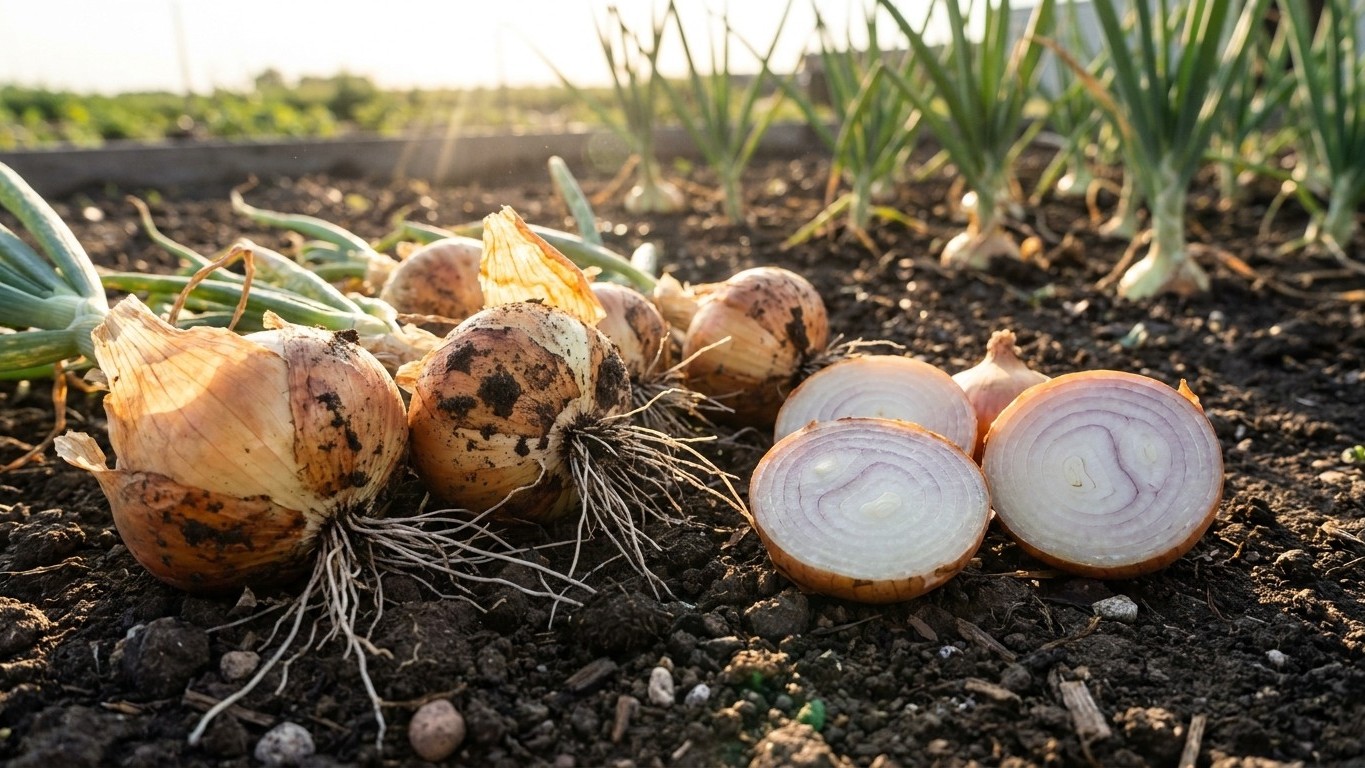

Lift onions when most of the tops have fallen over and the necks have gone soft. Then cure the bulbs somewhere warm, dry and airy until the necks are tight and the skins feel papery. Only after that do they go into storage. Skip the curing and moisture enters through the neck, so even a good keeper rots from the top down. The variety you planted decides how early or late that harvest comes, and day length is the reason.
When do you lift onions in Ohio, and how do you cure them?
Onions start a bulb because of day length, and warmth has little to do with it. A short-day variety begins bulbing at about 12 hours of light, according to Clemson Cooperative Extension. A long-day variety waits for 14 to 16 hours. Columbus, the reference city here, sits at 39.99 degrees north and gets 14 h 51 of daylight on the longest day of the year. That clears the bar for long-day onions, though not by a wide margin. Growers in the far north of the state, near Lake Erie, get a little more summer light. Growers along the Ohio River get a little less. If your garden is well away from Columbus, check your own latitude before choosing a variety. The best onion varieties for Ohio are sorted by exactly this requirement.
How do you know onions are ready to lift?
Watch the tops. As the bulb finishes, the necks soften and the green leaves flop over and begin to yellow. Once most of the tops are down, stop watering and give the bulbs a few dry days in the ground if the weather allows. Lift on a dry morning with a garden fork, working a few inches out from the row so you don’t spear the bulb. Handle them gently, because a bruise is where rot starts. Bulbs hit by maggots or thrips deserve the same caution, and what eats onion in Ohio, and when explains which damage to look for. Early-bulbing short-day types come out first. Long-day types finish later in the season.
How do you cure onions?
Spread the bulbs in a single layer, tops still attached, in a spot that is warm, dry, shaded and breezy. A covered porch, a barn aisle or a garage with the door cracked will work, as long as rain and direct sun can’t reach them. A wire rack or a screen lets air reach the underside. Don’t wash them and don’t pile them up.
There is no fixed number of days, because the weather sets the pace. Check the necks. They are done when the neck is tight and dry, the outer skins rustle and the roots are wiry. Then trim the dried tops and roots to a short stub. Bulbs with a thick, green, stubborn neck won’t cure properly, so cook those first. So should anything with a soft spot or a cut.
Keeping them, and for how long
Clemson Cooperative Extension’s Home & Garden Information Center says ideal conditions are between 45 °F and 55 °F, and 50 to 60 percent humidity. That is dry air. Carrots, beets and other roots want the opposite, which is why one cellar rarely stores both well. Onions held in damp air sprout and rot. Onions held too warm sprout and go soft.
Duration depends on what you grew. The University of Missouri Extension puts it plainly: “As a rule, ‘sweet’ onions do not store as well as the more pungent types.” The reason is chemical. The bite of an onion comes from volatile sulfur compounds, and those same compounds help protect the bulb in storage. A sweet onion has fewer of them. It tastes better raw, but it will not make it through winter, so eat those first.
This ties back to day length. Short-day types run sweeter, and long-day types keep longer. A southern garden gives you onions to eat soon. A northern garden, and much of Ohio qualifies, can give you pungent onions that last into late winter, even March, when everything goes right. Treat any storage time you hear as a ceiling under ideal conditions. A bulb that was bruised, harvested wet or cured halfway will fall short of it, sometimes by months.
Check the stored onions every couple of weeks. Pull out any that feel soft at the neck, smell sour or have started to sprout, because one rotting bulb spoils its neighbors. Pick the varieties with the strongest flavor for the bottom of the crate. They are the ones you will still be cooking with long after the sweet types are gone. The wider picture of timing, soil and varieties is covered in onions in Ohio.
Where in the house that actually is
A refrigerator is set well below that 45 °F to 55 °F range, and its air is humid and full of other food smells. It suits a cut onion in a sealed container. It is the wrong place for a winter’s supply of whole bulbs. A heated living space is too warm, and a kitchen cabinet next to the stove is worse. An unheated garage swings with the weather. On a mild October day it might sit in range, but an Ohio January cold snap can freeze bulbs, and frozen onions turn to mush once they thaw.
The room that comes closest is usually an interior one that stays cool without being heated: a dry corner of the basement away from the furnace and water heater, an unused back bedroom with the register closed, or an enclosed, insulated porch. Many Ohio basements run damp, especially after humid summers, so humidity is the usual problem. A basement can hit the temperature and still sit above 60 percent.
That is why a thermometer matters. Put a thermometer, ideally a min-max model with a humidity reading, in the spot you are considering and leave it for a few days across different weather. If you skip that step, you find out the room’s real conditions only when the onions start to sprout or go soft in January. If the humidity runs high, a small dehumidifier or a bit more air movement from a fan can help. If the temperature drifts out of range, move to a different room before moving the onions in.
Once you have a spot, store the bulbs where air can move around them. Mesh bags, slatted crates and shallow boxes all work, and a sealed plastic tub does not. Keep them off bare concrete and away from any root crops that need damp air.
Common questions
Can I store sweet onions through winter?
Not reliably. Sweet onions have fewer of the sulfur compounds that protect a bulb in storage, so they spoil sooner than pungent types. Use them first, and plan on pungent varieties for the winter supply.
Can I keep cured onions in the refrigerator?
You can, but it is not the best choice. A refrigerator is colder and more humid than onions like, and the humidity encourages rot. Use it for cut onions only, sealed in a container.
Can onions and carrots share the same cellar?
They store poorly together. Onions want dry air at 50 to 60 percent humidity, and carrots want it much damper. If you have only one space, give it to the crop that matters most, or keep the onions in a drier room of the house.
Why did my stored onions rot from the neck?
Usually the neck was not fully cured when the bulbs went into storage. Thick, green necks let moisture and rot enter. Bruised bulbs and humid storage cause the same problem. Next season, cure until the neck is tight and dry, and check your storage spot with a thermometer first.