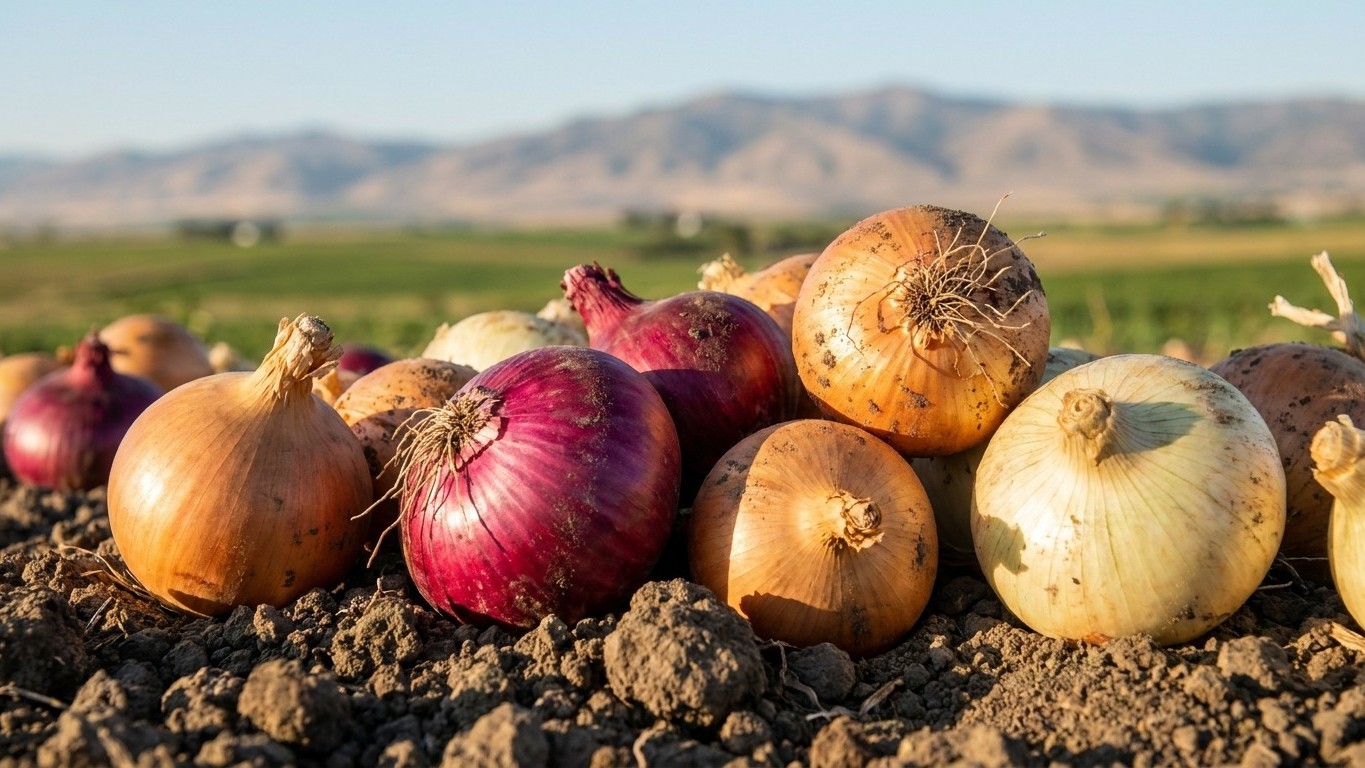

Lift onions when about half the tops have fallen over and the necks have gone soft, then cure them in a warm, airy, rain-free spot until the necks are tight and the skins feel papery. Only cured bulbs go into storage. Pulling them straight from the ground and stacking them in a cool room is how a good crop turns to mush by midwinter. Cure first, store second.
When do you lift onions in North Carolina, and how do you cure them?
Day length sets the clock, and the calendar only follows. An onion stops making leaves and starts swelling a bulb when the days reach a certain length. Short-day varieties start at about 12 hours, according to Clemson Cooperative Extension. Long-day varieties wait for 14 to 16 hours. Charlotte sits at 35.22 degrees north and gets 14 h 23 of daylight on the longest day, so a short-day onion bulbs early and a long-day onion barely reaches its trigger, and only for a few days around the solstice. A long-day type planted here tends to make leaves and little else. Gardeners in the far western mountains or near the Virginia line sit at a different latitude than Charlotte, so check your own before choosing. The best onion varieties for North Carolina are the ones whose day-length needs match what the sky delivers.
The plant tells you when it is done. Tops yellow, then flop over at the neck, usually on most of the row at about the same time. When roughly half the row has fallen, stop watering and let the soil dry. Where summers are hot and humid, a wet spell at this stage invites neck rot, so it pays to pull on a dry morning rather than waiting for a perfect day that may not come. Slide a garden fork under the row to loosen the soil, lift the bulbs by hand, and brush off clumps of dirt without scrubbing. Leave the tops attached.
How do you cure onions in a humid climate?
Curing dries the outer skins and seals the neck so rot organisms cannot get in. The conditions are warmth, moving air and shade. Spread the bulbs in a single layer on window screens, wire racks or slatted crates, off the ground, under cover. A covered porch, an open-sided shed or a garage with the door up all work, as long as rain cannot blow in. A box fan on low helps a lot during muggy stretches. Direct afternoon sun can scald the bulbs, which leaves soft, sunken patches that start rotting later.
Skip the calendar and use the neck test. Squeeze the neck just above the bulb. If it is still thick and moist, keep curing. If it is thin, dry and tight, and the outer skins rustle like paper, the bulb is ready. Trim the tops to a short stub and clip the roots. Any bulb with a thick, wet neck or a bruise goes to the kitchen first. Damage from insects also shortens storage life, so check the list of what eats onions in North Carolina and when if you see tunneling at the base.
Keeping them, and for how long
Clemson Cooperative Extension’s Home & Garden Information Center states the target plainly: “Ideal conditions are between 45 °F and 55 °F, and 50 to 60 percent humidity.” The number to write down is 45 °F to 55 °F with 50 to 60 percent humidity. Onions want dry air. Carrots, beets and other roots want the opposite, cold and damp, which is why one cellar cannot hold both well. Put onions in a corner with roots and either the onions sprout and rot or the roots shrivel.
Storage length is a ceiling that applies under those ideal conditions. A bulb kept a few degrees warmer or in damper air will not reach it. A cured pungent onion in the right spot can last into late winter, but that is the best case, and any one bulb can fail sooner.
Variety matters as much as the room. University of Missouri Extension, in its guide to planting, growing and harvesting onions, puts it this way: “As a rule, ‘sweet’ onions do not store as well as the more pungent types.” The reason is chemical. The bite of an onion comes from volatile sulfur compounds, and those same compounds help protect the bulb through months of storage. A sweet variety carries fewer of them. That makes it better raw and worse in the pantry. No amount of careful curing turns a sweet onion into a keeper, so eat those first.
Day length lines up with this trade-off. Short-day types, the ones that suit the South, run sweeter and keep shorter. Long-day types keep longer, which is why a northern garden can feed a household into March while a southern garden gives onions to eat soon. In North Carolina that means planning two lots: sweet onions for summer and early fall, and the most pungent short-day type you can grow for what has to last. The overview of onions in North Carolina covers the planting side of that split.
Where in the house that actually is
The refrigerator is the first place people think of, and it is wrong. A domestic fridge runs well below the 45 °F floor, and the air inside is humid enough to soften skins and encourage sprouting. A cured onion belongs in the fridge only after it has been cut. A heated living space fails the other way, because most rooms in winter run above the 55 °F ceiling and the bulbs break dormancy and sprout early.
A garage is the usual compromise and it is an unreliable one. It swings with the weather, so a cold snap can freeze bulbs and a warm week in October or March can push them past 55 °F. In a humid climate the air can sit above 60 percent for days after rain. A basement is often cool enough but tends to run damp, especially in the Piedmont and the coastal plain, where groundwater and summer humidity move into below-grade rooms.
The closest match in most houses is an interior room or closet on the cool side that is not heated, with the vent closed, or a dry corner of a basement away from the furnace and water heater. Neither is guaranteed. Put a thermometer and a small hygrometer where the onions will sit and read them for a week before you move the crop in, since skipping that check is how a winter’s worth of onions rots without warning. A reading that hovers inside 45 °F to 55 °F and 50 to 60 percent humidity is the signal to go ahead. If the humidity is high, a small dehumidifier or a bag of silica gel in the closet can pull it down.
Once the spot passes, store the onions in mesh bags, open baskets or slatted crates so air moves between the bulbs. Keep them away from potatoes, which give off moisture, and out of sealed plastic. Check them regularly. A soft bulb gives off a sour smell before it looks bad, and removing it right away protects its neighbors.
Common questions
How do I know my onions are ready to pull?
Look at the tops. When about half have yellowed and fallen over at the neck, the bulbs have stopped growing. Pull on a dry day, and if the weather turns wet, lift them anyway and cure under cover rather than leaving them in saturated soil.
Can I cure onions on the ground in the garden?
Only briefly, and only if no rain is coming. Bulbs left on bare soil pick up moisture from below and can scald in direct sun. Racks or screens in an open, shaded spot with a fan going do the job faster and with less rot.
Can I store sweet onions through the winter?
Plan on eating them within weeks of curing. Sweet onions have fewer of the sulfur compounds that protect pungent types in storage, and Missouri Extension notes that as a rule they do not store as well. Freezing chopped sweet onions is the better way to hold some for later.
Why are my stored onions sprouting?
The room is probably too warm or too humid. Sprouting starts when bulbs sit above the 45 °F to 55 °F range, or when damp air lets them take up moisture. Move them to a cooler, drier spot and use the sprouting bulbs first, since they will not stop once they start.